Thanks to this year’s historically low unemployment rates and the related labor shortage, U.S. workers should anticipate slightly higher pay raises in 2019, according to a new survey by Willis Towers Watson. Its study of 814 companies “representing a cross-section of industries” also showed that employers intend to give their top performers the biggest bumps.
“After a decade of consistently flat pay raises, we are witnessing a slight uptick as companies are feeling pressure to boost salaries, given the low unemployment rate and the best job market in many years,” said Willis Towers Watson North American business leader Sandra McLellan in a press release. “While companies have been able to hold the line on raises, the tides are changing.”
Wages are expected to rise slightly for most workers. Image source: Getty Images.
How much can you expect?
The 2018 General Industry Salary Budget Survey showed that U.S. employers project that they will give professional (i.e., salaried, non-management) employees raise averaging 3.1% in 2019. That’s a modest uptick from 3% this year.
Hourly workers will see a similar increase of 3% in 2019, up from 2.9% in 2018. Pay hikes have hovered in this range for the past decade; 2008 was the last time a significantly larger (3.8%) average raise was seen.
Star performers, however, have generally done markedly better. The highest-rated employees earned 4.6% in raises in 2018, compared to the 2.7% average raise given to employees with an average rating.
“A growing number of companies are coming to grips with the fact that employees are more willing to change companies to advance their careers and to talk openly about their pay,” McLellan said. “As a result, organizations are facing increased pressure entering next year to devise a focused strategy and plan on how to allocate their precious compensation dollars or risk losing some of their best talent.”
Discretionary bonuses are also expected to be slightly higher in 2019. But performance bonuses — which are tied to specific company and employee goals — are projected to be flat or decrease slightly.
What can you do?
Ideally, you’ll put yourself in the best possible position to earn a solid raise by being an indispensable top-tier performer. If you’re not already there, it’s probably not too late to start trying to up your game. Show that you’re worth getting paid more by working harder, volunteering for projects, and being open to anything asked of you.
The other way to get a raise is to be willing to leave. In a tight job market, it’s possible to make a lateral move for more money because it’s harder for companies to find qualified candidates. Still, while getting paid more is great, it can be unwise to leave a job you like over a small amount of money.
If you feel you deserve a bigger raise than you get, talk with your boss. Collaborate to figure out what you can do to make yourself more valuable to the organization, create an action plan that includes clear deliverables for you, and set up a schedule of check-ins with your boss to discuss how you’re faring. Be realistic, but fight to get what you deserve.
We all react differently under pressure. Some of us whistle loudly, others sing, and then there’s Karen.
On the season premiere of The Great British Bake Off, Karen introduced a new coping strategy for those fraught moments: kicking back with a packet of crisps.
When everyone around her was pretty much freaking out, Karen was, well, munching on some crisps.
We like your style, Karen.
Seemingly Karen had finished her first task before her fellow contestants. So she took a little break to have a well-earned snack, much to the delight of enthralled viewers.
Karen just casually whipping out 24 perfectly identical biscuits and then taking a break with a packet of crisps whilst everyone else stresses out. Already investing all my time in her! #GBBO
One even went so far as to say that Karen’s snack time was his favourite moment of this season.
best moments of #GBBO episode one in order: 14. you 13. can’t 12. rank 11. them 10. because 9. there 8. are 7. far 6. too 5. many 4. to 3. choose 2. from 1. this: pic.twitter.com/Ymo6gVB998
The names of the refugees and nun in this article have been changed to protect their identities.
In a German convent, the church is now being used as a last-resort shelter for a group of Iraqi Yazidis whose asylum applications have been rejected.
“It was clear in 2015 that we needed to respond in one way or another,” says Sister Stephanie, explaining why her convent opened its doors to refugees one year after the massacre of Yazidis in Sinjar, Iraq.
The UN estimated that in August 2014, around 3,000 were Yazidis were killed and 6,000 were taken captive.
“We’ll protect them because it’s clear that these people are refugees who have been through everything. We would take hundreds if we had hundreds of beds,” she says, adding that the convent is overwhelmed with requests for shelter.
The practice of seeking sanctuary in a church is a centuries-old tradition across Europe and was written into medieval canon and common law in England between the 12th and 16th centuries.
In Greek and Roman societies, temples could also harbour those in fear for their lives.
The German “church asylum” movement started in 1983, when a church in Berlin tried to shelter a Turkish man, Cemal Kemal Altun, who eventually committed suicide during his deportation proceedings.
A church offering asylum usually provides basic necessities such as accommodation and food.
While many countries, UN and international organisations have recognised the genocide, EU countries are refusing the asylum applications of so many Yazidis.
Ahmed Khudida Burjus from Yazda, an organisation which supports victims of the Yazidi massacre
In 2015, an agreement rooted in tradition was signed between the church and the German Federal Office for Migration and Refugees. Under the deal, the state must tolerate church asylum while notices of deportation are reconsidered.
Churches, in turn, have to notify the authorities about each case they take on.
“Church asylum is a grey area,” says Sister Stephanie, “it’s not recognised but it’s also not punishable so people who seek it and those who offer it are not punished. They have a lot of support here rather than at a house for refugees [where] the authorities can come in the middle of the night when no one is looking.”
‘We have nothing in Kurdistan’
Several Yazidis in the convent have had their application for asylum in Germany denied because of the EU Dublin regulation, which requires asylum seekers to remain in the first safe EU country that they are fingerprinted in.
Others face extradition to EU countries where they say they have been persecuted.
The refugees Al Jazeera interviewed at the church also wished to remain anonymous, because of their asylum situation.
All hope to remain in Germany.
Among them is a family of three – Haider, 22, Samira, 21 and their 19-year-old cousin Amer.
They say they have been told to return to Kurdistan where it is expected they can make a living. They have some family there, all of whom are currently unemployed and living in an unfinished building outside an IDP camp.
“We have nothing in Kurdistan,” says Haider, “Kurdistan is not our home, our other brother and parents are here and our life in Iraq was destroyed.”
They were trapped on Mount Sinjar for nine days when the Islamic State of Iraq and the Levant (ISIL, also known as ISIS) descended upon the Yazidi community in 2014. The siblings, alongside thousands of other Yazidis, took shelter on the mountain.
They eventually walked the Balkan route to Germany and were fingerprinted in Romania. They say that they were beaten in Bulgaria.
Displaced people from the minority Yazidi sect walk towards the Syrian border on the outskirts of Sinjar mountain on August 11, 2014 [Rodi Said/Reuters]
Their 53-year-old uncle is also in the convent and has had friends and family members who were murdered by ISIL. The uncle claimed church asylum after police attempted to deport him back to France.
Saido, 28, another refugee, is now being told he must return to Bulgaria, but he is still hoping to find a way to bring his wife and four children, who are still living in a camp on Mount Sinjar, to Germany.
“There is not enough food and the tents are falling apart there,” he says, “we lost everything in 2014 and we have not received protection in Iraq. Germany is a place where I have family support and where I hope I can bring my wife and children so that we can live together as a family in safety.”
‘How can Yazidis return?’
Official statistics show that although the acceptance rate for Yazidis claiming asylum in Germany is now around 83 percent, this is a significant decrease from the 97.4 percent of Yazidi asylum requests granted in 2015.
“It was a genocide,’ says Sister Stephanie, speaking of the events of 2014. “[Sinjar] is destroyed and there is no protection for Yazidis.”
They currently have 12 Yazidis staying with them.
“Church asylum is a last resort,” she says, adding that demand has increased since the beginning of last year.
Elsewhere in Europe, 11 Yazidis in the UK are currently facing deportation back to Iraq.
“While many countries, UN and international organisations have recognised the genocide, EU countries are refusing the asylum applications of so many Yazidis,” says Ahmed Khudida Burjus from Yazda, an organisation which supports victims of the Yazidi massacre.
“Yazidi lands are not stable. Yazidi areas have not been de-mined yet over 80 percent of them are living in a miserable situation in camps. Over 3,000 Yazidi are still missing, justice has not been served and those criminals who committed genocide and war crimes against Yazidis are walking freely in and around Sinjar. So how can Yazidis return?”
Human rights lawyer Amal Clooney is among those seeking the prosecution of ISIL in a court of law with Nadia Murad, a Yazidi woman who escaped ISIL captivity. As of yet, no member of ISIL has stood trial.
For now, this small German convent will pursue its humanitarian work.
In 2017, German churches managed to stop 1,478 planned deportations. In the first three months of this year, churches stopped or delayed more than 500 cases.
“If there is anyone who needs asylum it’s them,” says Sister Stephanie. “We will offer church asylum as long as we need to.”
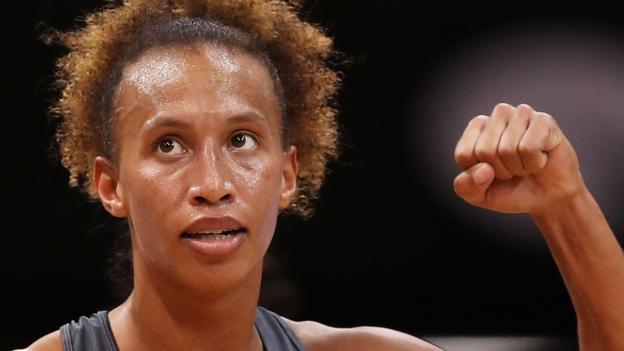
Guthrie won four league titles during her previous spell with Bath
England centre Serena Guthrie will return to Team Bath for the 2019 Superleague season.
The 28-year-old, who won four league titles with Bath, her first club, in an eight-year spell from 2007, is to leave Australian side Giants.
One of the world’s best players, she won Commonwealth Gold with England in April and was named in Super Netball’s team of the year for the 2018 season.
“I’m excited to come back home to where my career began,” Guthrie said.
“I’ve always wanted to come back and play in the English league and with the World Cup next year it makes sense to be back in the country in the build-up,” she told BBC Sport.
“I want to have a positive influence on the league at the peak of my game. I’m excited about going home and being back in front of the Team Bath fans where it started. I’d love to come back and win another Championship with Bath as a more senior player.
“Hopefully my story can inspire girls who want to play in Super Netball. But I think the cool thing is I’m someone who’s chosen to come back and I want to be a part of the English league while at my peak and that’s something quite special.
“There’s a lot of talk about Super Netball being a world-class league but we have to keep growing the leagues across the world. If I can help strengthen the English league by coming back and bring back a certain standard, then I’d love to be able to share that.
“I’m an English netballer and I’m passionate about bringing on our players so it will be a privilege to help them.”
A huge coup
Guthrie has excelled since moving abroad in 2015, picking up rookie of the year in New Zealand’s ANZ Championship before a successful spell in Australia.
She was awarded Giants most valuable player as her side were beaten in the 2017 Grand Final and Giants finished top of the regular season table a year later.
So this is a huge coup for Team Bath, and England netball, who are now reaping the rewards on an international stage after allowing their best English players to move abroad.
Guthrie’s return home during the best years of her career has come as a surprise, and the question now will be whether she can breathe new life into England’s domestic competition.
“There is no doubt that Serena would have had the pick of what clubs to go to but it is both testament to her loyalty and the club that she has chosen to return to Team Bath,” said head coach Jess Thirlby.
“We feel confident we can support Serena and her development both on and off the court in this World Cup year and will work tirelessly with her and the team to get the best out of each other.”
The nation’s eyes are on Arizona and its hotly contested U.S. Senate race, seen as a prime pickup opportunity for Democrats fighting to retake control of the chamber and challenge President Donald Trump’s agenda on everything from illegal immigration to taxes and trade.
The open Senate race is among the nation’s most competitive, and is consequential for a state that is on the cusp of electing its first woman senator.
U.S. Rep. Martha McSally, a two-term congresswoman from Tucson, defeated her Republican rivals, former state Sen. Kelli Ward of Lake Havasu City and former Maricopa County Sheriff Joe Arpaio of Fountain Hills, according to unofficial results from the Secretary of State.
Democratic Rep. Kyrsten Sinema, who has served three terms and is from Phoenix, also defeated her rival, Deedra Abboud, a progressive activist and attorney from Scottsdale.
The Associated Press called the races for McSally and Sinema.
President Donald Trump, whose presence has loomed over the Senate race, congratulated McSally in a late-night tweet while bashing U.S. Sen. Jeff Flake, R-Arizona, who announced his retirement last fall.
“Martha McSally, running in the Arizona Primary for U.S. Senate, was endorsed by rejected Senator Jeff Flake….and turned it down — a first! Now Martha, a great U.S. Military fighter jet pilot and highly respected member of Congress,WINS BIG. Congratulations, and on to November!”
Martha McSally, running in the Arizona Primary for U.S. Senate, was endorsed by rejected Senator Jeff Flake….and turned it down – a first! Now Martha, a great U.S. Military fighter jet pilot and highly respected member of Congress, WINS BIG. Congratulations, and on to November!
That the seat being vacated by retiring Flake is even in play is reflective of a traditionally red state trending toward purple at a level not seen in recent memory.
Arizona voters have not elected a Democrat to the Senate since Dennis DeConcini, an old-fashioned centrist, who won the seat in 1976 after defeating Republican Sam Steiger for the open seat and served three terms.
“It’s crucial to Democratic hopes of taking control of the Senate. It’s just hard to see how they would do it without Arizona,” said John J. “Jack” Pitney Jr., a political scientist at Claremont McKenna College in Southern California.
“If somehow they take control of the Senate, Democrats would control the confirmation process, making it extremely difficult for Trump to get his way.”
CLOSE
Kelli Ward concedes defeat to primary challenger Martha McSally during an election night party in Scottsdale, Arizona Aug. 28, 2018. Arizona Republic
Outside groups wage $8M ad war
In Arizona’s race, Democrats, Republicans and their well-financed allies are clawing for any advantage.
Outside groups allied with the top-tier candidates have waged an $8 million ad war in the primary election alone to promote and attack the candidates on health care, character and border security.
Sinema noted Tuesday night that Arizonans “are also reflecting on Senator John McCain’s lifetime of service and the example he has set for us” and said “it’s up to all of us to follow his lead of always putting country over party.”
“Tonight, we look ahead and continue fighting to uphold the values we all share: a fairshot at the American Dream and an unwavering commitment to the Arizona we love,” Sinema said in a written victory statement. “I’m grateful to everyone who voted today, and now, our work continues. We will spend these next ten weeks earning the vote of Arizonans across our state. Together, we can make sure that all Arizonans have an independent voice in the U.S. Senate.”
Arpaio, McSally and Ward battled fiercely for the Republican nomination.
In her victory remarks as prepared for delivery, McSally talked up her relationship with Trump.
“On issue after issue, by working together, we have shown an ability to solve problems and get thing done for Arizona. I have worked closely with President Trump to cut taxes for working families, to create jobs, to secure the border, to honor our veterans … and when I am in the Senate, I will work with him to confirm judges who uphold the Constitution,” McSally said.
McSally appeared emotional as she took the stage. She began her remarks by honoring Sen. John McCain and sharing personal recollections of working with him to, among other things, save the A-10. After a moment of silence, she said the general election will be a “choice between a patriot and a protester.”
The general-election race between her and Sinema, she said, will come to “a choice between a doer and a talker … between a patriot and a protester … between a career fighter pilot and a career politician — between proven grit and Hollywood glitz.”
Arpaio told The Arizona Republic he was disappointed with the results, but would accept the decision by voters. He offered to help McSally in the general election if she wanted it.
“I’ll still be working to support President Trump,” he said.
Ward was delivering a concession speech around the same McSally accepted her nomination. In the final days of the race, she drew heavy fire for suggesting an announcement by the McCain family that the late senator would be ending medical treatment was timed to harm her candidacy. She did not fully apologize for her remarks.
“The results tonight didn’t turn out as we would have liked, but I’ll remain forever grateful to the thousands of supporters and volunteers who helped carry our message to the people of Arizona,” Ward said. “It was your unyielding belief in our campaign that made it all worth it”
James Elliott, a U.S. Army combat veteran from south Phoenix, said he hopes McSally will help build Trump’s border wall.
“I believe that (Senators) McCain and Flake have done absolutely nothing for Arizona and I’m hoping that she will do actually something for Arizona,” said Elliott, 54.
“First and foremost the wall. I like the fact that she backs up the president. I’m a big supporter of Donald Trump and I’ve been there since he first came down the escalator.”
Elliott said he hopes she is being authentic about her support of Trump.
“I’m going to put my faith and my vote … in for Martha McSally and I’m really hoping that my vote counts and hope that I get what I’m voting for.”
Ken Roth, a real estate developer from Paradise Valley, said McSally’s credentials make her the best person to follow in the footsteps of former U.S. Sens. Barry Goldwater, John McCain and Jon Kyl.
“She’s got the talent and she’s certainly got the brains,” said Roth, 74, adding that he has supported her since the earliest days of her political ambitions.
Roth said that drive will help McSally win over Sinema in the November general election.
“You can’t uncover the fact that she is a Democrat,” he said. “I certainly think Martha just has a lot more to offer, just given her training.”
Sinema has been running as an independent candidate, free of partisan affiliations.
All three of the GOP candidates leaned into their relationships with Trump, who didn’t endorse any of them before voters weighed in. The president is considering a swing through Arizona in the days after the election to rally voters behind McSally.
All three candidates ran to the right on border security and issues involving illegal immigration. Ward and Arpaio have accused McSally of moving from the center to the right to appeal to Republican base voters who might view her as too lenient on the red-meat issue, an attack she has dismissed.
A win by any of the Republican candidates would have solidified the Arizona Republican Party’s attachment to the president. That marks a contrast with the combative stance that Flake has taken with the president over his political and personal actions.
“That would be a significant intra-party consequence,” said Richard Herrera, associate professor of political science at Arizona State University.
Running like a 3rd-party candidate
On the Democratic ticket, Abboud, a progressive activist and attorney, ran a long-shot campaign against presumed front-runner Sinema for the party’s nomination.
Abboud has emerged as a well-liked candidate among the Democratic base, but her chances of pulling off an upset were slim. She had shunned corporate donations, so had virtually no campaign money.
Sinema, a deft fundraiser, is running her campaign more like a third-party candidate than Democratic contender, frustrating some Democratic voters who want her to vocally oppose Trump and GOP leadership.
The strategy allows her room to pick up independent voters and possibly disenchanted Republicans who connect with her style and political messages.
The election of a Democrat could signal a shift in long-term partisan voting trends statewide, Herrera said.
“Certainly a Democratic candidate winning a prominent statewide race would energize Democrats across the state and could shift more independent voters,” he added.
At least eight people were killed and 12 wounded in a suicide car bomb attack on a security checkpoint in the Qaim district of Iraq‘s Anbar province, a local official told the Reuters news agency.
The checkpoint near the border with Syria was manned jointly by the army and government-backed militias, the official said on Wednesday. Five militiamen and three civilians were killed.
The death toll could climb because some of the wounded were in a critical condition, he said.
Mark Cavendish was eliminated from the Tour de France on stage 11 in July
Britain’s Mark Cavendish is to take a period of total rest from cycling because of illness.
His Dimension Data team said the 33-year-old would be taking an indefinite break “due to the presence of Epstein-Barr virus”.
Medical tests have shown Cavendish has been unwittingly training with EBV – which causes glandular fever – over recent months.
“This season I’ve not felt physically myself,” Cavendish said.
“Despite showing good numbers on the bike I have felt that there’s been something not right.
“I’m glad to now finally have some clarity as to why I haven’t been able to perform at my optimum level during this time.”
Cavendish, whose 30 Tour de France stage wins put him second on the all-time list, was first diagnosed with EBV in April 2017, but returned to action at the Tour of Slovenia two months later.
Since then, the Manxman has been beset by injuries, breaking his collar bone in a crash at the 2017 Tour de France before suffering injuries in two crashes in March which forced him to withdraw from April’s Commonwealth Games.
In July, he was eliminated from this year’s Tour when he finished outside the time limit on stage 11.
Editors, USA TODAY
Published 3:39 a.m. ET Aug. 29, 2018
Funeral events for John McCain get underway in Arizona
The body of Sen. John McCain will lie in state at the Arizona State Capitol in Phoenix on Wednesday. It’s the first of four days of funeral services for McCain, who died Saturday at age 81. A memorial service will be held in Phoenix on Thursday, after which McCain’s body will be flown to Washington, D.C. He will lie in state at the U.S. Capitol on Friday. On Saturday, there will be a procession past the Vietnam Veterans Memorial, followed by a funeral service at Washington National Cathedral. He will be buried at the U.S. Naval Academy in Annapolis, Maryland on Sunday.
Will Paul Manafort face a retrial on the other 10 charges?
Special counsel Robert Mueller faces a deadline Wednesday on whether to retry Paul Manafort on the 10 charges that ended in a mistrial last week after the federal jury was unable to reach a unanimous decision on them. The jury found the former Trump campaign chairman guilty on eight of the 18 counts in the financial fraud trial: five counts of submitting false tax returns, one count of failing to report foreign bank and financial accounts, and two counts of bank fraud. He faces a maximum of 80 years in prison. In addition, Manafort faces a second financial fraud trial that is set to begin in September.
CEO vs. worker pay: Taxpayers subsidize gaps
Are taxpayers subsidizing wide gaps between what some companies receiving lucrative federal government contracts and subsidies pay their CEOs in comparison to their workers? A new study released Wednesday suggests that is the case. More than two-thirds of the top 50 publicly-held federal contractors and federal corporate subsidy recipients paid their CEOs more than 100 times the median pay of their workers in 2017, according to the Institute for Policy Studies. High-earning CEOs at these companies in part “owe their personal good fortune to America’s taxpayers,” the report concludes. The company among the top 50 federal contractors with the largest pay gap is DXC Technology, a Virginia-based internet technology services company. The CEO receives 806 times as much pay as the median employee.
Democrats debate: NY gubernatorial hopefuls Cuomo, Nixon face off
New York Gov. Andrew Cuomo and primary challenger Cynthia Nixon will square off Wednesday in their only debate ahead of the Sept. 13 Democratic primary. For Cuomo, it’s a chance to tout his record during his eight years as governor and flaunt his progressive accomplishments. (He may also try to defuse the controversy over his recent remark that America “was never that great.”) For Nixon, the former Sex and the City star, it’s a chance to make the case that Cuomo isn’t progressive enough and gain ground in public-opinion polls that show her trailing. The debate will air on CBS stations and on cbsnews.com/live at 7 p.m. ET.
Heat wave hangs on for one more day in Northeast
Although the worst of the Midwest heat wave will be over Wednesday, scorching, near-record temperatures will again bake the Northeast and mid-Atlantic. Heat indices will approach or surpass 100 degrees from the Deep South to New England. In Boston, the National Weather Service warned that “the combination of hot temperatures and high humidity will combine to create a dangerous situation in which heat illnesses are likely.” While the intense heat will ease a bit later this week in the Northeast, steamy weather may fight back in the mid-Atlantic and Ohio Valley early next week, AccuWeather warned.
Myanmar‘s government has rejected a United Nations’ report on mass killings and gang rapes of Rohingya, which calls for Myanmar officials to face genocide charges over their campaign against the Muslim minority.
On Wednesday, a senior spokesperson for the government denied the UN‘s findings, calling the allegations false, the state-run Global New Light of Myanmar newspaper reported.
“We didn’t allow the FFM (the UN Fact-Finding Mission) to enter into Myanmar, that’s why we don’t agree and accept any resolutions made by the Human Rights Council,” Zaw Htay said in the newspaper.
Htay said Myanmar has “zero tolerance for human rights violations”, adding that his country has an “accountability and responsibility framework regarding human rights issues.”
“We shall take any action against violation of human rights”, Htay said.
He also said the country has set up its own Independent Commission of Inquiry in “response to the false allegations by the UN agencies and other international agencies”.
On Monday, UN investigators said they had found Myanmar’s armed forces had taken actions that “undoubtedly amount to the gravest crimes under international law”, forcing more than 700,000 Rohingya to flee starting in late August 2017.
Speaking in Geneva on Monday, Marzuki Darusman, the mission’s chairman, said his researchers amassed evidence based on 875 interviews with witnesses and victims, satellite imagery, and verified photos and videos.
Marzuki said victim accounts were “amongst the most shocking human rights violations” he had come across and would “leave a mark on all of us for the rest of our lives”.
Its assessment suggests crimes against the Rohingya could meet the strict legal definition used for genocide in places such as Bosnia, Rwanda and Sudan’s Darfur region.
The team cited a “conservative” estimate from aid group Reporters Without Borders that some 10,000 people had been killed in the violence, but outside investigators have had no access to the affected regions, making a precise accounting elusive, if not impossible.
The UN report said military generals, including Commander-in-Chief Min Aung Hlaing, must face investigation and prosecution for “genocidal intent” in Myanmar’s northern Rakhine state, as well as crimes against humanity and other war crimes in the states of Kachin and Shan.
The report singled out Myanmar’s military, known as the Tatmadaw, but added that other Myanmar security agencies were also involved in abuses.
Following the release of those findings, several countries in the UN Security Council – including the US, Britain, France and Sweden – called for Myanmar’s military leaders to be held accountable.


 n (@HausofDylan95)









 trendynewsday