Daugherty: Tiger Woods vs. Phil Mickelson on pay-per-view is more about greed than golf

news image

Paul Daugherty, @EnquirerDoc
Published 5:16 p.m. ET Aug. 27, 2018

CLOSE

Two of the biggest names in golf will square off on Thanksgiving weekend when “The Match” takes place between Tiger Woods and Phil Mickelson.
Time

Phil Mickelson and Tiger Woods are playing a winner-take-all, pay-per-view exhibition in Las Vegas over Thanksgiving weekend, for $9 million. I was against it until I heard both have agreed to donate the entire winner’s check to charity. And that each is putting up $9 mil of his own money.

Wait, what? That’s not true? Any of it?

Well whatever, never mind.

In reading all the news/hype stories that have accompanied this naked-greed grab – “fun’’ and “different’’ and “something that’s never been done before’’– a few words never came up.

Charity.

Risk.

Authentic.

So let’s be honest here. This isn’t golf. It’s vaudeville. It’s an exhibition hosted by a couple middle-aged players, ruined finery essentially, seeking a means to make a lot of money for doing almost nothing.

Excuse me. That’s not right. Phil says it’s a way to “bypass all the ancillary stuff of a tournament and just go to a head-to-head.”

Of course. Why bother making a cut or contending on Sunday or, you know, actually winning an event when you can scrap all that ancillary stuff and get right to the making-millions part?

Money for nothing. Chipshots for free.

Originally, the payout was going to be $10 million, but the PGA objected. It didn’t want a phony-baloney exhibition paying the same money the Tour pays the winner of the FedEx Cup playoffs.

So, a mere $9 million.

At least now we know why Tiger and Phil have pretended to be buds recently (practice rounds together at the Masters and Firestone) and why Mickelson just last week decided to create a Twitter account.

Soon enough, each will be hurling pseudo insults at the other, hoping to pump the pay-per-view:

“Your argyle socks are a joke!’’

“I could beat you with Old Tom Morris’ niblick and spoon!”

“You’re… you’re… a Democrat!’’

Fact is, they could take or leave one another if they weren’t suddenly partners in flim-flammery. And as much as we tried to create a rivalry between them, there never was one. Tiger owned Phil. They both knew it. Woods: 79 Tour wins, 14 major titles; Phil, 43 and five.

For the record, Woods net worth rested at $740 million at the end of 2016, according to Forbes. Mickelson checked in at a hand-to-mouth $375 million. In 2016 alone, Mickelson pulled in $50 million from endorsements. Phil – mouthpiece for Callaway, Barclays, KPMG, Exxon Mobil, Rolex and Amgen – is more corporate than a repp tie. Meantime, maybe Tiger can roll in to Vegas in one of those Buicks he liked so much. Young Tiger Woods, in a Buick. Right.

It’s easy to see why neither guy is anxious to part with a few dimes for charity.

We don’t know yet how much will be charged the average fan to clog the pockets of Tiger or Phil – one report has it at $24.99 – but Tiger assured us it’ll all be fine.

“I think they can afford it,’’ decided Woods, whose early career included a broad reputation for stiffing restaurant servers. “You know, how many times have we all purchased fights, whether it’s MMA or boxing, whatever it may be?’’

In this corner, zero. Zero times.

The difference is, MMA and prize fights are legitimate forms of competition. Something is on the line. In this thing, you either make $9 mil or leave on the $740 million horse you rode in on.

More Doc: ‘Hardface’ movie tells the story of Cincinnati, American boxing.

More Doc: It’s hard to get too worked up over Urban Meyer situation

More Doc: Bengals need more than lineman Cordy Glenn to protect Andy Dalton

As a very little kid, I watched bits of Shell’s Wonderful World of Golf on NBC on Saturday afternoons. It showcased greats such as Jack Nicklaus and Sam Snead, playing a match. Golf really is good at producing head-to-head drama. The difference then was, nobody was paying to watch it on his Philco “TV set’’ at home. And the participants weren’t making more in a day than Harry Hacker makes in a lifetime.

The prototype for this Thanksgiving weekend turkey was the Showdown at Sherwood in 1999. It featured Woods and David Duval in primetime on ABC. The winner got $1.1 million, the loser $400,000. Woods and Duvall each agreed to donate $200,000 to charity.

This ain’t that.

Phil likes to gamble. Why shouldn’t his bookie or his Guy or whoever arrive at the course with a briefcase full of Grover Clevelands? Woods could offer up the pink slip to his yacht. I’d pay to see that.

Failing that, the Octagon would do.

Read More

from Trendy News Day https://ift.tt/2MCrs8f
via IFTTT

Bobi Wine and the beginning of the end of Museveni’s power

news image

After close to two weeks of tensions in Uganda, a court in the northern town of Gulu granted bail to four opposition legislators including MP Robert Kyagulanyi Ssentamu, fondly known by his stage name Bobi Wine. In videos circulated on social media, Kyagulanyi was seen in the courtroom moving with difficulty using crutches.

The lawyer of the 36-year-old singer said he had been “brutalised” in detention. Kyagulanyi initially was charged with illegal possession of firearms and ammunition in a military court while the other three MPs were detained and charged with treason on August 16 along with 31 other Ugandans. After ten days in military confinement, the military court dropped Kyagulanyi’s charges but he was re-arrested and also charged with treason.

The detainees have been accused of pelting a presidential motorcade with stones on August 13 in the town of Arua; at the time of the alleged incident, President Yoweri Museveni was not in any of the cars and had long left the town. That day, political rallies were held by the ruling party and the opposition ahead of important by-elections.

After the rallies ended, the police and the Special Forces Command of the military descended on Arua, raiding hotels and violently arresting legislators, hotel guests and bystanders. Kyagulanyi has claimed that his driver was shot dead before the raids.

Two days later, independent candidate Kassiano Wadri, whom Kyagulanyi supported and who was also detained, won the vote in Arua. This was the third parliamentary by-election Museveni’s party lost to the opposition and Kyagulanyi, or Bobi Wine, played a key role in the outcome of the vote.

The presence on the political scene of the 36-year-old musician-turned-parliamentarian, who took up politics after 15 years in the music industry, is seen as a growing threat by the ruling elite. These fears and the violent reactions they are generating might turn into a self-fulfilling prophecy.

Music of resistance

Kyagulanyi was born in Mpigi district, central Uganda, but came of age in Kamwookya, one of the poorest suburbs of Kampala. It is here that he launched his music career in the early 2000s after he graduated from Uganda’s oldest university – Makerere University – with a degree in music, dance and drama. He came to be famously known as the “Ghetto President” for persistently speaking out about the struggles of the lower classes and the urban poor in Uganda.

His lyrical genius and courage to drop songs that hit directly at government failures and excesses made him spectacularly popular among Ugandan youth. He insisted that Ugandans had many questions but few answers from the corrupt political leaders. 

His outspokenness and growing popularity made him a target of government censorship, particularly after President Museveni, who has been in power since 1986, started feeling the demographic shift in the country’s electorate.

For a decade he had relied on the rural vote and older people who still suffered from the collective trauma of having survived the atrocities of past Ugandan regimes. These segments of Ugandan society are risk-averse and aren’t ready to rock the boat rowed by the man who gave them some feeling of safety even as war raged on in most of northern Uganda up until 2008.

Although Bobi Wine has always been political in his lyrics, it wasn’t until 2016 that he made his first step into politics. That year, the presidential elections were yet another contest between President Museveni and his longest-running political rival Dr Kizza Besigye.

It was that year that Museveni decided it was time to reach out to the young and increasingly desperate generation. To do that, he paid Uganda’s leading artists to compose a song praising his efforts and to campaign for him, a move that infuriated many young people, who retaliated by boycotting their music until some of the musicians apologised. It was then that Bobi Wine’s star shone brightly on the Ugandan political scene: he rejected the president’s offer to join his campaign and was quite vocal about his decision.

As other musicians sang Tubonga Naawe (We are With You) for Museveni, praising his great deeds, Kyagulanyi released Dembe (Peace), attacking the president’s greed for power directly and condemning political violence.

“Why would you wash white clothes only to hang them on a dirty log to dry?” sang Bobi Wine in reference to what Museveni was doing to the little he had achieved by clinging onto power. “Why don’t you look up to Mandela as an example? He ran for one term and released the flag” goes another line of the song.

Another song released in 2016, Situka (Rise up), which his supporters sang during protests against his detention, called on young people to rise up and march together against oppression. “When the going gets tough, the tough must get going, especially when leaders become misleaders, and mentors become tormentors, when freedom of expression becomes the target of suppression, opposition becomes our position,” goes the opening line of the track.

In 2017, when a court nullified an earlier parliamentary election in Kyaddondo East, a  constituency on the outskirts of Kampala, Kyagulanyi seized the opportunity. He won the seat in a landslide victory despite Museveni all but camping in the area during the campaign period.

Bringing ‘the ghetto’ to the parliament

After he was sworn in as an MP, Kyagulanyi did not stop being Bobi Wine. He told reporters that if the parliament won’t go to the ghetto, the ghetto will go to the parliament. He then embarked on several concerts across the country, prompting Uganda’s highly partisan police to ban some of his scheduled performances in October 2017.

At the height of debates on the constitutional amendment that would later remove the age limit for the president, allowing Museveni to run for yet another re-election, Bobi Wine released Freedom.

“We know you fought a Bush war, but imagine a child who was unborn when you came has long become a parent… They request that you don’t touch their constitution because it’s their only remaining hope,” Bobi Wine sang.

Uganda: Court frees jailed opposition MP Bobi Wine

Together with the opposition Democratic Party, he led the “Togikwatako” (Do not touch) movement which protested the changing of the last clause in the constitution that stood in the way of 74-year-old Museveni holding onto power for life.

During one of the parliamentary deliberations, the army stormed parliament and several MPs were assaulted. This was a clear signal that President Museveni had grown impatient about dealing with any opposition.

In July this year, Bobi Wine was also instrumental in rallying young people to protest an imposed Social Media Tax which the president initially presented as being intended to deter “gossip”, but was actually a desperate measure trying to curb escalating anti-Museveni sentiment among the young generation. 

Why is Bobi Wine a threat to Museveni’s power?

Bobi Wine’s magnetic pull on the electoral scene, which has helped the opposition in key by-elections, has increased paranoia within the ruling party. The realisation that the ground is slowly shifting under their feet has sent those in power into a panic.

These few electoral victories are a sign of what awaits President Museveni if he tries to run again in a country where around 65 percent of the population was born after he took power. His previous tactics of paying off voters and using the trauma of the past to coax people into voting for him are no longer working. And his attempt to talk to the young generation has ended in complete failure.

Young people have responded with contempt to Museveni calling them his “bazzukulu” (grandchildren); their aspirations largely do not include him ruling Uganda past his 77th birthday.

Young Ugandans face high unemployment rates and a lack of economic opportunities. What was once touted as Museveni’s greatest achievement – security – has been put to a great test the last two years. Crime has increased, with around 43 women targeted, kidnapped, raped and murdered within Kampala and the surrounding areas in the last 18 months.

Trying desperately to cover up the fact that his popularity is rapidly declining, the president has blamed the recent electoral setbacks on the Electoral Commission, which he has accused of being “full of rotten people”. This is a president grappling with defeat and fearing he could lose the next presidential vote.

Nothing about the arrest, torture and charges against Bobi Wine is new.  Museveni has handled his main opponents and their supporters in the same way in the past. What is new is the ability of young people to organise, speak up and mobilise on and offline, galvanised by a young voice who is just like them – Bobi Wine.

His is the story of an outsider who brought his own folding chair to a table no one expected him to be at. Whether he will continue with the same gusto after his release and medical treatment remains to be seen. What Kyagulanyi has given young Ugandans is an idea and a hope for a post-Museveni future that the president cannot just wish away.

However, it will take a lot more effort on the part of the opposition – beyond Bobi Wine and a grwoing cult-like following – to bring down Museveni’s rule.

The views expressed in this article are the author’s own and do not necessarily reflect Al Jazeera’s editorial stance.  

Read More

from Trendy News Day https://ift.tt/2LyiB1K
via IFTTT

The Astrological Signs As BTS Songs Because Loving Yourself Is A Big Leo Mood

news image

Scorpios are messy and live for drama, but behind that cool, confident exterior lies deep insecurities. A Scorpio will never let you know how they’re really feeling, so even if it looks like they’ve moved on after a breakup, chances are they’re a total mess inside. Still, passionate Scorpio can put on a brave front. That hard-earned emotional resilience is front and center on “I’m Fine.” The song is a spiritual continuation of the group’s 2016 track “Save Me.” Now, however, BTS doesn’t need anyone to save them; they can save themselves. And a Scorpio has never had a problem being the hero of their own story.

Biggest mood: “I’m feeling just fine, fine, fine / I’ll keep telling myself / Even if I fall down again / I’m fine”

Read More

from Trendy News Day https://ift.tt/2BQ6PQZ
via IFTTT

Hungarian GP: Jolyon Palmer column – Why F1’s ultimate underdog Force India has bright future

news image

Former F1 driver Jolyon Palmer, who left Renault during the 2017 season, has joined the BBC team to offer insight and analysis from the point of view of the competitors.

Aside from a big first-corner crash, the 2018 Belgian Grand Prix probably won’t live too long in the memory for many. But for the Force India team, it was one of the most significant weekends of their existence.

Just four weeks ago, at the Hungarian Grand Prix, the team entered administration as mounting long-term debts finally caught up with them. They remained hopeful of salvation, but things were bleak and only deepened throughout that race weekend.

Both drivers limped out of qualifying at the first hurdle, ending up in 18th and 19th on the grid at the Hungaroring, and subsequently finished the race well outside the points.

Force India are the ultimate underdog team of recent years. They have one of the smallest budgets in Formula 1, but have punched well above their weight, scoring numerous against-the-odds podiums (including one in Baku this year).

But at the end of July, the outfit known as the best ‘bang-for-buck’ performers was in turmoil, on the precipice of collapse and with an on-track performance to match.

Fast forward four weeks and things have never looked rosier for them.

Bright start of a new dawn

Force India drivers Esteban Ocon, left, and Sergio Perez, right, battle for position at the start of the Belgian Grand Prix

Bought out by a consortium led by Canadian businessman Lawrence Stroll, father of Williams driver Lance, more than 400 jobs at the factory have been saved, and the team reconstituted as a ‘new’ entry, with a new-ish name, Racing Point Force India.

More memorably, last weekend saw one of their best ever team qualifying performances – Esteban Ocon and Sergio Perez took third and fourth on the grid in a crazy, wet top 10 shoot-out in Spa on Saturday.

It could have been so different, as Perez survived one of the biggest moments I’ve ever witnessed at Eau Rouge, on slick tyres on a wet track.

It is a notoriously punishing corner and Perez absolutely rally-crossed it, sliding at high speed right next to the barriers. But he held on majestically.

Both drivers did a superb job and really showed the talent they both possess.

Finishing fifth and sixth in the race was ultimately the most they could do in a car far slower than those in the ‘A’ race ahead, but Perez’s attempt to hold off Valtteri Bottas’ Mercedes in the closing stages was valiant.

A horrible situation to perform in

Force India were near to collapse but with their future secured delivered a superb weekend performance

The whole season must have been uncomfortable for Perez and Ocon. We now know how close Force India were to collapse, and being in a team on the precipice is a horrible situation for a driver to have to perform in.

When I was third driver for Lotus in 2015, it was a similar situation. For the entire year, the team was scraping by with last-minute sponsorship deals left, right and centre, and a bit of goodwill to match. For the drivers, though, it is extremely tough.

I was only doing some free practice sessions in 2015, but the precarious nature of the team upped the pressure and responsibility massively.

Firstly, turning up not knowing if we would be racing or not, it was tough to get into the right mental space to drive.

Secondly, knowing that a lack of spare parts meant any damage could result in the team not being able to race, or even worse, collapse completely.

It made the job Romain Grosjean did to take a podium in Spa 2015 even more remarkable. As he celebrated, the bailiffs were literally impounding the Lotus cars and equipment in the Belgian paddock.

Lotus moved on and turned into Renault at the end of the year following a buyout, and Force India look to be through the chaos and unpredictability of their current predicament.

It is a testament to both drivers that they have remained so professional throughout, and ultimately managed to keep delivering on track through difficult times.

I had my first F1 test with Force India back in Abu Dhabi 2014 and I know first-hand how good they are, how hard working, but mainly what a great atmosphere they have in the team.

That must have helped them through the tough moments. It’s good to see their future secure again and marked with a superb weekend performance.

Ocon the pawn in a wider game

Esteban Ocon’s position at Force India could be under pressure

The next question now Force India have been saved is, what will happen to their drivers?

It would seem obvious to keep the same pairing for the future, given both are proven to be quick and consistent.

The only question mark last year was their relationship after a few on-track incidents and off-track niggles. They seem to have put that behind them this year, though, and have been much more controlled.

What changes the situation goes back to the saviour of the team – Lawrence Stroll.

His son Lance is racing for Williams and it’s been heavily rumoured that Lance will be driving for Force India at the latest next year, and possibly before the end of this one.

It was one of the big talking points in the paddock last weekend, and no-one involved in the situation – Lance Stroll, Force India or Williams – said anything to suggest it was not on the cards.

Perez was instrumental in the changing of ownership at Force India. He was owed a large sum of money and ended up putting them into administration, with a view to them being saved in the long run. The feeling in the paddock is that Perez’s seat is therefore safe as he is linked in to the new ownership. He also brings a sizeable chunk of sponsorship from his Mexican backers.

So the pressure and question marks gather around Ocon.

Ocon didn’t need his performance in Belgium to demonstrate how good he is – he’s already done that in his now two-year career in Formula 1.

In theory, the timing of the buy-out should be good for him, because logic dictates that Stroll, who has had an extremely difficult season in an underperforming Williams team, can’t replace a future star who is delivering and is backed by Mercedes, who supply Force India’s engines.

Stroll Jr switch would be risky

Will Williams driver Lance Stroll Jr join his father at Force India?

For Stroll Jr, there are two main risks in stepping into the Force India.

Firstly, his ‘pay driver’ image, which comes from his billionaire father buying his way up the motorsport ladder and into Formula 1, would only be massively enhanced.

Secondly, he would then be paired up alongside Perez and could be found wanting, as he was alongside Felipe Massa at Williams for the vast majority of last year.

Stroll’s team-mate this year is rookie Sergey Sirotkin, and the Russian has been on average the quicker of the two, up eight-five in qualifying after 13 races.

Williams say it’s impossible to judge the drivers in a car so bad. I disagree. Looking back through the years, great drivers have shown well in poor cars. Think back to Ayrton Senna in the Toleman in 1984, Fernando Alonso in a Minardi in 2001, or even more recently the late Jules Bianchi in the Marussia.

The Renault I was driving in 2016 was a difficult car as well, but the fundamentals of driving it quickly don’t change. You spend practice setting up the car as best you can, and then qualify and race to the maximum within the limits of the equipment you are given.

Despite that, both Lawrence and Lance Stroll will surely be tempted by the prospect of a Force India drive, though, and the chance to move up the grid.

After all, Stroll has had a few stand-out performances in Formula 1 as well. There’s talent there and that was proven by his qualifying effort in the wet in Monza last year, to put a Williams on the front row alongside Lewis Hamilton.

Although there are risks for Stroll, the signs are that he will end up in a Force India sooner or later.

That would mean Ocon is left looking for another seat, which would be a shame for him, and it’s tough for him to be in this position.

A number of teams have potential vacancies for 2019 – McLaren, Williams, Haas and Sauber. But there are complications involved in all of them, especially in sorting out a deal for the remaining races of this season. And right now it’s not obvious where he might end up.

But surely someone with his talent and with Mercedes behind him will be an attractive proposition for another team in the end?

Read More

from Trendy News Day https://ift.tt/2Mybmwe
via IFTTT

Missouri becomes first state in U.S. to regulate use of the word ‘meat’

news image

CLOSE

On Tuesday, a law goes into effect that prohibits calling plant-based meat alternatives “meat.” The legislation is supposed to clear up shopper confusion. However, not everyone is on board.
USA TODAY

On Tuesday, Missouri becomes the first state in the country to have a law on the books that prohibits food makers to use the word “meat” to refer to anything other than animal flesh.

This takes aim at manufacturers of what has been dubbed fake or non-traditional meat.

Clean meat — also known as lab-grown meat — is made of cultured animal tissue cells, while plant-based meat is generally from ingredients such as soy, tempeh and seitan.

The state law forbids “misrepresenting a product as meat that is not derived from harvested production livestock or poultry.” Violators may be fined $1,000 and imprisoned for a year.

More: Trump trade war: Why he’s fighting it and how tariffs work

More: Nasdaq tops 8,000 for first time, led by Apple, Netflix, Amazon

More: Student loan watchdog quits in protest, says largest banks are ‘ripping off students’

A similar argument is unfolding on the federal level. 

The meat-substitute market is expected to reach $7.5 billion-plus globally by 2025, up from close to $4.2 billion in last year, according to Allied Market Research.

The Missouri Cattlemen’s Association, which worked to get the state law passed, has cited shopper confusion and protecting local ranchers as reasons for the legislation.

“The big issue was marketing with integrity and…consumers knowing what they’re getting,” said Missouri Cattlemen’s Association spokesman Mike Deering. “There’s so much unknown about this.”

The bill was signed into law by then-Gov. Eric Greitens on June 1.

On Monday, the company that makes Tofurky filed an injunction in a Missouri federal court to prevent enforcement of the statute, alleging that the state has received no complaints about consumers befuddled by the term “plant-based meats” and that preventing manufacturers from using the word is a violation of their First Amendment rights. Plus, it pointed out, “meat” also refers to the edible part of nuts and fruit.

The statute “prevents the sharing of truthful information and impedes competition,” according to documents filed in U.S. District Court for the Western District of Missouri. “The marketing and packaging of plant-based products reveals that plant-based food producers do not mislead consumers but instead distinguish their products from conventional meat products.”

The co-plaintiff is the Good Food Institute, a Washington, D.C.-based advocacy group.

Deering said he was surprised by the suit, because the primary target of the law was lab-grown meat.

Tofurky’s main ingredient is the the first two syllables of its name — tofu.

In June, the U.S. Food and Drug Administration announced that it would regulate lab-grown meat. Traditional animal proteins are the jurisdiction of the U.S. Department of Agriculture.

Ernest Baskin, an assistant professor of food marketing at St. Joseph’s University, said consumers use the word “meat,” when applied to non-animal protein, as shortcut to understand how they eat the food they see on supermarket shelves.

“There’s a segment of consumers that doesn’t have to eat alternative products, but wants to,” he said. “In those cases, putting those options together in front of consumers gives them the thought that ‘Hey, maybe these two are similar. Maybe I can substitute.”

CLOSE

Chili’s new Boss Burger contains nearly a day’s worth of calories and a week’s worth of guilt. Nathan Rousseau Smith shows us the 1/2 foot tall sandwich.
Buzz60

Follow USA TODAY reporter Zlati Meyer on Twitter: @ZlatiMeyer

Read or Share this story: https://usat.ly/2LtWY2Q

Read More

from Trendy News Day https://ift.tt/2BQ6uOd
via IFTTT

Jamie Vardy: England striker to step aside from international football

news image

Leicester’s Jamie Vardy (right) made his England debut in 2015

Striker Jamie Vardy is stepping aside from international football to allow England manager Gareth Southgate to bring younger players in.

But the 31-year-old – who scored seven goals in 26 international appearances – and Southgate have agreed to “not shut the door completely”.

Leicester City’s Vardy says he first told Southgate of his intentions at the World Cup in Russia.

“This has been on my mind for a while,” Vardy told the Guardian.

“I’m not getting any younger and you can see, to be fair to the gaffer, he wants to make it more youthful, which obviously had its benefits during the World Cup.”

Vardy, who made his England debut against the Republic of Ireland in June 2015, made four appearances for England at this summer’s World Cup, where they reached the semi-finals.

He has told Southgate he also wishes to concentrate on his club football and his family.

“Gareth said that he felt I still had a lot to offer, and we’ve not shut the door completely,” he said.

“If the worst came to happen and everyone was injured, then obviously I wouldn’t say no.”

More to follow.

Read More

from Trendy News Day https://ift.tt/2ofhN91
via IFTTT

Emmett Till: Finding the truth behind decades of lies

news image

The story that many Americans believe about the Emmett Till case is a pack of lies.

That’s because the 1956 Look magazine article on the killing — long regarded as a confession by the two white men acquitted in the case  — was, in fact, a cover-up concocted by them and their lawyers to conceal others involved in Till’s brutal murder, experts say.

“To this day, the story most people believe about the murder of Emmett Till is the story first peddled by Look,” said Dave Tell, author of a book to be published in April, Remembering Emmett Till.

But a fresh look at the case by a band of Till experts, a new investigation by the FBI and the voices of witnesses refuting the myths around the case have begun to unravel these cords of deception for a new generation.

“It’s amazing how we have gotten this story wrong for so long,” said Keith Beauchamp, whose documentary, The Untold Story of Emmett Louis Till, helped inspire the Justice Department to reopen the case in 2004.

For more than half a century, Beauchamp said, “we’ve made (William Bradford) Huie out to be this amazing journalist who runs to Mississippi” and gets two men who had just been acquitted of the murder, J.W. Milam and Roy Bryant, to talk and publishes their confession to the killing in Look magazine for $3,150.

Beauchamp believes Huie was more interested in making a movie than in digging deep for the truth in Till’s killing. The agreement the two killers signed gave Huie permission to depict them in a Hollywood film.

Huie happened to be on the movie set of The Revolt of Mamie Stover, an adaptation of one of his books, when he first heard about the Till trial.

His film on the Till murder never materialized, but that did little to keep a generation from believing the words he wrote in Look.

“A lot of the lies that people do believe about the Emmett Till case can ultimately be tracked back to the confession that was published in Look magazine in January 1956,” Tell said.

In July, the FBI’s reexamination of Till’s 1955 slaying became public. The reexamination took place in the wake of historian Timothy Tyson quoting Carolyn Bryant Donham as saying it wasn’t true when she testified that Till accosted her.

Her family denies she ever recanted, and Tyson admitted to the Clarion Ledger that he did not have the bombshell quote of her confession on any of the recordings from his two days of interviews with Donham.

Till loved life, ‘used to pay people to tell him jokes’

Mississippi native Wheeler Parker has long been upset about the lies told about Till, his cousin.

The two of them lived next door to each other in the Summit-Argo village in Illinois, just south of Chicago, where they would fish, play and ride their bicycles. “I was like a big brother to him,” he said.

In August 1955, the two of them traveled on the train to Mississippi, staying in Money with Parker’s grandfather, Moses Wright, and his family.

It was a vacation for the cousins, who made plans for their fun.

“Emmett was a prankster,” he recalled. “He never had a dull day in his life. He enjoyed life to the fullest. He used to pay people to tell him jokes.”

On Aug. 24, 1955, the cousins traveled to Bryant’s Grocery & Meat Market in Money, where they went inside to buy candy and the like. Till decided on bubble gum.

Parker and Wright’s late son, Simeon, have told the Clarion Ledger they never saw Till do anything to Donham — then Carolyn Bryant — inside the store.

Parker said when they emerged from the store, Till wolf-whistled at her. When someone said she had a gun, Parker said the cousins jumped into a car and sped away.

On Sept. 2, 1955, after her husband and his half-brother were indicted for murder in Till’s death,  Donham spoke with defense lawyer Sidney Carlton about waiting on Till at the candy counter.

After selling him bubble gum, she reached out her hand to give him change. According to Carlton’s notes, she said Till grabbed her hand and asked her for a date, and when she pulled her hand away, he asked, “What’s the matter, baby, can’t you take it?”

She said he also said goodbye and whistled at her, according to Carlton’s notes.

Donham said that as soon as her husband, Bryant, returned home two days later at 4:30 in the morning, she told him what happened in the store with Till, according to Carlton’s notes.

But since then, she has repeatedly said someone else told Bryant first.

More: What did Carolyn Bryant say and when?

More: Bombshell quote missing from Emmett Till tape. So did Carolyn Bryant Donham really recant?

More: Feds reopen Emmett Till murder case, family ‘wants justice to prevail’

More: Jeff Sessions reopens Emmett Till case. A hunt for justice or a civil rights charade?

“I didn’t say anything, and one of the reasons I didn’t ever say anything more about it was because I was afraid that, what I was worried about was he’s gonna go find and beat him up,” she told FBI agent Dale Killinger.

Past investigations by civil rights leader T.R.M. Howard and author Devery Anderson each concluded Bryant learned of what happened at the store from someone other than his wife.

Donham’s family said she never wanted Till harmed and didn’t encourage any violence toward Till. “She was appalled (at his murder),” said her daughter-in-law, Marsha Bryant.

The night Till was abducted was ‘as dark as a thousand midnights’

During Till’s stay, he and his cousins picked cotton by day. On Saturday night — Aug. 27, 1955 — they traveled to the nearby town of Greenwood.

“We had a great time,” Parker said. “It was like the Fourth of July.”

It had been four days since they had been to Bryant’s Grocery, and it was after midnight by the time Parker and his cousins fell asleep in the early morning hours of Aug. 28.

Hours later, Parker said they awoke to the sound of men with guns saying, “We want to talk to the fat boy who did the talking.”

Believing he might be killed, he began to pray. “It was as dark as a thousand midnights,” Parker said. “I’m shaking like a leaf on the tree.”

His mind raced. “I thought of every wrong thing I had ever done,” he said. “When death is imminent, you forget about all the foolishness.”

He closed his eyes, waiting to be shot. “It was pure hell,” Parker said. “It was pure terror.”

When he opened his eyes, he realized the pair had passed by.

The men with guns took Till, announcing that they would bring him back if “he wasn’t the right one.”

When daylight came, Parker made his way to his uncle’s home and then back to Chicago. “I went to Emmett’s mother’s house,” he said. “The atmosphere was so somber.”

He recalled the fear that overwhelmed him that night. “At 3 o’clock in the morning, the safest place in the world should be your home,” Parker said. “But it wasn’t for us. It wasn’t for us.”

After Till’s abduction, the Leflore County sheriff picked up Bryant for questioning. He admitted abducting Till but claimed he released the 14-year-old unharmed.

Then Milam, Bryant’s half-brother, turned himself in, perhaps to keep an eye on Bryant. After Till’s battered body was found three days later, both were charged with murder.

In addition to those confessions, Moses Wright was able to identify Milam and Bryant as his great-nephew’s kidnappers.

“The defense had a real problem,” said Davis Houck, co-author of Emmett Till and the Mississippi Press.

What the defense decided to do became apparent a day before the trial began on Sept. 19, 1955. Defense lawyer Carlton announced to reporters that Donham would testify that Till “mauled” her “while making indecent proposals” — a far different story than what she had told defense lawyers a few weeks earlier.

The lawyer’s proclamations fit the defense plan, Houck said. “It might surprise people, but their main defense was justifiable homicide.”

Till’s mother feared coming to Mississippi for the trial

Before Till was killed, the slayings of many other African Americans went unprosecuted and unpunished in Mississippi.

Unlike the others, his cousin’s case didn’t go away, Parker said. “They were having a trial, accusing a white man of something.”

Milam couldn’t believe it, Parker said. “He believed he was protecting the Southern way of life. … He thought, ‘You all should be rewarding me.’”

In Chicago, Till’s mother, Mamie, kept her son’s casket open at his funeral so the world could see what had been done to him,

Now she was coming to Mississippi to testify.

As he sat inside the restored Tallahatchie County courtroom, Parker recalled that Mamie Till “was afraid of coming in here. She didn’t know if she’d be able to get in and out of the courtroom alive.”

He said that “was the atmosphere back then. You could be killed, and nothing would be done about it.”

With the jury out of the courtroom, Donham stepped to the witness stand wearing a black dress with a white collar and ribbon.

Mississippi newspapers described her as “the pretty 21-year-old mother of two children” who testified with “her dark eyes downcast, her voice little more than a whisper.”

“This n—– man came in the store, and he stopped at the candy case,” she testified. 

When she held her right hand out for his money, “he caught my hand.” she testified.

“Like this?” Carlton asked, grabbing her hand.

“Yes,” she replied.

“Was that a strong grip or a light grip that he had when he held your hand?”

“A strong grip,” she said, adding that it was difficult to get loose.

“What did he say when he grabbed your hand?” the defense lawyer asked.

“How about a date, baby?” she replied.

“How did you get loose?” he asked, still holding her by hand.

“I just jerked it loose.”

Then she claimed he came behind the cash register, grabbing her by the hips with both hands. She demonstrated by putting the defense lawyer’s hands on her hips.

“What did he say?” Carlton asked.

“You needn’t be afraid of me,” she replied.

More: Lawyers in Emmett Till case pushed ‘justifiable homicide’ defense

More: Why you need to see the Emmett Till exhibit at the Smithsonian

More: Emmett Till eyewitness dies; saw 1955 abduction of his cousin

She testified that Till remarked that he had had sex with white women before.

After this, she said Till said goodbye and wolf-whistled at her.

“Was it something like this?” asked Carlton. He blew his own wolf-whistle, a sound that undoubtedly carried into the room where jurors were sitting.

The story that Donham told on the witness stand spread like wildfire across Mississippi, newspapers calling Till a “molester” who “tried obscenely to date her.”

When the judge ruled her testimony inadmissible, the defense shifted to Plan B, claiming the corpse recovered from the Tallahatchie River was not Till, Houck said.

After the body was recovered, then-Tallahatchie County Sheriff Clarence Strider identified it as being Till and said it had only been in the river a few days.

But now, in front of a jury, the sheriff testified that the body had been in the river for “at least 10 days, if not 15,” and he couldn’t tell if the body was black or white.

In their closing arguments, defense lawyers accused civil rights organizations of throwing a “rotten, stinking corpse” in the river, hoping to “destroy the Southern way of life.”

Defense lawyer John Whitten told the all-white jury that he hoped “every last Anglo-Saxon one of you has the courage to free these men.”

And free these men is what jurors did, after deliberating a little more than an hour. “We wouldn’t have taken so long,” one of them pointed out, but they had stopped deliberations to drink Cokes.

Seven years after the verdict, Florida State University student Stephen Whitaker interviewed all the jurors, who had reportedly been visited by members of the white Citizens’ Council during the trial to make sure they voted “the right way.”

All but one of the jurors believed the body pulled from the river was Till. (DNA tests in 2005 confirmed the body was indeed Till.)

All the jurors believed Milam and Bryant had killed Till, yet all of them voted to acquit.

The reason? “A Negro had insulted a white woman. Her husband would not be prosecuted for killing him.”

Moaning and pleas: ‘He knows Emmett Till is dead when he stops screaming’

Look published as fact that Till told the killers that he had had sex with white women.

In reality, Till had just turned 14 on July 25 and knew nothing about sex, Parker recalled.

Alvin Sykes, president of the Emmett Till Justice Campaign, said Huie’s depiction of Till as a “sexual predator” was a horrible lie.

Tell said the lies didn’t end there.

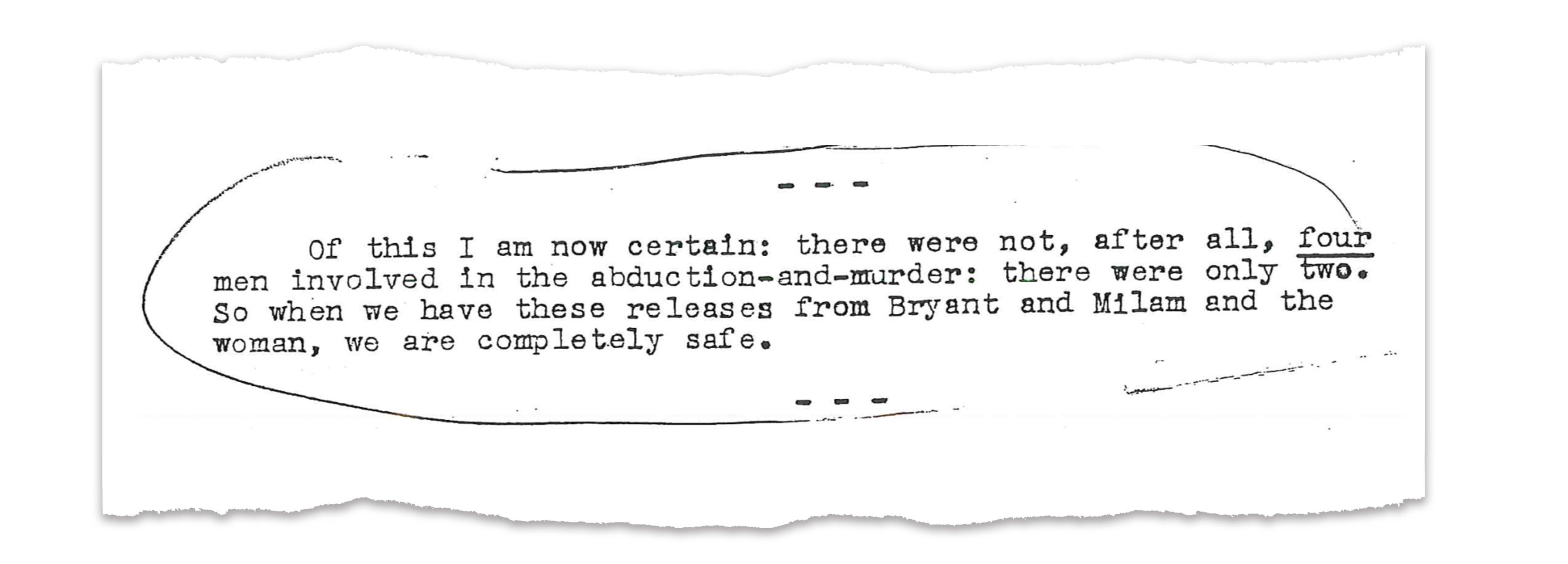
In an Oct. 17, 1955, letter, Huie wrote Look editor Dan Mich that there were four killers involved.

After Mich told him the only way he could print an article would be for each killer to sign a release that indemnified the magazine, Huie responded that he was now certain there were only two killers.

“What changed?” Tell asked. “When Huie was unable to get release forms from the others, the murder party shrank to two people.”

Those two were Bryant and Milam. Huie left out other possible candidates, including Leslie Milam, who gave a deathbed confession, and Elmer Kimbell, who killed Clinton Melton, a black gas station attendant, for putting too much gas in his car. (An all-white jury acquitted Kimbell.)

The story also left out the three black field hands in the back of the truck with Till.

“To this day,” Tell said, “90 percent of my students and probably 90 percent of the public believe that Emmett was killed by two people, Roy Bryant and J.W. Milam.”

By reducing the murder party to two, Huie faced an additional problem: why didn’t Till just hop out of the back of the truck?

To address this problem, Huie created another fiction, Tell said. “He said the reason Emmett Till didn’t run was he wasn’t scared.”

In the Look article, Till faces his torturers without flinching, calling them “bastards” and telling them he’s as good as they are and that he’s had sex with white women.

This makes no sense, Tell said. “Why would a 14-year-boy, who was hundreds of miles from home, who was kidnapped at gunpoint in the middle of the night, who was tortured until portions of his skull fell out, who was carted around in a pickup truck with two men guarding him, why would such a boy not be scared?”

Till’s mother recognized the ridiculousness of Huie’s story, saying, “Emmett was no superman and saying that he took all that beating without begging for mercy or that he kept talking back to them to the very end just isn’t true. They were only trying to justify why they did it.”

Despite her insights, Huie’s version has persisted, Tell said. “There was a newspaper article the other day talking about how Emmett Till faced his killers bravely. That just boggles the imagination.”

Sharecropper Willie Reed testified about the moaning and pleas he heard, Tell said. “He knows Emmett Till is dead when he stops screaming.”

Despite the lies, Huie still regarded as the expert on Emmett Till

Henry Lee Loggins and Levi “Too Tight” Collins were identified as two of the possible black men guarding Till in the back of the truck. According to defense lawyers, Sheriff Strider had both men jailed in another county to keep prosecutors from finding them.

Huie created the fiction of the two-man murder party, Tell said, to write Loggins and Collins out of the story.

Testimony made obvious that Till was beaten and killed inside the barn on the plantation that Leslie Milam managed in Sunflower County.

“The only reason that murderers had access to that barn was he was manager of the plantation,” Tell said.

In order to conceal Leslie Milam’s involvement, Huie moved the murder site “nearly 20 miles east, across the county line, to an abandoned river bank in Tallahatchie County,” Tell said. “To this day, people believe the murder happened in Tallahatchie County — all because Leslie Milam wouldn’t sign a release form.”

After Huie finished his draft of the Look article, he shared it with the defense lawyers and their clients, J.W. Milam and Roy and Carolyn Bryant.

Huie gave Roy Bryant and Milam $3,150 for the rights to depict them in books, movies or other literary works as Till’s murderers — an apparent advance on a share of profits he promised them. Their lawyers received $1,260 as part of a share.

Days after the Look article came out, news broke of a movie deal with Milam and the Bryants.

Huie began writing a book and screenplay, speaking with defense lawyers about shooting portions of the movie in Sumner and “particularly whether or not we will be able to use the Tallahatchie County Courthouse for the courthouse and courtroom sequences.”

He bragged in a letter to Basil Walters, executive editor of Knight Newspapers, that the Till story might make him $150,000.

“I am ‘hot’ in Hollywood now, with three ‘big’ sales this year,” he wrote. “This Mississippi story, with proper releases, is a good bet for $100,000 in Hollywood … so a ‘secret’ 15 percent of such an effort by me is a damn good way for Milam and Bryant to make crime pay.”

In the decades that followed, the lies in the Look article continued to be regarded as facts, and Huie continued to be regarded as the expert, appearing in the 1987 documentary Eyes on the Prize

Huie repeated his claim to viewers that Till was never afraid of his killers.

“All you have to do is read the coroner’s report to know that’s a bunch of s—,” said Tyson, author of The Blood of Emmett Till.

The killers pistol-whipped Till with a .45 automatic, he said. “Two places in his head were completely bashed in.”

Through the Look article, Milam and Bryant hoped to justify their killing to their perceived audience — white Mississippians, he said. “They were saying, ‘You’d have done it. You’d have killed him.”

Till’s cousin: Donham should tell all she knows to ‘help bring closure’

Ask the average American who knows about the Till case, and “they will quote William Bradford Huie to you,” Houck said. 

That’s because the Look article functions as a confession from the killers with Huie playing the part of the journalist running down the facts.

Devery Anderson, author of Emmett Till: The Murder That Shocked the World and Propelled the Civil Rights Movement, said he believes Huie “did his homework,” interviewing people in both Mississippi and Chicago.

“However, the ‘confession’ became one in which Milam and Bryant acted alone,” he said, “and so details were falsified where needed to drive that narrative.”

More: Author Devery Anderson shares 5 myths on the Emmett Till case

More: Author Dave Tell explains how magazine’s needs helped lead to myths

More: Nearly 80-year-old civil-rights murder case reopened in Tennessee

The FBI investigation concluded that many of Huie’s details were false. For example, if Milam and Bryant went all the places the article claimed, they would have driven more than 164 miles — something the FBI concluded was almost physically impossible.

Tell believes the Look article became a vehicle for defense lawyer J.J. Breland’s racist diatribes, pointing out that much of what Milam is quoted as saying in the Look article sounds suspiciously like the lawyer.

“There ain’t gonna be no integration,” Breland told Huie. “And the sooner everybody in this country realizes it, the better. If any more pressure is put on us, the Tallahatchie won’t hold all the n—–s that’ll be thrown into it.”

For the most part, Huie went with the tale that the defense lawyers and killers spun for him, justifying the murder and concealing the other killers, Houck said. “The story he told is pretty much a series of lies.”

Despite the current reexamination by the FBI, those familiar with the case doubt there will be any prosecution. In 2007 a majority-black grand jury in Greenwood declined to indict Donham, considering charges ranging from manslaughter to accessory after the fact.

Parker has long been forced to defend his cousin whenever he spoke because of the lies in the Look article, he said. “I tell people, ‘That’s not him.’”

More than anything, he would love to hear Donham share all of what she knows about his cousin’s murder, he said. “That would help bring closure.”


Read More

from Trendy News Day https://ift.tt/2BQUn3k
via IFTTT

Hamas: Between unity with Fatah and a deal with Israel

news image

On Saturday, a Palestinian Authority (PA) delegation departed for Egypt to discuss reconciliation with Hamas and the ongoing negotiations with Israel for de-escalation in Gaza. This visit comes after weeks of tensions between Ramallah and Cairo, marking the lowest point in relations between the two in recent years.

Reports have been circulating that Palestinian President Mahmoud Abbas has become increasingly angered by the Egyptian government, fearing its alleged role in the “deal of the century” and its disregard for Ramallah’s interests in Gaza.

Egypt has been given the green light by the United States and Israel to lead efforts to reconcile Fatah and Hamas and form a unity government meant to usher the PA back into power in the Gaza Strip. It has also been mediating in de-escalation negotiations between Israel and Hamas, which Fatah views with suspicion.

But given the increasing hostility and intransigence in relations between the two main Palestinian factions, it paradoxically appears that the Palestinians are more ready to conclude a truce with the Israelis than reconcile with each other. 

Why reconciliation talks are faltering

Last month marked the 11th anniversary of the political division between Gaza and the West Bank. In 2006, Hamas won the elections in Gaza, which Fatah refused to recognise. After clashes erupted between the two, Fatah supporters were expelled and Israel imposed its siege in Gaza in 2007.

Since then, there have been numerous attempts to broker a deal – by Egypt, Qatar, Saudi Arabia, and Yemen. Despite the signing of a number of agreements by Fatah and Hamas, the latest of which was in Cairo in 2017, effective reconciliation has not been reached and the political feud continues.

In late July, Egypt set up a reconciliation programme which outlined the steps the two political powers would have to take in order to complete the process. Hamas approved it, but Fatah recently announced that it would not abide by it. Instead, Abbas came out with a set of tougher demands, including Hamas’ complete surrender of Gaza. Ramallah now wants to regain full political, security and military control over the strip in exchange for reconciliation – a demand that Hamas will not heed.

Despite the involvement of various local and regional players in the dispute between Fatah and Hamas, it doesn’t seem that there is any progress towards dissuading Abbas from his decision to pursue this rigid position. His intransigence has contributed to the unusual low in his relations with Egypt.

In fact, Ramallah has only intensified its pressure on Hamas. In the past few months, the PA took a number of punitive measures against Gaza, including arbitrary cuts to salaries of state employees and a serious decrease in the operational budget of the Strip. This has pushed Gaza to the verge of collapse, which was the intended effect of these measures. Abbas hopes that when pushed to the brink, the Palestinians of Gaza will rebel against Hamas and take down its government.

Given that the reconciliation process along the lines Egypt is proposing has been approved by Washington, one could wonder why Abu Mazen is rejecting it so categorically and where he gets the courage to do so. In mid-August, the Palestinian president went as far as refusing to meet the head of Egyptian intelligence who was on a visit to Israel and was supposed to meet with PA representatives.

Perhaps the answer to this question can be found in Israel’s recent announcement that the intelligence arm of the PA has uncovered a plot to attack an Israeli military patrol in the West Bank. Abbas clearly feels confident that as long as Israel depends on him for security cooperation in the West Bank, he has enough freedom to manoeuvre and reject deals he fears could sideline or hurt his power.

De-escalation talks are on track

And while reconciliation efforts are failing, there is significant progress being made towards de-escalation between Hamas and Israel through the mediation of Egypt, Qatar and the UN. Advances have been made in that direction despite the absence and even opposition of the PA.

All sides in these talks consider the de-escalation a much-needed move to preclude other much more dangerous developments.

From one side, Hamas is trying to avoid any escalation which could prove much more deadly than any previous wars with Israel and could completely wipe out its military capabilities. More importantly, it could lead to the collapse of its power over Gaza, precipitating a period of political chaos or even the PA rolling into the Strip on top of Israeli tanks.

This would mean the loss of the last Hamas stronghold (after the movement was uprooted by the PA and Israel from the West Bank) and potentially the loss of its status as a major player on the Palestinian political scene. That is why Hamas is trying hard to avoid another major war with Israel and will never accept the terms Abbas is currently offering for reconciliation.

On the other hand, Israel too realises that a possible war with Hamas poses a high security, economic and political risk. Hamas has missile capabilities which might not be able to cause vast destruction but danger of a mass missile attack would surely paralyse Israel’s major cities.  The last war also demonstrated that the fighters of Gaza-based armed groups are capable of infiltrating and striking deep into enemy territory.

For Israel, this would mean heavy economic losses and dozens of soldiers and civilians killed and injured, which is a huge political risk for the government. At the same time, there is also the risk that Israel would fail to wipe out Hamas from the Strip and would face the very same uneasy stalemate in Gaza that it currently is in.

Also, both sides know full well that a fourth major war would decimate Gaza and result in an unimaginable humanitarian disaster. The vast destruction inflicted by the previous wars still debilitates life in the Strip and the international community has not had the chance to conduct any meaningful reconstruction.

Despite the obvious need for a de-escalation, there are still major barriers to the conclusion of a deal. One of the biggest challenges is the lack of agreement between the two sides on what this deal should entail. Hamas wants major steps made to alleviate the humanitarian situation in Gaza – such that the Palestinians living there would feel a difference in their lives. Israel, on the other hand, doesn’t want to allow that and instead hopes to get a deal in exchange for a modest amount of humanitarian aid.

There are also various opponents to the idea of a de-escalation, both among the Palestinians in Gaza and the Israelis. Within the Israeli government, for example, Prime Minister Benjamin Netanyahu is clashing with Defence Minister Avigdor Lieberman, who rejects any engagement with Hamas, arguing that it would give the armed group time to regroup, rearm and be better prepared for another war.  

It is also expected that the PA will not stand by idly if a de-escalation deal is reached.

Reports have been circulating in Israeli media recently that Tel Aviv is preparing for the possibility of Abbas announcing another set of escalation measures against Gaza, which could provoke Hamas. Such a move would aim to ensure that whatever relief comes through as a result of a de-escalation deal does not make a real difference on the ground and Gaza continues to face a humanitarian disaster and potential political instability.

Hamas has been trying to negotiate guarantees as part of the deal that it would be compensated for whatever additional financial cuts the PA decides to impose. This, however, would be difficult to achieve because it would contradict Israel’s strategy of allowing the bare minimum to trickle into Gaza and to keep the Palestinians there “neither dead nor alive”.

In the coming weeks, it is likely that we’ll see more efforts to thwart the de-escalation deal which will make Gaza the scene of more intense military and political developments. But, regardless of what happens, there seems to be a much better prospect for the conclusion of a de-escalation deal than reconciliation between Fatah and Hamas. 

The views expressed in this article are the author’s own and do not necessarily reflect Al Jazeera’s editorial stance.  

Read More

from Trendy News Day https://ift.tt/2oe73I2
via IFTTT

Andy Murray column: US Open victory on return & fuelling on sushi, bacon and porridge

news image

2018 US Open
Venue: Flushing Meadows, New York Dates: 27 August-9 September Coverage: Live radio coverage on BBC Radio 5 live sports extra; live text commentaries on the BBC Sport website

Andy Murray made his return to Grand Slam tennis with a four-set win against Australia’s James Duckworth in the US Open first round on Monday. In his regular BBC Sport column, the 31-year-old Scot talks about post-match pain in his hip, fuelling his body in the heat and humidity of New York and eating sushi at 8:30am.

Being back playing at a Slam tournament for the first time in 14 months was a great feeling and I’m very happy I managed to mark it with a win.

I played some good stuff, although spending three hours and 17 minutes on court was more than I would have liked.

In the fourth set I made things a bit harder than I needed to and I also had a chance to close out the first set.

But I got through it – that’s good news.

And the other positive thing is I felt better than I expected to at the end of the match.

When I’m going into the match I’m trying to prepare myself mentally that I’m not going to feel great physically after the match, or that my hip will feel painful, so I think about how I’m going to handle that.

Hopefully not feeling too bad at the end of the match continues and that my body adapts to the load I’m putting it through.

This is the first time I have played four sets in 14 months, so I just have to wait and see how I pull up.

‘Sushi, bacon and porridge’

After a match, and around my media interviews, I refuel by eating three boxes of sushi. I had two of them before I spoke to the press and then I save one for afterwards.

This time I chose spicy tuna sushi from the players’ restaurant at Flushing Meadows – it’s pretty good.

Sushi is something I eat regularly and I actually had sushi at 8:30am on Monday – that was odd.

That’s because I eat whatever is recommended to me. I have a nutrionist at home who will tell me to eat chicken, or rice, or pasta.

The morning before my match against James I also ate a bowl of porridge, and then I ate eggs, bacon, some gluten free toast.

When the weather is like it was in New York on Monday – hot and humid – I try to drink two litres of fluid an hour.

Then I have these energy gels which I eat every 20 minutes.

My team make up a sports drink before the match and as it goes longer I have saltier drinks to help with cramp or to prevent it.

The team study the humidity and the temperature and it all helps inform what and how much I drink.

Andy Murray said he felt “better than I expected” at the end of his victory over James Duckworth

‘Flushing Meadows can be noisy but I don’t mind it’

I really liked playing on the new Louis Armstrong Stadium – I think it’s a bit easier to play on than the old one.

It’s a little bit more sheltered from the wind, although you can get a breeze in there. Before it used to swirl a lot in the old Armstrong. Now it blows but tends to go in one direction.

Also, it’s shaded from quite early on in the day, which is nice for the players and also, I think, for the people watching.

There is still a constant hum of noise from the spectators when you’re on court here and it takes a while to get used to it.

At Wimbledon and a lot of the other tournaments the etiquette is you’re quiet during play but here it is not really the case.

It takes a bit of getting used to but five or six games into it becomes normal and you get over it.

I don’t mind noise during points – it doesn’t just happen here, it happens at most of the tournaments.

People arriving late to their seats happens quite a lot here too and that can be a problem if they’re behind the court.

When you’re having to track a moving object and people behind the court are wearing different colours or moving around it makes it very difficult to pick up the ball.

I wouldn’t say it is more of a problem at Flushing Meadows than anywhere else, maybe it was just because it was the first day of the tournament and the ushers were letting people in when it’s not an end change.

‘I’m still taking it one match at a time’

Fernando Verdasco beat fellow Spaniard Feliciano Lopez in three sets in the first round

Fernando Verdasco is my opponent in the second round – he will certainly test my movement, that’s for sure.

He has got a huge forehand and can do whatever he wants with that shot. He can hit angles, he can flatten out, higher balls.

He is never an easy guy to play against if he’s on his game.

It’s my job in that match to stop him dictating and hopefully I can be a bit more offensive and keep him on the back foot.

Before the tournament I said I wasn’t expecting to go far and I don’t think anything changes after beating James.

I’m still taking it one match at a time, but it’s great being back playing.

Read More

from Trendy News Day https://ift.tt/2odU8pw
via IFTTT

Social Security recipients could see their biggest raise in years: A Foolish Take

news image

Most people who get retirement benefits from Social Security get the bulk of their income from their monthly benefits. Because they don’t have many other sources of money to pay for living expenses, the annual cost-of-living adjustments (COLAs) that Social Security gives participants every January play a vital role in helping people make ends meet — especially as the expenses they have to pay inexorably rise.

Over the past decade, Social Security has been pretty stingy in the COLAs it gives to retirees. But 2019 could be different. With a couple months left to go before we get a definitive answer, early indications suggest that Social Security benefits could go up by a greater amount than retirees and other participants have seen since 2012.

Graph showing Social Security cost-of-living adjustments for the past 10 years.

Data source: Social Security Administration. Chart by author. Note: Graph indicates increase that took effect in January of stated year. Estimate for 2019 is based on July inflation data and assumes flat Consumer Price Index readings for August and September.

Social Security calculates each year’s COLA by looking at the Consumer Price Index from July through September and comparing it to the previous year’s levels. So far, only the July figure is available, but if that reading were to stay flat in August and September, it would give retirees a 2.7% increase come January. If price levels rise this month and the next, then it’s conceivable that the COLA could reach 3%.

The trade-off, of course, is the same rising levels of inflation that produce larger increases to Social Security benefits also end up forcing recipients to pay more for the essential goods that they need. But when the costs of the things that you need as an older American always seem to go up regardless of what government inflation figures say — especially in areas like healthcare — then getting a boost to your Social Security is at least a bit of a consolation.

Read More

from Trendy News Day https://ift.tt/2BVd5H9
via IFTTT

Design a site like this with WordPress.com
Get started