South Sudan rebel leader Riek Machar along with other main opposition groups have refused to sign the latest draft of a peace deal with the government that would end a brutal civil war.
But Machar’s refusal to sign the latest draft could be a sign of how difficult it will be to implement a full agreement.
“The main South Sudanese opposition groups, including the SPLM-IO (Machar faction), refused to sign the final document demanding that their reservations be guaranteed in it,” Sudan‘s Foreign Minister Al-Dierdiry Ahmed told reporters in Khartoum on Tuesday.
Previous peace deals have held for only a matter of months before fighting resumed.
Kiir has blamed the collapse of previous peace agreements on foreign influence.
The warring parties have held weeks of talks in Khartoum in search of a comprehensive peace deal to end the conflict that has killed tens of thousands of people and displaced millions.
In June, an initial agreement was signed to end the fighting, but Machar rejected some proposals such as having three different capitals to distribute power.
“In 2015, the government changed the number of states from 10 to 32,” said Al Jazeera’s Hiba Morgan.
“Machar has opposed that vehemently and said he didn’t want 32 states. He wanted 10 so that he can have more control. This was one of the main sticking points between the two sides.
South Sudan‘s civil war erupted in December 2013, less than two years after the country gained independence from Sudan.
The war has uprooted a quarter of South Sudan’s population of 12 million, ruined the country’s agriculture sector and battered its economy.
On Saturday, South Sudan resumed drilling for oil in some abandoned oilfields to boost the country’s economy.
Brett M. Decker, Opinion contributor
Published 5:00 a.m. ET Aug. 28, 2018
A damning allegation from Catholic leader charges Pope Francis of covering for Cardinal McCarrick’s despite knowing about his sexual abuse record.
A report released this weekend by a former Vatican ambassador to the United States charges that Pope Francis knew about sexual abuse by former Cardinal Theodore McCarrick, removed a suspension placed on him by Pope Benedict, and proceeded to make the known abuser one of his most trusted advisors. Pope Francis “knew from at least June 23, 2013 that McCarrick was a serial predator, [but] he covered for him to the bitter end,” wrote Archbishop Carlo Maria Vigano, nuncio to Washington from 2011-2016, before demanding the pontiff resign.
The pope knew.
That is a damning allegation coming from a very senior church leader. It also corresponds to anecdotal evidence piling up against Francis. Earlier this year, Pope Francis attacked Chilean sex-abuse victims for “calumny” and defended the bishop who covered up for a pedophile priest. The pope ignored complaints about the enabling bishop before promoting him in 2015.
There are accusations against Pope Francis
Even more profound is the charge by an Argentinian woman who says the sexual abuse of her son was covered up by this pope, who had her forcibly removed from his office when she tried to report the crime when he was archbishop of Buenos Aires, and then known as Cardinal Jorge Bergoglio. “Bergoglio was aware of my complaint,” says Beatriz Varela, whose son was awarded monetary damages from the church by a civil court. “Everyone knows and everyone remains silent, so they’re all accomplices.”
The charge that “everyone knows” caused me to reflect on my own firsthand experience with the McCarrick case. In late 2002, I was editing a book review of Paul Dinter’s upcoming release “The Other Side of the Altar” for one of America’s largest newspapers. In it, the former priest detailed a church culture of arbitrary power and secrecy that nurtured a dynamic where systematic abuse could occur unimpeded.
Dinter recounted the sexual transgressions of a then-U.S. cardinal and former New York auxiliary bishop who was notorious for taking groups of seminarians to his weekend home and sexually harassing or abusing them but was nonetheless promoted up through the ranks by Pope John Paul II. It took a few short minutes to figure out that the only cardinal who fit the description at that time was McCarrick.
Outraged, I copied and highlighted the relevant pages of the book, attached a list of U.S. cardinals and McCarrick’s bio, which proved the priest described was him, and hand-delivered the package to the chancery of the Archdiocese of New York. I was assured the information would receive urgent attention, but I never heard back, and my follow-up calls were sent to an inactive voicemail.
That was over 15 years ago. McCarrick was finally, belatedly forced to resign from the cardinalate last month. For Church leaders to deny knowledge of notorious, serial abuses that appeared in print in prominently published books strains credulity.
McCarrick’s successor and current archbishop of Washington, D.C., Cardinal Donald Wuerl, denies knowing that Pope Benedict had censured his predecessor despite that he and McCarrick continued to live in the same city. “[He] lies shamelessly,” says Archbishop Vigano, the former nuncio. “I myself brought up the subject with Cardinal Wuerl on several occasions.”
Bishops aid priests instead of victims
Wuerl swears he knew nothing about legal settlements for McCarrick’s misdeeds. Wuerl likewise is playing dumb about a proliferation of coverups of clergy sexual abuse reported by the Pennsylvania attorney general that was perpetrated in the Diocese of Pittsburgh, where Wuerl previously was bishop for 18 years. “Cardinal Wuerl is not telling the truth,” insists Attorney General Josh Shapiro, who headed the investigation that found more than 1,000 cases of child abuse by more than 300 priests in the Keystone State.
A sentiment I’ve heard regularly in Catholic circles in Washington and elsewhere is: At least we’re not Boston. That refers to the far-reaching abuse scandals that rocked the nation and took down Cardinal Bernard Law, the late, powerful archbishop of Boston and favorite of John Paul II who was exposed for shuffling around pedophile priests.
The implication of the “At least we’re not Boston” attitude is that some places are worse than others, or recent abuse reporting protocols instituted by the bishops are effective. The harsh reality that all Catholics need to realize is that everywhere is like Boston. There are few protections when the predators are the bishops who are empowered to police themselves and instead cover up for each other, from the pope on down.
A trope of the last six papacies has been to extol the advances of a supposed “Springtime of Vatican II,” the revolutionary church council from 1962-65 that was called to open the Church to the modern world. Far from a spring flowering, the festering sex-abuse scandal shows that the Church of Rome is actually going through a long, cold, very dark winter.
Brett M. Decker, an assistant professor of business at Defiance College, is a former editor and writer for The Wall Street Journal and Washington Times. Follow him on Twitter @BrettMDecker.
Activists and families of eight victims of the Philippines “war on drugs” have filed a complaint with the International Criminal Court (ICC), accusing President Rodrigo Duterte of murder and crimes against humanity.
Tuesday’s 50-page complaint calls for Duterte‘s indictment over thousands of extrajudicial killings during his crackdown on drugs, which the activists and families said included “brazen” executions by police acting with impunity.
Critics of the campaign were being “persecuted”, they said, and cases filed by victims’ families had gone nowhere.
The latest move is led by a network of activists, priests and members of the poor, urban communities that have borne the brunt of a fierce two-year campaign in which police have killed about 4,400 people, causing international alarm.
“Duterte is personally liable for ordering state police to undertake mass killings,” Neri Colmenares, a lawyer representing the group, told reporters.
Duterte says he has told police to kill only if their lives were in danger.
In his annual address to the nation last month, he said the anti-drug campaign would be as “relentless and chilling” as its first two years.
In September 2016, an Al Jazeera investigation revealed that police officers were involved in attempted killings of unarmed drug suspects.
And in December 2017, Al Jazeera recorded cases of children being killed by police officers.
‘I will arrest you’
Presidential spokesman Harry Roque said the latest petition was “doomed” because the Philippines’ was no longer covered by the ICC’s Rome Statute.
Duterte unilaterally withdrew from the ICC’s founding treaty in March, saying it skirted due process and the presumption of his innocence, and sought to portray him as a “ruthless and heartless violator of human rights.”
He even threatened to arrest ICC prosecutor Fatou Bensouda if she were to comes to the Philippines to investigate him, and said he would convince other countries to follow him in quitting the ICC.
“Ms Fatou, don’t come here, because I will bar you. You cannot exercise any proceedings here without basis. That is illegal and I will arrest you,” Duterte said.
Opposition lawmakers maintain that Duterte’s withdrawal from the treaty, which takes effect in March 2019, was illegal because it was done without Senate approval.
They have challenged it at the Supreme Court, which started hearing oral arguments on Tuesday.
Jurist groups say that regardless of how the court rules, Duterte is not protected from a possible indictment because the alleged crimes took place while the Philippines was a member of the ICC, and therefore covered by its jurisdiction.
The Philippines is a signatory to the Rome Statute, a multilateral treaty that created the international court.
However, Duterte maintains the Philippines never actually acceded to the Rome Statute in 2011, because it was not published in the country’s official gazette.
The ICC is a court of last resort that can exercise jurisdiction if states are unable or unwilling to investigate crimes, which Duterte’s spokesman said was not the case in the Philippines.
According to a Human Rights Watch (HRW) report published in January 2018, more than 12,000 people have been killed since Duterte took office in June 2016.
Other estimates put the death toll as high as 14,000.
Duterte’s administration has disputed these numbers, claiming that 3,906 “drug personalities” were killed during police operations from July 1, 2016, to September 26, 2017.
Williams is aiming for a 24th Grand Slam title which would level Margaret Court’s all-time record
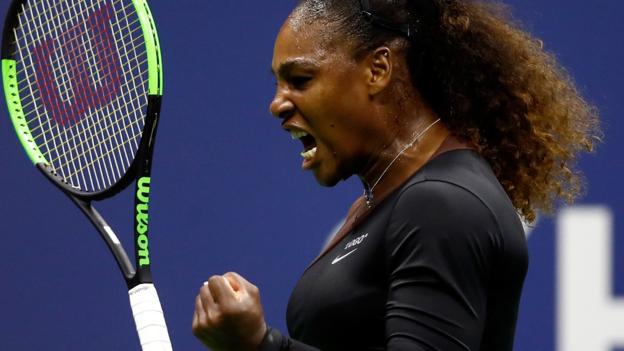
Six-time champion Serena Williams made her return to the US Open with a clinical first-round win over Poland’s Magda Linette.
Williams, 36, missed her home Slam last year, giving birth to daughter Olympia shortly after the tournament started.
Opening Monday’s night session at Arthur Ashe Stadium, she won 6-4 6-0 against her 68th-ranked opponent.
The 17th seed will meet Germany’s Carina Witthoeft in the second round.
Williams is still on course to meet older sister Venus in the third round, although the prospect of facing world number one Simona Halep – her projected last-16 opponent – has disappeared after the Romanian’s shock defeat by Estonia’s Kaia Kanepi.
Although she will face tougher challenges, Williams looks well placed to challenge for the record-equalling 24th Grand Slam on the evidence of her victory over Linette.
She put the Pole’s serve under pressure in a lengthy third game without being able to convert, going on to break it in the seventh.
After avoiding a brief scare when she was taken to deuce in the following game, she saw out the opening set without facing a break point.
The second set was a different story.
Linette could not cope with her power and accuracy in a 28-minute set, winning just nine points as Williams sealed victory with a 114mph ace out wide.
“It was such a good feeling to be back here – it is one of the best feelings in the world,” Williams said.
“The first set was tight, it was my first match back here in New York so it wasn’t the easiest.
“Once I got settled I started to do what I’ve been doing in practise and I felt better.
“I think I’m getting there – I’ve been feeling great in practice.”
Here’s what you need to know about Arizona’s Senate candidates: Kyrsten Sinema, Deedra Abboud, Joe Arpaio, Martha McSally and Kelli Ward. Carly Henry, The Republic | azcentral.com
WASHINGTON – Kelli Ward suggested an announcement about John McCain’s cancer was designed to hurt her campaign. After the senator’s death, she doubled down on Twitter and blamed critics for taking her statements the wrong way.
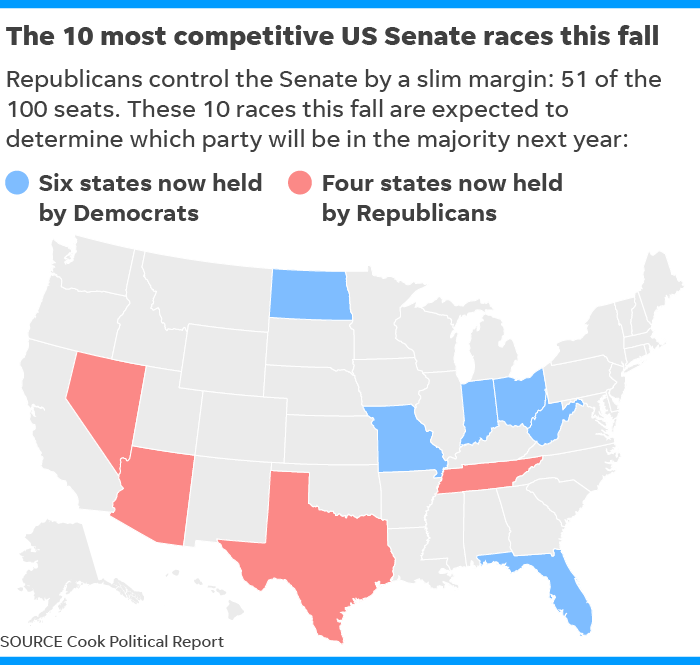
But can the physician and former state senator win the GOP nomination to replace Arizona’s other GOP senator, Jeff Flake, who’s retiring? Polling shows Rep. Martha McSally, the establishment choice, ahead of Ward, and that’s good news for Republicans who believe McSally offers their best chance to keep the seat come November.
Ward and McSally share the ballot in Tuesday’s primary with former Maricopa County Sheriff Joe Arpaio – who President Donald Trump pardoned for criminal contempt of court last August.
Facing backlash over the comment, Ward remained defiant, tweeting early Monday that “Political correctness is like a cancer!” Later, Monday she lashed out against the media and people offended by her comments.
“I do understand how many could have misconstrued my comments as insensitive,” she said. “And for this, I apologize.
“But again, the intention of my comments were in no way directed at Senator McCain or his family.”
Democratic Rep. Kyrsten Sinema is predicted to win the Democratic nomination Tuesday night. Sinema is running against lawyer and consultant Deedra Abboud. Republicans concede Sinema will be a formidable opponent in November.
Arizona isn’t the only state where voters are going to the polls Tuesday. Florida has primaries – including a fascinating race on both sides for governor – and Oklahoma has a handful of runoffs.
Here’s what we’ll be watching for as the results come in Tuesday night:
Polls are open 6 a.m. to 7 p.m. Pacific Time/Mountain Standard Time.
Both McSally and Sinema leave behind competitive House districts. In McSally’s 2nd Congressional District – one of the biggest battlegrounds in the country – voters split almost evenly between Democrats and Republicans and it’s a packed primary on both sides of the aisle.
Four people seek the GOP nomination, with Lea Marquez Peterson, CEO of the Tucson Hispanic Chamber of Commerce, favored by national Republicans. Meanwhile, seven Democrats want to flip the district back to blue. Two favorites lead the pack: physician Matt Heinz, who ran against McSally in 2016, and former U.S. Rep. Ann Kirkpatrick, who once represented a different district in the state.
Rep. Tom O’Halleran aims to keep his seat in Congressional District 1, one of just a handful of districts President Trump won in 2016 that is held by a Democrat. He has no primary opponent, but there are three Republicans vying for the chance to beat him in the general election: Wendy Rogers, a pro-Trump retired Air Force colonel; Tiffany Shedd, a lawyer and cotton farmer, and Steve Smith, a former state lawmaker.
Rep. David Schweikert – a conservative member of the House Freedom Caucus – represents a district that has been red for years. But Democrats hope shifting boundaries and an ethics investigation into Schweikert’s conduct will put the district in play.
Schweikert is unopposed on the Republican side for Congressional District 6. Anita Mali, who works in technology and communications; Garrick McFadden, a lawyer, and Heather Ross, a nurse practitioner, seek the Democratic nomination.
CLOSE
Here is what you need to know about everyone running for governor in Arizona this year. Carly Henry, The Republic | azcentral.com
GOP Gov. Doug Ducey is running for re-election. Even though the state has had a Republican governor for 21 of the last 27 years, Ducey faces headwinds in the general election because of energized Democrats and voters who are unhappy with problems in public education. Ducey faces a primary challenge from former Arizona secretary of state and Arizona Senate president Ken Bennett.
Three Democrats seek the nomination: state lawmaker Steve Farley, Kelly Fryer, former CEO of the YWCA of Southern Arizona, and Army veteran David Garcia.
Ducey will appoint someone to fill McCain’s seat until 2020.
Polls are open 7 a.m. to 7 p.m. (part of the state is in the Central and part in the Eastern time zone).
If Arizona is one of the Democrats’ top offensive states this cycle, Florida offers one of the country’s biggest pickup opportunities for Republicans.
On Tuesday, race watchers don’t expect many surprises in the Senate primary. Democratic Sen. Bill Nelson is unopposed. On the GOP side, Gov. Rick Scott is the clear favorite, although he faces a challenge from perennial candidate Roque “Rocky” De La Fuente. President Trump tweeted his support for Scott Monday.
The real state-level drama lies in the GOP primary for governor, where Rep. Ron DeSantis, a hard-line conservative and a founding member of the House Freedom Caucus, faces off against Adam Putnam, the state’s agriculture commissioner. Establishment Republicans are hoping Putnam pulls off a win because they see him as having the best chance of carrying the purple state in November.
Trump has other plans. After he endorsed DeSantis and rallied for him in Florida, polling shows DeSantis is ahead. A half-dozen other Republicans also are vying for the nomination, but the race is assumed to be between DeSantis and Putnam.
In a crowded Democratic field, former U.S. Rep. Gwen Graham, former Miami Beach Mayor Philip Levine and former Tallahassee Mayor Andrew Gillum seek their next job in government. Gillum would be the state’s first black governor if he were to be elected in November.
If the blue wave hits Florida, there are multiple pick-up opportunities for Democrats in the Sunshine State. Analysts are watching three races closely.
In one of two GOP-held districts won by Hillary Clinton in 2016 – Florida’s 27th – Rep. Ileana Ros-Lehtinen’s retirement offers Democrats a chance to flip a seat.
Ros-Lehtinen’s open spot inspired a packed primary on both sides. National Republicans recruited former Univision reporter Maria Elvira Salazar, but she must beat eight other candidates on the right.
On the Democratic side, Donna Shalala, secretary of Health and Human Services under President Bill Clinton and former president of the University of Miami, and state Rep. David Richardson have pulled in the most money, but they face additional hopefuls.
In the 26th District, Rep. Carlos Curbelo faces a tough challenge from his own party, but is expected to win.
On the Democratic side, retired Navy Cmdr. Demetries Grimes faces Debbie Mucarsel-Powell, a health care advocate.
In District 18, GOP incumbent Rep. Brian Mast must make it past two challengers, entrepreneur Dave Cummings and physician Mark Freeman. Both Cummings and Freeman mounted bids after Mast called for a temporary moratorium on assault weapon sales.
On the left, former Obama foreign relations adviser Lauren Baer has the support of most national Democrats. Baer is running against Navy veteran and lawyer Pam Keith, who previously ran for U.S. Senate in 2016.
Oklahoma
Polls are open 7 a.m. to 7 p.m. Central time.
Oklahoma had its primary back in June, but the state requires a runoff if no candidate gets a majority of the vote. So there will be rematches for a handful of Sooner races.
The GOP nominee for governor should be decided Tuesday between former Oklahoma City Mayor Mick Cornett and businessman Kevin Stitt.
If Democrats take back the House, it likely won’t be through Oklahoma, a state that has no Democratic members of its congressional delegation. Race handicappers say no Oklahoma seat is in much danger of turning blue.
But the state does have an open seat in the 1st Congressional District after former Rep. Jim Bridenstine was named director of NASA. Tuesday will cement that matchup. Tulsa County District Attorney Tim Harris and McDonald’s franchiser Kevin Hern will battle for the GOP spot. On the left, education advocate Amanda Douglas and lawyer Tim Gilpin will go head-to-head.
On Saturday, South Sudan resumed pumping 20,000 barrels per day (bpd) of crude oil from the Toma South oilfield, where production had been suspended since 2013 due to civil war, Sudan’s oil and gas minister Azhari Abdulqader said.
Once maintenance work on five previously suspended oil fields is completed, it is expected to increase production to 80,000 bpd with the country’s oil output reaching 210,000 bpd by the end of the year.
Income from oil accounts for 98 percent of the country’s budget.
Insecurity and the post-2014 oil price crash left the economy in tatters. But the increased oil output will revive South Sudan’s economic fortunes, according to Kimo Adiebo, an economics professor at the University of Juba.
“This increases government’s share in oil production and eventually oil revenue,” Adiebo told Al Jazeera.
“Additional oil revenue would enable the government to stick to its policy of not printing money – borrowing from the central bank – and hence more control of inflation and the exchange rate, leading to gradual macroeconomic stability.”
The most intense fighting between rebels and South Sudanese government troops took place at the Toma South oilfields, just over 30km from the border with Sudan, damaging oil production facilities.
But the country’s oil crisis could have been avoided, Professor Paul Moorcraft, director at Centre for Foreign Policy Analysis, said.
“Juba cutting the oil off at the start of the post-independence war with Khartoum was the biggest self-inflicted political injury since Hitler declared war on the US,” said Moorcraft.
“Clearly, independence has been a catastrophe for the south and a disaster for the north. Yet, in Africa, politics always trumps economic logic.”
Minister of Petroleum Ezekiel Lol Gatkuoth launches the pumping of crude oil in Ruweng state [Jok Solomun/Reuters]
Working relationship
The resumption of oil activities is part of a ceasefire and power-sharing agreement between President Salva Kiir, rebel leader Riek Machar and other rebel groups to end the country’s civil war.
The peace deal has revived hopes of economic stability being restored.
South Sudan lacks the infrastructure to process its oil production. It is landlocked, forcing the young nation to use pipelines that go through Sudan to export its oil to the international market.
In June this year, Khartoum and Juba agreed to repair oil infrastructure facilities destroyed by the war within three months in order to boost production and said a joint force would be established to protect the oilfields from attacks by rebel forces.
“Maybe utter war-weariness and famine may allow some sense to prevail and the two main sides in the civil war may now work with Khartoum,” said Moorcraft.
“It is interesting how President Omar al-Bashir has had a good working relationship with Kiir and Machar. The level of corruption in the south is so bad that very little of any oil – or aid – money gets to the ordinary citizen. The problem is that all the money is held in Juba.
“Yet, if some money gets to peripheries, it fuels tribal warlordism. [The] paradox of development.”
Oil production was at around 245,000 bpd at the time fighting started. But plummeted to about 120,000 bpd during the war from a peak of 350,000 bpd, according to the World Bank.
Investor confidence
Juba is seeking new investors in the oil sector after the government halted talks with French oil company Total about developing two oil blocks.
Total, along with two other oil companies, had been in talks about developing those oilfields since 2013.
But Total and the government failed to agree on the duration of the exploration and the commercial terms of a production-sharing agreement.
However, despite the peace deal, investors remain sceptical. Rights campaigner Beny Mabor told Al Jazeera that the prospects of attracting investors are bleak as long as conflict go unaddressed.
“Investment is equal to secure environment, Therefore, if there’s peace, the investors will come and if not, I’m afraid they might not either,” Mabor said.
In March, the US imposed sanctions on 15 South Sudanese oil operators who allegedly assisted government to buy weapons and funded militia groups.
The conflict in South Sudan has killed tens of thousands and displaced millions [File: Reuters]
Tens of thousands of people were killed by the civil war which also forced millions to flee their homes, triggering a humanitarian crisis and ruined the country’s economy that heavily relies on crude oil production.
Seven million South Sudanese, more than half of its population, will need food aid in 2018, according to the United Nations.
“This additional oil money may enable the government to increase spending towards poverty reduction, education, health, social welfare and humanitarian aid,” said Adiebo.
“Diverting more of this additional oil money towards consolidation of peace would bring security to rural areas and hence enable the IDPs to return to their home areas and engage in more productive activities such as farming with the view of addressing food insecurity,” he added.
The BBC Get Inspired Unsung Hero award returns to celebrate volunteers who dedicate their free time to help people participate in grassroots sports and fitness activities.
Returning for its 16th year, Unsung Hero 2018 will search for the most dynamic, forward thinking and driven volunteers from across the UK, who are inspiring people of all ages to get up and get active.
We are once again asking you to champion an Unsung Hero from your area.
Send your nominations today!
How?
It’s really simple: why does your nominee deserve to be our BBC Get Inspired Unsung Hero.
Enter by:
Uploading a video or audio nomination using our online tool OR
You can view examples of a written nomination here and video nomination here.
Why?
We want to continue to celebrate those who have been encouraging people to get active for years, but we also want to focus on the young Unsung Heroes who have inspiring stories to tell.
We are talking about the college student who drives mass participation at his weekly running club via his savvy social media skills, the young professional who spends his nights in the boxing gym to keep underprivileged kids off the streets. And the 17-year-old dance teacher who is using her class as a platform to talk about the importance of mental health.
If it’s a sport or activity* that needs volunteers, and you know somebody who is driven and selfless to getting people active, then we need your nomination!
(* as long as the activity is recognised by a national governing body – as mentioned anywhere in this document)
Who?
Dynamic, hungry, ambitious and dedicated to making a difference for your community or club. Who do you know that measures up?
Imagine them having selfies with the stars on the BBC Sports Personality red carpet and being presented with the award in front of a sold-out arena, knowing it was your nomination that got them there. The 2017 winner, Denise Larrad, knows exactly what we are talking about.
Well worth a shot, isn’t it? Nominate the person who always puts others first by entering them for 2018.
Even if you have nominated someone previously, you can nominate them again this year – as long as they haven’t won in your region before.
Community volunteer wins BBC Get Inspired Unsung Hero award 2017
Where?
We want to find the most driven, passionate and inspiring volunteers from all corners of the UK.
From Thurso to Torquay, Llanelli to Lowestoft and everywhere in between, our regional and national BBC stations will be gathering your nominations.
Following your nominations, and with the help of a locally-sourced panel, a shortlist is considered and a regional winner is announced.
Fifteen winners, one from each region, go forward into the national award, where a panel of elite sportspeople – with a little help from sport industry and media folk – look closely at each Unsung Hero. After a day’s fierce debate, they will agree on the 2018 BBC Get Inspired Unsung Hero.
When?
Nominations are open NOW – so go on, do something little for someone who does something big!
Nominate your Unsung Hero before the deadline, midnight on Sunday, 21 October 2018, or you’ll have to wait until 2019.
You can also view this page in Welsh and in Gaelic and can view the terms and conditions in Welsh.
Tariffs on goods from China imported into the United States will cost American consumers roughly $6 billion a year, according to a study commissioned by the National Retail Federation (NRF).
The report showed that the proposed 25% tariff on furniture from China would cost Americans $4.6 billion per year in added cost “even if retailers switched their sourcing to other foreign countries or U.S. furniture makers.” A similar 25% tariff on travel items including luggage and handbags would add $1.2 billion to what American shoppers would pay for those items, “even if the goods no longer came from China,” according to the research.
The U.S. is expected to levy tariffs on $200 billion in goods imported from China. Image source: Getty Images.
Alternate sourcing won’t keep pricing down
Whether manufacturers opt to make the impacted items in the U.S. or in a country not impacted by tariffs, tariffs will still lead to higher prices according to NRF Vice President for Supply Chain and Customs Policy Jonathan Gold in testimony prepared for a hearing U.S. Trade Representative (USTR).
“The threat that these tariffs could be imposed, and even expanded to include all consumer goods imported from China, has already started a scramble among importers to find alternative sources of supply, including in the United States,” Gold said. “While you may think this is a positive development, the administration needs to know that the scramble is already bidding up prices for consumer products from all possible alternative manufacturers.”
And, no matter what happens with the tariffs, actions already taken by manufacturers will lead to higher prices, according to Gold. He added that “even if the administration decides not to impose the tariffs, higher prices are already on the horizon for American families.”
Gold warned that tariffs will hit small business owners especially hard. A recent NRF survey showed that 46% of smaller retailers expect that proposed or implemented tariffs will hurt their businesses.
“The collateral damage to wide swaths of the U.S. economy will be significant,” Gold said. “This will only get worse as the additional tariffs take effect and retaliation escalates.”
What happens next?
The NRF has been vocal in its opposition to the proposed tariffs on Chinese goods. It has actively lobbied the USTR and President Donald Trump to rethink these policies.
“By now the administration should know something it questioned several months ago: Tariffs will not get China to change its unfair trade practices,” Gold said. “Instead, these tariffs threaten to increase costs for American families and destroy the livelihoods of U.S. workers.”
What can you do?
As a consumer there’s very little you can do. In theory, you might consider not putting off purchases in areas potentially impacted by the tariffs. For example, if your couch is on its last legs or your luggage has seen better days, you may save some money by replacing them now.
Unfortunately, the range of items that could be impacted by tariffs is very broad. Aside from a little selective advance purchasing or simply not buying items as prices rise, there’s nothing a consumer can do. This is a situation where your best hope lies in comparison shopping to see which retailers and manufacturers find the most creative ways around the tariffs or choose to take lower margins to keep prices down.
The United Nations has accused the Saudi-UAE military alliance of committing possible war crimes in Yemen, adding there was “little evidence of any attempt … to minimise civilian casualties.”
In a damning report on Tuesday, the UN said air attacks had caused the most direct civilian casualties in the war, and a blockade of Yemeni ports and airspace may have violated international humanitarian law.
The alliance, which has been at war with Houthi rebels since March 2015, has repeatedly denied allegations of war crimes, and claims its attacks are not directed at civilians.
However, data collected by Al Jazeera and the Yemen Data Project, has found that almost one-third of the 16,000 air raidscarried out in the country have hit non-military sites.
The attacks have targeted weddings and hospitals, as well as water and electricity plants, killing and wounding thousands.
The charity Save the Children has estimated that an average of 130 children die every day from extreme hunger and disease – a crisis brought about by the conflict.
And according to the UN, at least 10,000 people have been killed since the start of the conflict. However, analysts say the death toll is likely to be higher.
‘Violations continue to be perpetrated’
“The group of experts has reason to believe the government of Yemen, Saudi Arabia, and the UAE, are responsible for violations of human rights,” said Kamel Jendoubi, the chair of the Group of International and Regional Eminent Experts on Yemen.
“Violations and crimes have been perpetrated and continue to be perpetrated in Yemen by the parties to the conflict.
“Members of the government of Yemen and the [Saudi-UAE] coalition may have conducted attacks that were disproportionate and could constitute war crimes,” said Jendoubi.
“They may have committed acts that could constitute war crimes such as mistreatment, torture, attacks on peoples’ dignity, rape, recruitment, and enrollment of children under the age of 15 in the hostilities.”
The experts urged the international community to “refrain from providing arms that could be used in the conflict “- an apparent reference to countries like the United States and Britain, which supply the Saudi-UAE alliance.
Despite repeated petitions by human rights groups, the US assists Saudi Arabia and the UAE in “conducting aerial bombings in Yemen” and provides “midair refuelling services” for their warplanes.
Between 2010 and 2015, Washington also sold more than $90bn of military equipment to Riyadh.
But following a recent air attack on a school bus that killed 40 children, individual members of Congress called on the US military to clarify its role in the war and investigate whether support for the air raids could render American military personnel “liable under the war crimes act”.
‘Questions will be asked’
Al Jazeera’s Alan Fisher in neighbouring Djibouti
“US Defense Secretary James Mattis is expected to hold a briefing at the Pentagon later today, and he will undoubtedly be asked about the continuing US role.
What we have heard from the panel of experts was criticism of Saudi Arabia, the UAE, and the Yemeni government.
The US and UK are helping this coalition, so questions will now be asked about where we go from here and whether any of these governments will accept the findings from this panel of experts.”
Fragments of an MK-82 bomb were found near a school bus that was bombed earlier this month [Ahmad Algohbary/Al Jazeera]
‘No light at the end of the tunnel’
The experts also criticised work by the alliance’s Joint Incidents Assessment Team (JIATY), which was set up as a bulwark against possible rights violations.
They questioned the JIAT’s explanations for the air attacks that have killed civilians, and challenged its “independence and its ability to carry out impartial investigations.”
The experts also said nearly a dozen deadly air attacks they investigated over the last year “raise serious questions about the targeting process applied by the coalition.”
They chastised some in-the-field coalition combatants for “routinely” failing to seek information about official “no-strike” lists that should have been avoided.
“Despite the severity of the situation we continue to see a complete disregard for the people in Yemen,” said Charles Garraway, one of the authors of the report
“This conflict has reached its peak, with no apparent sight of light at the end of the tunnel.
‘Respect! Respect! Respect!’ – Mourinho walks out of news conference
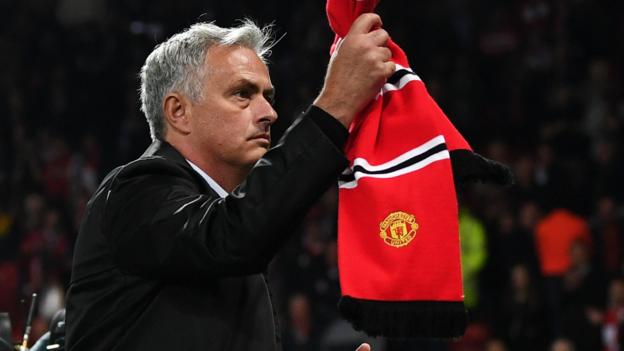
Manchester United manager Jose Mourinho betrayed the pressure and irritation eating away at him in the final seconds of a passionate news conference at Old Trafford following the 3-0 home defeat by Tottenham.
Mourinho had gone on the front foot to defend his side’s performance, telling the assembled media they had to decide what was most important, brilliant football, or results.
He had accurately pointed out that last season in particular, he had been castigated for supposed negative football, even when United had won.
Mourinho was forceful. He argued well. United were outstanding in the first half. They pressed, they played quickly, they created chances. They should have been in front.
The crack appeared when, in response to telling his inquisitors how the United supporters had stayed behind his team, even as they slid to the biggest home defeat he has suffered as a manager, he strayed away from his theme.
Raising three fingers, he said: “Do you know what this means? Yes, it means 3-0, but it also means three Premier Leagues – and I won more Premier Leagues alone than the other 19 managers put together. Three for me. Two for them.”
And as he got up to leave. “Respect! Respect! Respect man!”
It is beyond argument that Mourinho is in a tough place right now.
Two defeats in three games is as bad a start as United have made to a season since 1992-93.
They have not been beaten as badly at home in a league game by Tottenham since 1972.
He knows the pressure is on.
Mourinho, in all probability, understands all that and accepts it as part of the job.
What has eaten away at him, and continues to do so, is that his record fails to insulate him from the kind of criticism he thinks others – who have not achieved anything like as much as him – seem to escape.
United finished runners-up to Manchester City last season, and before the season’s opening game against Leicester, Mourinho questioned why Liverpool boss Jurgen Klopp and Tottenham’s Mauricio Pochettino receive what he feels to be an easy ride despite their failure to win a trophy.
He said: “It is difficult for me to believe we finished second when I listen, when I read, because you are capable of making people that finish second look like they were relegated and people who win nothing, finish below us, and you make them look like serial winners.”
Mourinho ‘frustrated’ with lack of Man Utd efficiency
It is the same kind of attitude that, much earlier in his career, saw Mourinho label Arsenal manager Arsene Wenger “a specialist in failure”.
Mourinho regards himself as a winner. Even at United he has won silverware, securing the Europa League and EFL Cup in his first season.
He thinks those trophies, along with his successes at Porto, Chelsea, Inter Milan and Real Madrid, should buy him time – and respect.
Why don’t they? Put simply, Mourinho does not help himself with his surly outward demeanour.
Neither Pochettino nor Klopp have arrived half an hour early for news conferences, then delivered curt responses to any question asked before exiting less than 10 minutes later, as Mourinho did on Friday.
Both Pochettino and Klopp have engaged with their own club’s fans in a way Mourinho, who still lives in a hotel in Manchester city centre, has not.
This is nothing new for United. During Sir Alex Ferguson’s era, there was a belief that Wenger escaped media criticism because he was seen as being sophisticated and intelligent, in contrast to the Scot’s Glaswegian-streetfighter reputation.
Ferguson’s intellect is huge. His sense of humour legendary. But in front of the media he was aggressive, and the reputation stuck, deserved or not.
Behind the scenes at Old Trafford, Mourinho is said to be amusing – at least before this tortuous summer began – but the more he scowls in front of the cameras, the greater the disparity with Klopp and Pochettino.
Following the summer exits of Wenger and Chelsea’s Antonio Conte, Mourinho was right when he said the score on Premier League titles is three to him, two to the rest.
But unless he finds an answer soon, that lead will evaporate.
Manuel Pellegrini is unlikely to add to his championship at West Ham this season. But Pep Guardiola well could at Manchester City.
And, on the evidence of the past three weeks, Klopp and Pochettino have a decent chance of lifting the trophy as well.









 trendynewsday