Democrats are continuing their calls to delay the confirmation hearings of Judge Brett Kavanaugh to the Supreme Court. They cite a lack of information and Michael Cohen linking the president to a federal crime as reasons to delay the hearings. (Aug. 23) AP
Citing concerns about possible “criminal wrongdoing” by President Donald Trump, the Democrats of the Senate Judiciary Committee called for a postponement Friday of the Supreme Court confirmation hearing for Judge Brett Kavanaugh.
In a letter to committee chairman Chuck Grassley, R-Iowa, the Democratic senators said that, “Given the possibility of criminal wrongdoing by the President, doubts that Judge Kavanaugh believes a president can even be investigated, and the unprecedented lack of transparency regarding this nominee’s record, we should not move forward with hearings on September 4th.”
The lawmakers instead suggested a special committee meeting “to discuss a bipartisan, fair, and transparent process for moving forward.”
The Democrats said “in light of this week’s developments” – referring to the news that two former Trump associates were guilty of felonies – it was particularly important that the hearing be postponed.
“Importantly, there is no legitimate reason for the Senate to rush this nomination and fail to perform its constitutional duty,” they said. “This is especially true, when the President, who faces significant legal jeopardy, chose the one candidate who has consistently and clearly expressed doubt as to whether a sitting president can be investigated or indicted for criminal wrongdoing.”
The senators also said they could not move forward because “97 percent of Judge Kavanaugh’s White House record is being withheld from the public and more than 94 percent is being withheld from the Senate.”
Earlier this week, in response to calls for a delay, Grassley spokesman George Hartmann said the planned hearing will go forward in September. Hartmann noted that Supreme Court Justice Stephen Breyer was confirmed by the Senate while then-President Bill Clinton was dealing with the Whitewater investigation.
“Obviously, we are nowhere close to that situation today,” Hartmann said. “Calls to delay the hearing are just the latest tactic from opponents who decided to vote ‘no’ weeks ago, frantically looking for anything that sticks.”
All the Democrats on the committee signed the letter: Sens. Dianne Feinstein of California, Pat Leahy of Vermont, Dick Durbin of Illinois, Sheldon Whitehouse of Rhode Island, Amy Klobuchar of Minnesota, Chris Coons of Delaware, Richard Blumenthal of Connecticut, Mazie Hirono of Hawaii, Cory Booker of New Jersey and Kamala Harris of California.
Yuval Noah Harari was catapulted into the international literary spotlight in 2014 following the English translation of his book Sapiens.
The book, which covers the history of humanity from the discovery of fire to modern robotics, became a non-fiction publishing phenomenon, feted by then-US President Barack Obama and Facebook founder Mark Zuckerberg, and went on to sell more than eight million copies worldwide.
In his next book, Homo Deus, the Israeli historian and author explored how the growth of big data, artificial intelligence (AI) and biotechnology could radically alter and divide human society, perhaps ending the species altogether.
The same themes crop up again in his latest work, 21 Lessons for the 21st Century, which collects essays, talks and responses to his readers in a series of observations on everything from meditation to climate change.
In an interview with the Talk to Al Jazeeraprogramme, Harari discussed technology, immigration and politics with Al Jazeera’s Harry Fawcett in Tel Aviv.
Editor’s note: This interview has been edited for clarity and brevity.
Al Jazeera: In your view, what are the key challenges and threats we face right now and going forward?
Yuval Noah Harari: There are three big challenges facing humankind in the 21st century: nuclear war, climate change and technological disruption, especially the rise of AI and bio-engineering. This will change the world more than anything else.
Hopefully, we can prevent a nuclear war and climate change from happening. But technological disruption is bound to happen. We still have some choice about what kind of impact AI and bio-engineering will have on the world, but they will change the world, maybe more than anything that happened previously.
These are the main challenges. Anything else is a distraction.
Al Jazeera: What do you think is going to happen with big data, bio-engineering and AI? What is going to be the impact on all of us?
Harari: Some things are definitely going to happen. For example, computers and robots replacing more and more humans. But what will the consequence of that be? Will this create an extremely unequal society in which an elite control all of the economy and make all the profits, whereas most humans become part of some kind of useless class? This is not inevitable, this is up to us.
Similarly, the combination of AI and bio-technology means that we are very close to the point when you can hack human beings.
There’s a lot of talk about hacking computers, emails and bank accounts. But we are entering an era of hacking humans. And I’d say the most important fact anybody who is alive today needs to know about the 21 century is that we are becoming hackable animals.
Al Jazeera: Hackable how?
Harari: It starts by having corporations and governments amass enormous amounts of data about where we go, what we search online and what we buy. But this is all surface information about our behaviour in the world. The big watershed will come once you can start monitoring and surveying what is happening inside your body and inside your brain. Then you can really hack human beings and we’re very close to this.
Already, a lot of people go about with Fitbit fitness trackers that constantly measure their heart rate and blood pressure. You cross that with what you buy and what you search online, or what you read or what you watch on television. You watch a movie and at the same time Netflix knows what is happening with your heart rate or your brain.
We still have some choice about what kind of impact AI and bio-engineering will have on the world, but they will change the world, maybe more than anything that happened previously.
Yuval Noah Harari
When you combine our increasing understanding of biology, especially brain science, with the enormous computing power that machine learning and AI is giving us, what you get from that combination is the ability to hack humans, which means to predict their choices, to understand their feelings, to manipulate them and also to replace them. If you can hack something you can also replace it.
Al Jazeera: There are a lot of concerns around AI taking a bigger role in the future. You don’t seem as worried about that. Why?
Harari: The big danger is the job market and that AI will serve to empower a small number of people and create a digital dictatorship.
I think it’s highly unlikely that in the near, or even medium, future AI will gain consciousness and start having feelings and desires of its own and start killing people. That is science fiction. I really like science fiction but I think the worst service that it has done over the last few years is to distract people from the real dangers of AI, and focus them on unrealistic scenarios.
There is absolutely no indication that AI and computers are anywhere on the road to becoming conscious.
I’m not against giving more authority to AI, but the question is, who is the master of AI? Does it serve a small elite or big corporations? Does it serve dictatorial governments? Or does it serve me? You can use AI to create a total surveillance regime of the government, controlling the population. And you can use AI for the citizens to survey the government and make sure there’s no corruption. The same technology can go both ways.
Al Jazeera: You said that your latest book is one for “right now”. Politics right now are more roiled than they’ve been for a while and you’ve suggested that Brexit may unravel both the United Kingdom and the European Union. How do they unravel from this point?
Harari:As people lose faith in the ability to cooperate with others and with other countries, they become much more self-centred. Then, everybody puts their interests first and it becomes harder and harder to cooperate.
I don’t think there’s anything inherently wrong with Brexit. We saw the UK wanting to be independent from the EU, the problem is really one of timing. All of the global problems – AI, climate change, nuclear war – have no national solutions.
You cannot prevent climate change on a national basis. You can reduce your own greenhouse gas emissions to zero, but if the other countries are not doing the same, it won’t help. Similarly, you cannot regulate AI on a national basis.
The most important fact anybody who is alive today needs to know about the 21 century is that we are becoming hackable animals … If you can hack something, you can replace it
Yuval Noah Harari
Al Jazeera: Brexit was inspired, to a large extent, by fears of greater immigration. Do ideas you’ve talked about like culturism not give license to people who are racist and who fear people unlike them coming into their zone as we see happening in the EU at the moment?
Harari:There’s a danger there, of course. The differences between racism and culturism is that racism is an argument about biology. You say ‘these people, there is something in their blood, there is something in their genes, there is something in their biology which inevitably makes them a certain way, and this cannot be changed, it’s in their biology.’
Culturism is not about biology. It’s saying ‘there’s something in the culture. Their culture is less respectful of women, their culture is more authoritarian, their culture is … whatever.’
The thing about arguments regarding culture is that sometimes, not always, they are correct. Whereas, there is no scientific basis for thinking that there are significant biological differences between people. What we need to remember is that cultures change and people change. Even if you are born into a particular culture, it doesn’t mean that for the rest of your life you can’t change your world view, your morality, or your behaviour.
Within the lifetime of a person, an entire culture can change in a tremendous way. If you think about Germany over the last 100 years, it has undergone so many cultural changes. Germany’s culture in Hitler’s time and in Merkel’s time is completely different and at least some of the people are the same.
Al Jazeera: Some of your harsher reviewers have said you are good at diagnosing the trends and problems but you’re less forthcoming when it comes to proposing solutions and answers.
Harari: It’s true, it’s much harder to find solutions but it is also very hard to pinpoint the problems and the questions. I see my main job at present in just bringing clarity by making people focus on the most important problems. Then comes the issue. So what are the solutions? In many cases, we do know what the solutions are. It’s just difficult to implement them, especially without global cooperation.
With climate change, we know what the solutions are. It’s no longer a big mystery. We know what kind of technologies we need to develop and we can do it. We know what kind of environmental regulations we need to enforce and we can do it. But the problem is there is no political will.
With AI and bio-engineering, it’s far more complicated because nobody knows where it’s going and nobody knows what kind of possibilities are opening before us. Even here, there are many things we can do. The problem is the lack of political will and, even more, the lack of attention. If people focus on these issues, I don’t think the solutions are so difficult.
Crystal Palace winger Wilfried Zaha has been booked for diving on his past two visits to Vicarage Road
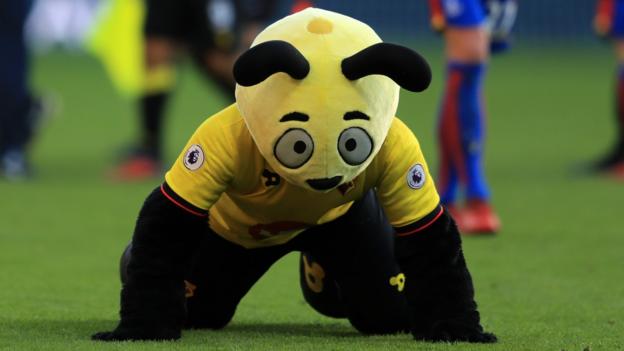
Crystal Palace boss Roy Hodgson has warned Watford mascot Harry the Hornet against “disgraceful” provocation of Wilfried Zaha in Sunday’s Premier League game at Vicarage Road.
Harry the Hornet mocked Zaha, 25, by diving in front of him after the Palace winger was booked for simulation during a 1-1 draw on Boxing Day in 2016.
Zaha said there was an “agenda” against him after he was also shown a yellow card for diving at Watford in April.
“Zaha does not dive,” said Hodgson.
“If you’re asking me whether Harry the Hornet, who I presume is the mascot, should dive in that way, I think it’s disgraceful, because that’s not what football matches are about.
“And certainly if it’s provoking the crowd into looking for something that’s not there, it should be stopped.”
Former Palace boss Sam Allardyce said Harry the Hornet was “out of order” after the incident in 2016 but the mascot avoided disciplinary action by the Football Association.
After the goalless draw at Vicarage Road in April, the Ivory Coast international said he felt people were trying to get him banned and Hodgson again backed his player on Friday.
“Wilf Zaha does not dive for penalties,” said the former England boss. “He gets knocked over sometimes and sometimes he gets unbalanced without it being a penalty or a foul, because he runs at such speed and has such agility with the ball.
“But of course teams try to take every advantage they can.
“I would be very disappointed if the Crystal Palace mascot was doing something like that to provoke the crowd against an opponent.
One word is sure to surface again and again as Sen. John McCain’s legacy is detailed and debated in the wake of his decision to discontinue medical treatment for a deadly form of brain cancer.
The description reflected a backstory of heroism and duty during the Vietnam War and fit McCain’s efforts to lead bipartisan reforms of the campaign-finance and U.S.-immigration systems. His central focus on Capitol Hill was national security, a bipartisan concern. And he eagerly sparred with presidents George W. Bush, Barack Obama and Donald Trump.
The “maverick” reputation suggested an independent streak that played well with some voters in his Senate and presidential runs, and McCain himself would use it when it suited him politically.
But it wasn’t always a comfortable fit for McCain or even accurate, as the Arizona Republican could be a partisan brawler and GOP team player, too, much to the exasperation of his admirers in the Democratic Party and the Washington media.
McCain, R-Ariz., distanced himself from the “maverick” label when it became a liability during his bid for the 2008 Republican presidential nomination, and in his 2010 and 2016 Senate re-election races. But he never let it go completely, just as critics on the left would use it against him when they felt he wasn’t living up to their idea of bipartisanship.
“That was a label that was given to me a long time ago,” McCain said in 2010. “I don’t decide on the labels that I am given. I said I have always acted in what I think is in the best interests of the state and the country, and that’s the way that I will always behave.”
In a 2002 memoir, McCain wrote that he worried “the (‘maverick’) act might be getting a little tired for a man of my years.”
Days before that vote, in a memorable July 25 Senate floor speech, delivered at the height of partisan rancor over whether to repeal or save Obama’s Affordable Care Act, McCain made a passionate case for the Senate to return to regular order and the civility and camaraderie for which the upper chamber was once known.
“The most revered members of this institution accepted the necessity of compromise in order to make incremental progress on solving America’s problems and to defend her from her adversaries,” McCain said in the remarks, which came less than a week after the disclosure that he was battling a deadly form of brain cancer. “That principled mindset and the service of our predecessors who possessed it come to mind when I hear the Senate referred to as the world’s greatest deliberative body. I’m not sure we can claim that distinction with a straight face today.”
In an August interview with The Arizona Republic, McCain said he was comfortable with people remembering him as the Republican maverick, but added, “I also hope that they recognize what I’ve done on a lot of issues, especially national defense.”
Legislative contributions
In the legislative arena, McCain’s work on the influential Senate Armed Services Committee, of which he became chairman in 2015, and on defense policy were among his most lasting contributions.
His namesake campaign-finance-reform bill, which sought to combat the pervasive influence of special-interest money in politics, became law in 2002 but the U.S. Supreme Court overturned key parts, including regulations on independent corporate and union spending on political advertising.
Critics argued the campaign-finance law backfired and actually worsened the situation because it weakened the political parties and shifted power toless accountable and more extreme third-party organizations. It also led to the 2010 decision in Citizens United vs. the Federal Election Commission that greatly increased the influence of corporations, unions and outside groups on elections. One ramification, given Congress’ failure to mandate disclosure, has been that certain politically active non-profits can hide the source of their money.
And despite years of trying, none of McCain’s attempts to overhaul the immigration system became law, though two major pieces passed the Senate in 2006 and 2013.
Sen. Jeff Flake, R-Ariz., agreed that national security is a big part of McCain’s legacy.
“He has really helped shape our policy for a good amount of time — a quarter-century, at least — in the Senate in terms of the post-World War II liberal international order with strong U.S. leadership and security arrangements and a focus on human rights.”
Former three-term Sen. Dennis DeConcini, D-Ariz., who served six years with McCain in the Senate from 1987 until DeConcini’s 1995 retirement, said he and McCain often had ideological differences and disagreed about the use of earmarks to fund projects for the state. But DeConcini said he always respected McCain’s military service in the Navy. More recently, DeConcini said he admired the way that McCain was willing to stand up to Trump, his own party’s president.
“I considered him a maverick,” DeConcini said of McCain. “He went on his own trajectory on issues. He would not always support the Republican position, though he also could be very partisan, and was while I was there, but that’s understandable.
“I give him great credit for taking on Trump, not just because I am no fan of Trump’s, but because that is really a courageous thing to do,” DeConcini said.
McCain’s presidential runs in 2000 and 2008 elevated him in the national consciousness.
During McCain’s first bid for the Republican presidential nomination, Americans became acquainted with his personal story of being shot down over North Vietnam in 1967 and spending more than five years as a prisoner of war. McCain, the son and grandson of Navy admirals, refused early release because the military code of conduct demanded POWs only accept release in the order in which they were captured.
McCain’s scrappy, upstart 2000 presidential campaign and its reform platform were given little chance of victory but managed to throw the GOP establishment into a panic after his surprise upset of then-Texas Gov. George W. Bush in the New Hampshire primary.
Anti-McCain forces descended on South Carolina to halt his momentum ahead of that state’s party. In a brutal primary that has entered the lore of U.S. political history, his opponents waged an all-out effort that included, in some cases, outlandish and vicious smears of McCain and his family.
“I will not take the low road to the highest office in this land,” McCain said after his South Carolina loss. “I want the presidency in the best way, not the worst way.”
Though McCain carried on to Michigan and Arizona, his campaign was mortally wounded.
But even in defeat, he inspired some in his party.
“His run in 2000 was kind of the first inkling of the ability to run in an unorthodox way,” said Sen. Marco Rubio, R-Fla., who would run for president in 2016. “That was an unorthodox campaign against a favorite who ended up winning, but Senator McCain, without any of the trappings of a traditional campaign front-runner, really gave future President Bush a run for his money.”
McCain and Bush remained at odds after Bush moved into the White House in 2001, with McCain famously opposing the GOP president’s signature tax cuts in 2001 and 2003.
But financial troubles nearly upended his machine and by summer 2007 McCain was running on a tight budget, preaching the need for victory in the unpopular Iraq War while stumping at town-hall-style events in Veterans of Foreign Wars meeting halls and similar venues all over Iowa, New Hampshire and South Carolina.
“I’d rather lose a campaign than lose a war,” McCain would say of the risk that his Iraq War stance posed to his political prospects.
In what was seen as a major comeback, McCain won the GOP nomination over rivals such as former Massachusetts Gov. Mitt Romney, former New York City Mayor Rudy Giuliani and former Arkansas Gov. Mike Huckabee.
In the end, McCain’s attempt to revive the “maverick” brand didn’t changes voters’ perceptions; his campaign and foreign policy were painted as extensions of Bush’s presidency and it stuck.
Whether his pick of then-Alaska Gov. Sarah Palin, chosen to help shore up the conservative base that distrusted him, hurt or helped remains a matter of debate. But some blame McCain’s choice of Palin for the rise of right-wing populism that eventually led to Trump’s election in 2016.
“One, Barack Obama was a very, very strong candidate and that’s the most important thing,” McCain told The Republic in an interview in August 2017. “Second, when the stock market collapsed, it really sent us into a real drop. Third of all, I guess, Americans were ready for a change, too.
“But I’d like to emphasize the first thing I said: Barack Obama was an incredibly impressive candidate and he did a great job campaigning,” he said.
For some hard-right Republicans, McCain didn’t hit Obama, the first African-American nominee of a major party, hard enough or often enough out of what they considered a fear of being tagged a racist.
For example, McCain declined to make an issue of the Rev. Jeremiah Wright, Obama’s former pastor in Chicago who had made a string of controversial political statements in his fiery sermons, including rejecting the slogan “God Bless America” for “God Damn America.”
In another memorable moment, McCain corrected a woman at a town hall meeting who said she couldn’t trust Obama because he was “an Arab.”
“No, ma’am. He’s a decent, family man, citizen, that I just happen to have disagreements with on fundamental issues and that’s what this campaign is all about,” McCain said.
McCain’s honorable campaigning seems quaint when viewed through the lens of Trump’s scorched-earth assault on his Democratic rival, Hillary Clinton, in 2016.
Just eight years after McCain received the party’s nomination, Republicans would chant “Lock her up!” at the Republican National Convention in Cleveland.
But Rubio recalled McCain’s exchange with the woman who said Obama was an Arab as “an iconic moment” in presidential campaign history.
“In the process of running in the 2008 election, there were multiple moments in that campaign where you saw him elevate above the moment and refuse to go in a direction that perhaps some wanted him to go,” Rubio said. “It was a testament to his character.”
McCain never settled his differences with the far-right wing of the Arizona Republican Party despite being the party’s 2008 standard-bearer. At one point, party activists censured him as too liberal on issues such as immigration. He drew conservative primary challenges from the right in 2010 and 2016, but dispatched both J.D. Hayworth and Kelli Ward easily.
With his seniority and national profile, McCain’s clout in the Senate grew. He got a reputation as a Senate heavyweight who could get things done.
In 2015, McCain, the classic Senate hawk on foreign policy, got his Capitol Hill dream job, taking the Armed Services Committee gavel.
As the panel’s chairman, McCain was in his element, whether it was working to reform the Defense Department’s weapons-acquisition process to curb waste, grilling Pentagon officials on policy or strategy, or blasting disruptive anti-war demonstrators as “lowlife scum” as he ordered them out of the hearing room.
“In his time in the Senate, this is a deeply passionate individual who has a sense of tackling injustice, whether it’s the suffering in Syria or what (Russian President) Vladimir Putin has done,” Rubio said. “When he locks on, he’s going to lock on. Very few things are going to move him off of it.”
McCain’s worldview was greatly influenced by the Cold War standoff between the United States and Soviet Union — as a naval aviator, he was stationed on the nuclear aircraft carrier USS Enterprise off Cuba during the 1962 Cuban Missile Crisis — and he was a relentless critic of Putin, whom he often called a murderer and a thug. Putin officially sanctioned McCain in 2014. A few years later, a Kremlin spokesman said McCain was known for his “maniacal hatred towards our country.”
McCain urged the United States to stand up to the threat posed by Putin.
“We need to be strong and steadfast,” McCain said. “Vladimir Putin is no fool. And he’s going to figure out the profit and loss from actions that he can take. We have to make it clear to him that the cost exceeds the benefit. And that doesn’t mean we’re back in the Cold War. But it does mean that we take a realistic approach to Vladimir Putin and his ambitions.”
McCain’s foreign-affairs outlook is set to live on through Arizona State University’s McCain Institute for International Leadership, which the senator helped get started in 2012 with unspent money from his 2008 presidential campaign.
The institute aims to groom new generations of global leaders and scholars by studying and debating world issues.
Spirit of bipartisanship
McCain’s chairmanship of the Armed Services Committee was, like much of his work in the Senate, marked by a spirit of bipartisanship. He worked well with Sen. Jack Reed, D-R.I., the committee’s ranking Democrat.
The committee turned out annual defense authorization bills that would pass the Senate overwhelmingly.
“That’s because, all these years, I’ve developed all these relationships with these guys and women, that we trust each other,” McCain told The Republic.
Even before he became chairman, McCain was able to get many of his priorities included in the must-pass defense bill, including in December 2014 language to allow a federal land swap needed for a massive copper mine near Superior. The project is expected to provide jobs and an economic boost to the area.
“I think it has a lot to do with national security,” McCain said at the time. “This mine, when it’s fully operational, will supply 25 percent of America’s copper supply, and that is a national security issue.”
As the committee’s chairman, McCain made overhauling defense acquisition one of his biggest priorities.
“In the last three National Defense Authorization Acts, Senator McCain has championed sweeping measures to reform, streamline and improve the defense acquisition system,” Julie Tarallo, McCain’s spokeswoman, said in November. “There is a long way to go to ensure America’s weapons systems are delivered on time and at cost, and Senator McCain continues to exercise rigorous oversight of the implementation of these much-needed reforms.”
Immigration reform failure
McCain’s bipartisan efforts yielded mixed results on other issues.
The failure of comprehensive immigration reform to become law after years of trying was perhaps his biggest disappointment.
McCain worked on the issue for more than a decade. His belief in legislation that balanced border security with a foreign-worker program and a pathway to citizenship for millions of undocumented immigrants who have settled in the country hurt him politically with many anti-“amnesty” voters in his own party. A 2013 compromise he helped write as part of the bipartisan Gang of Eight, which also included Rubio, passed the Senate, but the Republican-controlled House of Representatives refused to consider it.
McCain viewed the issue as crucial for his home state — and his party’s future — and gave this advice to Arizona Republicans who refuse to budgeon the issue:
“I would tell them to recognize that Arizona is a state that is undergoing change,” McCain told The Republic. “We have a growing Hispanic population. We have a growing influx of people from states like California. I think they’ve got to be attuned to the demographics of Arizona.
“We ought to understand that Arizona is a state that is changing and, arguably, for the better.”
Nowicki is The Republic’s national political reporter. Follow him on Twitter, @dannowicki.
Baghdad, Iraq – It is Friday afternoon and a lively and diverse crowd starts to gather under a blazing August sun on the banks of the Tigris River, just metres away from al-Mutanabi Street, the Iraqi capital’s historic bookselling centre.
For several years now, al-Qishla, an Ottoman military barracks-turned-cultural-hub in the heart of Baghdad, has become a space where intellectuals, poets and artists come together to exchange ideas and discuss current affairs.
Regular attendees say al-Qishla provides residents with a safe avenue to share views freely, as well as a sliver of hope that Baghdad – once a major international intellectual and cultural hub – may return to a shadow of its former self before successive wars that gripped the country for decades left it in decay.
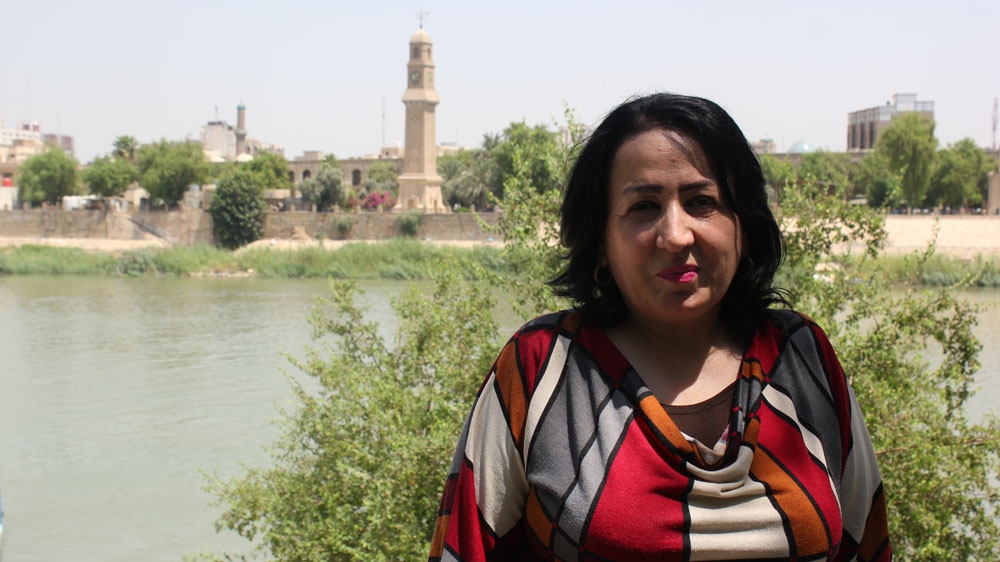
Shatha Faraj, a 52-year-old poet and journalist who has been attending the weekly events for the past four years, says al-Qishla is a space that “poets and artists flock to breathe”.
“It is a place where we feel alive as we sense a bit of Iraq’s beauty and history again,” she adds.
Omar Ahmed, a 28-year-old lawyer, says he and his friends come here every week.
“We discuss everything from the protests to the economic woes facing Iraq,” he says, shortly before attending a discussion on US and Iranian involvement in Iraqi politics.
“We don’t just criticise, we try to find solutions as well.”
Shatha Faraj, a poet and journalist, stands in front of al-Qishla’s clock tower [Arwa Ibrahim/Al Jazeera]
Baghdad was founded in the eighth century during the Abbasid era.
Strategically located in the heart of several vital trade routes, it was for centuries a leading centre of commerce and learning, attracting philosophers, scholars and scientists from around the globe.
Baghdad was the city where a large corpus of Greek philosophy was translated into Arabic, with its House of Wisdom – initially built as a private library by the ruler Harun al-Rashid – grew into housing the largest selection of books on medicine, philosophy and science in the ninth century.
Al-Qishla’s two-story building was built by the Ottomans in 1861 to serve as an administrative centre and as the headquarters of their forces.
In 1868, the Ottoman military erected a 23-metre high tower in the barracks’ gardens and placed a clock in it – gifted by Britain’s King George V – to help soldiers wake up on time.
The monumental clock tower stands to this day, serving as al-Qishla’s key landmark.
The site, which housed British officers during the British mandate period in the early 1920s, also hosted the coronation of King Faisal I, the first monarch of modern-day Iraq, and his successor King Ghazi.
After the establishment of the Iraqi republic in the 1950s, al-Qishla’s significance gradually diminished over the decades, before suffering further neglect and destruction – like other heritage sites in Iraq – in the wake of the US-led invasion in 2003.
But in 2012, Baghdad’s provincial council dedicated funds to restore parts of the site, in an attempt to revitalise it as a cultural space.
Baghdad’s speakers’ corner
After its March 2013 reopening, the site has been welcoming every Friday a wide array of visitors who get the chance to engage in political debate, watch performances and attend art exhibitions and poetry readings.
“Baghdad was a cultural and literary centre in the past. Since al-Qishla’s been restored, it attracts increasing numbers of intellectuals, artists and critics every week,” says Mazen Razouki, head of the tourism and heritage committee at the Baghdad provincial council, noting that only the first restoration phase has been completed due to limited funds.
“It is the place where people who love their country can express themselves freely = and that is exactly what we need in Iraq,” adds Razouki, comparing al-Qishla to the famed speakers’ corner in London’s Hyde Park.
“Both are spaces for free expression, but while Hyde Park is near the centre of government and the queen’s palace, al-Qishla is far removed – both physically and psychologically – from the Green Zone.”
The Green Zone is a 10-square kilometer area in central Baghdad where most of the government buildings and foreign missions have been based since the US-led invasion.
Despite their stark differences, with the Green Zone being off-limits to members of the pubic, many Baghdad residents refer to al-Qishla as the “old Green Zone” for being the city’s former administrative centre.
Visitors to al-Qishla’s gather for a music performance in the middle of the gardens surrounding the ancient Ottoman barracks [Arwa Ibrahim/Al Jazeera]
In recent weeks, violent protests demanding better services, jobs and an end to government corruption spread in different parts of Iraq, including in Baghdad’s Tahrir square where tear gas was used against the demonstrators.
Al-Qishla is also seen as a gathering space for government critics, but those visiting the site are left undisturbed.
“Although many critics of the government who protest in Tahrir also attend al-Qishla’s weekly events, there is a big difference between the two spaces,” says Razouki.
“Al-Qishla is an intellectual hub where the literary classes gather, whereas Tahrir brings together the most exhausted societal groups who have nowhere else to voice their demands and frustrations,” he adds.
Faraj, the journalist, says the government “definitely” does not support the activities of those attending the events at al-Qishla.
“Real freedom of expression is something we only wish to realise in Iraq one day,” says Faraj.
Omar Ahmed has been attending political debates with his friends at al-Qishla for years [Arwa Ibrahim/Al Jazeera]
Despite Baghdad’s victory over ISIL in December 2017, feelings of apathy and dissatisfaction over chronic mismanagement and lack of economic opportunity still run deep across Iraq – as evidenced in May’s parliamentary election where 44 percent of eligible voters – a record low – cast their ballots.
But for Abu Hussein, a 70-year-old retired teacher, al-Qishla brings hope for a better future.
“When I come to al-Qishla and al-Mutanabi Street, I’m taken back to the united and strong Iraq it once was,” says Abu Hussein, as he packs a stack of newly-purchased books into his bag.
“I’m reminded of the glory, heritage and courage that were once Baghdad.
“I tell everyone who is feeling down about our conditions to come to al-Qishla,” adds Abu Hussein, as makes his way to a debate on secularism.
“Their positivity towards and hope in Iraq becomes revitalised by this space.”
Months after Fifth Harmony disbanded, Normani has found a (temporary) new “girl gang” — and they’ve got a biting, badass message for the men of the world.
The newly minted soloist has hopped on a fresh remix of Jessie Reyez‘s self-love anthem “Body Count,” which also features fellow R&B star Kehlani. Together, the three women flex their hard-earned independence — Normani, for one, cooly instructs, “You were birthed by a woman, show some fucking respect / I like you much better when you shut up and get down on your knees.” Woo!
Normani and Kehlani’s swaggering verses are tied together by Reyez’s original, passionate hook: “We don’t care what they say / We gon’ love who we wanna love.” It might be the most empowering, feminist anthem you’ve heard since “God Is a Woman.”
Reyez’s “Body Count” remix appears on her upcoming Being Human in Public EP, slated for release this fall. The seven-track project also features her first Spanish-language release, “Sola,” and the recently released “Apple Juice,” which Reyez performed at last weekend’s VMAs. Revisit that performance below, and keep your fingers crossed for more collabs from this dynamite trio.
WASHINGTON – President Donald Trump on Friday nixed a planned trip to North Korea by Secretary of State Mike Pompeo, suggesting Kim Jong Un’s regime had not made good on promises to relinquish its nuclear weapons arsenal.
Trump announced the cancellation in a series of tweets Friday, just one day after Pompeo said he would be traveling to North Korea next week to press that country on its pledge to denuclearize. Pompeo announced the trip in a carefully orchestrated appearance on Thursday with Stephen Biegun, who was just named as the Trump administration’s special representative for North Korea.
But on Friday, Trump said he asked Pompeo not to go to North Korea because “because I feel we are not making sufficient progress with respect to the denuclearization of the Korean Peninsula.”
The president said Pompeo would go at a later date, after the U.S. and China resolve an escalating trade war that has complicated America’s diplomatic efforts in North Korea.
“Secretary Pompeo looks forward to going to North Korea in the near future, most likely after our Trading relationship with China is resolved,” Trump tweeted. “In the meantime I would like to send my warmest regards and respect to Chairman Kim. I look forward to seeing him soon!”
…Secretary Pompeo looks forward to going to North Korea in the near future, most likely after our Trading relationship with China is resolved. In the meantime I would like to send my warmest regards and respect to Chairman Kim. I look forward to seeing him soon!
During a highly publicized summit on June 12 in Singapore, Trump and Kim signed a vaguely worded agreement in which North Korea promised to work toward a “complete denuclearization of the Korean Peninsula.” But the North Koreans have not taken any visible, concrete steps toward fulfilling that pledge.
And on Monday, a United Nations watchdog organization reported there were no signs that Kim Jong Un’s government has stopped its nuclear weapons activities. The International Atomic Energy Agency said “the continuation and further development” of North Korea’s nuclear program is “cause for grave concern,” according to the IAEA’s Aug. 20 report.
In his tweet, Trump suggested China was partly to blame for the lack of progress on denculearization. China is North Korea’s biggest trade partner, giving its leaders significant leverage over Kim’s regime. The U.S. has pushed China to use its influence to force North Korea to give up its nuclear weapons.
But the Trump administration’s growing trade battle with China has limited the president’s ability to get cooperation on North Korea. Trump has slapped a series of tariffs on Chinese goods, prompting China to respond in kind.
Just this week, the Trump administration levied 25 percent tariffs on $16 billion in Chinese imports, a move that could mean U.S. consumers will pay more for dozens of products including farm equipment, motorcycles, mopeds, electronics and plastics. China retaliated with an equal amount of tariffs on more U.S. imports, including large passenger cars, motorcycles and baby carriages.
In one tweet, Trump said that “… because of our much tougher Trading stance with China, I do not believe they are helping with the process of denuclearization as they once were.”
Harry J. Kazianis, a North Korea expert with Center for the National Interest, a Washington-based foreign policy think tank, said China and North Korea both share blame for the lack of progress in denuclearization.
“China might be using North Korea as a the ultimate bargaining chip, saying to Trump if you’re not willing to play ball with us on trade, we’re not willing to play ball with you on North Korea,” Kazianis said.
He said Trump’s abrupt decision to nix Pompeo’s trip may be more strategic than it looks. He noted that Trump initially cancelled his summit with Kim, citing “open hostility” he said Kim’s regime had displayed in statements at the time. But Trump reversed course a week later after North Korea dispatched a top-level Kim deputy to Washington in an effort to repair relations.
“This might be a strategic play by Trump,” Kazianis said.








 trendynewsday