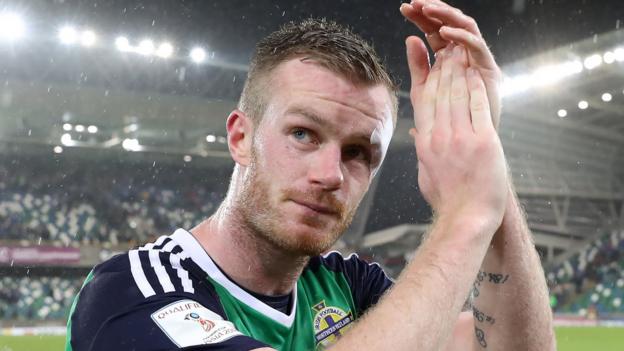
Brunt was regularly deployed by Michael O’Neill as a left-back for Northern Ireland in recent years
West Brom’s Northern Ireland midfielder Chris Brunt has retired from international football.
Brunt, 33, won 65 international caps and scored three goals after making his debut against Switzerland in 2004.
He missed out on Northern Ireland’s thrilling Euro 2016 finals campaign owing to a serious knee injury.
Brunt, who also featured at left-back, played his final game for his country in the 2018 World Cup play-off second leg against Switzerland last November.
O’Neill’s side drew 0-0 in Basel to lose 1-0 to the Swiss on aggregate and miss out on a place at this summer’s World Cup finals in Russia.
Manager Michael O’Neill left Brunt out of his recent squads to give the player time to consider his international future following the defeat by Switzerland.
Brunt scored one of his three international goals in the 4-0 win over Azerbaijan in November 2016
“I am disappointed Chris is retiring as I believe he still has much to offer the team, however I completely understand his decision to spend a bit more time with his young family and to concentrate on his club career,” said O’Neill.
“I want to thank him for everything he gave me on the pitch. He was a model professional and his contribution to the Northern Ireland team over the past 14 years will be remembered for a long time.”
Brunt played in eight of the games that saw Northern Ireland reach Euro 2016 – their first appearance in a major finals for 30 years.
Despite a knee injury ruling him out of the tournament, the former Sheffield Wednesday player travelled to France to support his team-mates.
His first and last goals for his country were free-kicks – the first away to San Marino in 2009 and the last against the Czech Republic at Windsor Park in September 2017.
He also scored the last of Northern Ireland’s goals in a 4-0 home World Cup qualifier win over Azerbaijan in Belfast in November 2016.
While a potential eruption of the supervolcano that lies beneath this iconic park may garner more alarming headlines, the more likely hazard is a major earthquake. USA TODAY
YELLOWSTONE NATIONAL PARK, Wyo. – While concerns about a potential eruption of the supervolcano beneath this iconic park may garner the most alarming headlines, a more likely hazard in the coming decades is a large earthquake.
“The biggest concern we have for Yellowstone is not with the volcano, it’s with earthquakes,” said Michael Poland, scientist-in-charge at the Yellowstone Volcano Observatory, a consortium of eight organizations led by the U.S. Geological Survey. “This is an underappreciated hazard in the Yellowstone area. There can and there will be in the future magnitude-7 earthquakes.”
On average, Yellowstone experiences 1,500 to 2,500 earthquakes a year, most of them so small they can’t be felt. But large quakes can – and have – occurred in the not-too-distant past.
On Aug. 17, 1959, a magnitude-7.3 earthquake rocked the park, killing 28 people when a massive landslide pummeled into a campground. More than 80 million tons of rock fell, blocking a river and forming a lake, aptly named Earthquake Lake, that remains today.
At the time, the quake was the second-largest to occur in the lower 48 states in that century. It remains the largest historical earthquake in the Intermountain West, a region between the Rocky Mountains to the east and the Cascade Range and Sierra Nevada to the west.
Compared to even a minor eruption of Yellowstone’s supervolcano, the threat of an earthquake on a similar scale happening again is more likely.
“That’s something that happens on a human life scale,” Poland said. But unlike a volcano, large earthquakes don’t show warning signs. “We can say where they are likely to occur, but we can’t say when.”
The hazards posed by a large quake today would be greater than what happened nearly 60 years ago due to a higher influx of visitors, especially in the summer. More than 4 million people visit Yellowstone every year, with peak visitation in July and August.
“It would be a lot worse today with more people in the area,” said Jamie Farrell, a geology professor at the University of Utah.
Yellowstone sits in a rural area with few roads. If one road goes out, it creates a huge detour, Farrell points out. If two roads become impassable, sometimes you can’t even get there by car.
“The good thing is that Yellowstone is one of the best seismically monitored regions in the world,” he said.
More than 40 seismic stations with the University of Utah continuously record the Earth’s movements in and around the Yellowstone region and report it back to the National Park Service.
“We can’t predict them, but by looking at past data, these earthquakes tend to cluster in areas,” Farrell said. “Given what’s happened in the past, we can give a probability of having an earthquake over the next X amount of time.”
Minor earthquakes rattle the park pretty much every day. But visitors wouldn’t know it: The quakes are so small, they’re only picked up on seismographs.
Scientists watch those quake swarms diligently, keeping a close eye on the timing, location and depth. “We’re well aware there is a potential, because it’s a dynamic system, that we might want to actually move people away from an area or close an area,” said Jeff Hungerford, the park’s geologist.
The Yellowstone system has two main contributors to its earthquakes: the volcanic system, which puts stress on the crust, and the tectonic system, which is represented here by an area of active stretching of the crust from east to west.
The earthquakes also play an important role in helping keepgeysers like Old Faithful rumbling. “We need this seismicity to keep these beautiful features alive because they clean the throat of many of our geysers and pools,” Hungerford said.
In addition to a major quake causing landslides and damaging or collapsing buildings and bridges, there’s another hazard: It could trigger a hydrothermal explosion, a mixture of hot water, hot mud and rocks that could injure people if they happened to be nearby at the time.
As for a large earthquake triggering a volcanic eruption: While that is possible, a lot of things would need to already be in play. The 1959 quake, for example, didn’t trigger a volcanic eruption.
“In order for a large earthquake to trigger a volcanic eruption, you probably already need to have an eruption almost ready to happen,” Farrell said.
Regardless, Farrell said visitors shouldn’t be on high alert for a geological event of any sort.
“We like to talk about these big, grandiose things happening like big earthquakes or large volcanic eruptions, but those are highly unlikely events,” he said. “You’re in much more danger driving to Yellowstone than you would be by any of these things happening while you’re there.”
Russia will begin S-400 missile system deliveries to Turkey in 2019 – a year earlier than previously announced.
The move comes amid a growing rift between Turkey and its NATO allies in the West.
“The contract on the S-400 to Turkey is being executed within the agreed timeline,” said Alexander Mikheyev, chief of Rosoboronexport, Russia’s state weapons exporter.
“In 2019, we will begin to fulfil this contract,” Interfax news agency cited him as saying on Tuesday.
Last year, the chief executive of S-400 manufacturer Rostec said the missile system deliveries would start in 2020.
Rosoboronexport also said it would switch to using local currencies in deals with foreign trade partners instead of using the US dollar, RIA news agency reported.
$2.5bn deal
Turkey will be the first NATO member state to acquire the advanced Russian surface-to-air missile system in a deal worth $2.5bn, Rostec’s Sergei Chemezov told Russian newspaper Kommersant in December.
The S-400 system, incompatible with NATO systems, is touted as being able to engage aerial targets within a 400km range.
US military officials and politicians have expressed concerns over Turkey’s intention to buy the Russian missile system.
The United States in recent weeks imposed sanctions against Turkey in an effort to effect the release of a US pastor allegedly linked to plotters of the country’s failed 2016 military coup.
The sanctions have played a role in sending Turkey’s economy into a tailspin.
Two days after shocking allegations surfaced that #MeToo leader and Harvey Weinstein accuser Asia Argento had sex with an underage boy and paid him hush money, the Italian actress finally responded: “I strongly deny” the claim, she said in a statement.
Her statement appeared on Twitter Tuesday, posted by New York magazine writer Yashar Ali. She decried the allegations, hinted she might take unspecified legal action, and lamented she is the victim of “long-standing persecution.”
“I am deeply shocked and hurt by having read news that is absolutely false,” her statement opened. “I never had any sexual relationship with (Jimmy) Bennett.”
Argento’s statement said that her late boyfriend, Anthony Bourdain, considered her accuser “dangerous” but decided Bennett’s need for money was worthy of “compassion.”
She said Bourdain, who committed suicide in June, helped arrange to pay Bennett $380,000. She did not mention Bourdain’s suicide or what role, if any, her arrangement with Bennett may have played in his death.
Bennett, a former child actor-turned-rock musician who is now 22, had just turned 17 when he claims he and Argento, then 37, had sex in a hotel room in Marina del Rey near LAX in 2013, according to a stunning New York Times story posted Sunday.
The paper said the story was based on an encrypted email the reporter received from an unknown source; it contained documents about the settlement between Argento and Bennett and her lawyer over his demand for compensation, and included a selfie of the two in bed.
The story said Bennett approached Argento in 2017 shortly after she went public with her accusation that Weinstein raped her, becoming one of the first women to do so. She thus called world-wide attention to herself and helped to set off the #MeToo movement to call out sexual abuse by powerful men in multiple industries, especially Hollywood.
Bennett and Argento were former cast mates in a 2004 movie she wrote, directed and starred in; Bennett was 7 and was cast as her son in the film.
Argento, who declined to comment to the Times when its story was published and did not return calls from USA TODAY on Monday, portrayed Bennett as opportunistic and in desperate need for money, having sued his own relatives for millions for allegedly mishandling money he earned as a child actor.
Argento acknowledged in her statement that she was “linked” to Bennett by “friendship only.” That ended when her role in accusing Weinstein became public in October 2017 and Bennett “unexpectedly made an exorbitant request for money from me.”
Her statement said Bennett knew Bourdain and “perceived” that he was wealthy with a reputation to protect.
“Anthony insisted the matter be handled privately, and this was also what Bennett wanted,” the statement said. “Anthony was afraid of the possible negative publicity that such person, whom he considered dangerous, could have brought upon us.
“We decided to deal compassionately with Bennett’s demand for help and give it to him. Anthony personally undertook to help Bennett economically, upon the condition that we would no longer suffer any further intrusions in our life.”
Argento’s statement, which may have been originally composed in Italian, said that this latest development “of a sequence of events” brings her “great sadness and constitutes a long-standing persecution.”
She said she had no other choice but to “oppose such false allegations” and will seek “all necessary initiatives” for my protection before all competent venues.”
So far, Argento’s lawyer, Carrie Goldberg, has not responded publicly to the allegations, even though the encrypted email the Times said it received included private messages between the lawyer and her client.
Bennett’s lawyer, Gordon Sattro, also has declined to comment, saying his client would continue to focus on his music.
But if the alleged encounter between Argento and Bennett actually did happen, it was a crime and the statute of limitations in California for child sexual abuse has not yet run out.
The Los Angeles County Sheriff’s Department, the police agency for Marina del Rey, said Monday there has been no report filed but detectives are aware of the reports and are looking into the matter.
“To date, the LASD has not located any police report alleging criminal activity within our jurisdiction in relation to this incident,” according to a statement posted online by Capt. Darren Harris of the Sheriff’s Information Bureau. “The LASD’s Special Victims Bureau is attempting to reach out to the reported victim and/or his representatives in an effort to appropriately document any potential criminal allegations.”
The People for Ethical Treatment of Animals just freed five circus animals — well…kind of.
The animals pictured on boxes of Barnum’s Animals Crackers have been released from their cages after PETA pressured Nabisco to redesign the snack’s box art.
According to a report from the Associated Press, PETA sent a letter to Nabisco’s parent company Mondelēz International in 2016 criticizing the box art that it said glorified the use of circus animals.
“Given the egregious cruelty inherent in circuses that use animals and the public’s swelling opposition to the exploitation of animals used for entertainment, we urge Nabisco to update its packaging in order to show animals who are free to roam in their natural habitats,” PETA wrote in the letter, according to the AP.
The company reportedly took what PETA said into consideration, and just recently made the change. The new boxes have started rolling out, and the animals are pictured cage-free and out in the wild. PETA Executive Vice President Tracy Reiman celebrated the change, telling the AP, “The new box for Barnum’s Animals crackers perfectly reflects that our society no longer tolerates the caging and chaining of wild animals for circus shows.”
While Nabisco reportedly didn’t really fight the issue much, the new change has gotten mixed reactions from Twitter.
Some are here for the new box art, and praised PETA for its advocacy:
Bravo @nabisco for freeing the animals. @peta spoke, and you listened. Been a fan since childhood. Pouring a big glass of milk to salute you.
I mean, sure, it’s a relatively silly thing to complain about, even for PETA, but… well, I have to hand it to Nabisco: the new design is just plain better looking than the old one. https://t.co/UUUYwlszfF
Other users feel that it was an unnecessary change:
PETA, rather than focusing all of its efforts on mistreatment of actual animals, instead chose to waste time and therefore money on stiff-arming Nabisco into redesigning the packaging for a box of crackers that nobody eats anymore.#mentalillnessonparadehttps://t.co/hGGcUgMC1l
Was there a negotiation Peta: How about Vegetable Crackers? Nabisco: well they aren’t made of different Vegetables so that would be confusing. Peta: How about inedible Animal Crackers? Nab: Look if we lose the cages will you leave us alone? Peta: Yesss… Another Win for Peta https://t.co/BYGW5AExZf
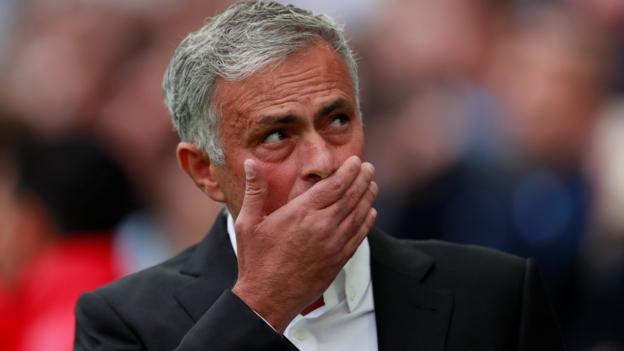
Jose Mourinho has never completed four seasons in charge of a club
Two Champions Leagues, eight domestic titles and 15 cup triumphs. Jose Mourinho’s sides know how to win – so why is it the Portuguese tends to bow out after three seasons at a club?
Just once has Mourinho made it into a fourth campaign, only to leave Chelsea before Christmas during his first spell at Stamford Bridge.
So what leads to Mourinho heading for the exit after season three? And do his sides actually perform worse than the previous two campaigns? BBC Sport examines the evidence.
Built for short-term success?
Having begun his managerial career with a short stint at Benfica, Mourinho enjoyed a successful half-season with Uniao de Leiria that led to Porto appointing the then 39-year-old in January 2002.
Porto:
2001-02: Climbed from fifth in the league to finish third after taking over in January
2002-03: Primeira Liga champions, Uefa Cup winners, Portuguese Cup winners
2003-04: Primeira Liga champions, Champions League winners, Portuguese Super Cup winners, joins Chelsea
Chelsea:
2004-05: Premier League champions, League Cup winners, Champions League semi-finalists
2005-06: Premier League champions, Community Shield winners
2006-07: Premier League runners-up, FA Cup winners, League Cup winners, Champions League semi-finalists
2007-08: Leaves club by mutual consent in September
Inter Milan:
2008-09: Serie A champions, Supercoppa Italiana winners
2009-10: Serie A champions, Champions League winners, Coppa Italia winners, joins Real Madrid
Real Madrid:
2010-11: Copa del Rey champions, La Liga runners-up, Champions League semi-finalists
2011-12: La Liga champions, Champions League semi-finalists
2012-13: Supercopa de Espana winners, Champions League semi-finalists, Copa del Rey runners-up. Leaves Real by mutual consent
Chelsea:
2013-14: Third in Premier League, Champions League semi-finalists
2014-15: Premier League champions, League Cup winners
2015-16: Leaves Chelsea in December
Manchester United:
2016-17: Europa League champions, League Cup winners, sixth in Premier League
2017-18: Premier League runners-up, FA Cup runners-up
2018-19: ?
Mourinho won the title in his first two seasons at Chelsea
The form book
Mourinho’s league win percentage by season
Season one
Season two
Season three
Season four
Porto
73.3% (15 games)
79.4% (86 points)
73.5% (82 points)
–
Chelsea
76.3% (95 points)
76.3% (91 points)
63.2% (83 points)
50% (after six games)
Inter
65.7 % (84 points)
63.2% (82 points)
–
–
Real Madrid
76.3% (92 points)
84.2% (100 points)
68.4% (85 points)
–
Chelsea
65.7% (85 points)
68.4% (87 points)
25% (after 16 games)
–
Man Utd
47.3% (69 points)
65.7% (81 points)
50% (after two games)
–
What happens in season three?
Leaving Porto on a high: Two-and-a-half seasons after taking charge, Mourinho left Porto after delivering the Champions League as part of a remarkable treble.
The end at Chelsea, part one: Having won both domestic cups and finished second in the league in his third season, the Blues’ fourth campaign under the Portuguese manager got off to a stuttering start and a 1-1 draw at home to Rosenberg in the Champions League saw the reign of the ‘Special One’ come to an end.
Inter: Mourinho left after two seasons.
Runners-up at Real Madrid: With two games left of the season, it was announced Mourinho would leave Real Madrid. At the time, his side trailed Barcelona by 13 points and had lost the Spanish Cup final to Atletico Madrid, as well as being knocked out of the Champions League at the semi-final stage.
Chelsea, part two: Sixteen league games, just four wins and languishing one point above the relegation zone – Mourinho’s tenure was up at Chelsea for a second time, just seven months after he had delivered them a title.
What are the early signs during Mourinho’s third season at Manchester United?
Defeat at Brighton on Sunday, following an unconvincing win over Leicester at Old Trafford on the opening day, has done little to dispel the notion of a ‘third-season syndrome’.
They host Tottenham at Old Trafford next.
Friction and fallouts – who’s to blame?
Mourinho fell out with Real Madrid players after dropping goalkeeper Iker Casillas
Mourinho’s departures from both Chelsea, twice, and Real Madrid have followed high-profile fallouts and fractious relationships with both club officials and players.
Do things always come to a head for Mourinho during his third season?
Leaving Porto on a high: Mourinho’s knee slide at Old Trafford as his side knocked out Manchester United in the Champions League may have irked Sir Alex Ferguson, but there were no complaints in Porto as he left the club a hero.
Tension at Chelsea: Mourinho’s relationship with Blues owner Roman Abramovich became increasingly strained and was not helped when the Russian billionaire bought Andriy Shevchenko for £30m from AC Milan – a player the manager was reluctant to pick.
Tensions bubbled in the January of Mourinho’s third season, when he was reportedly unhappy over having a lack of funds to sign players. The pair also disagreed over the arrival of director of football Avram Grant in the summer, who then replaced Mourinho as manager in September.
Winning at Inter: Mourinho didn’t make it to a third season at Inter, announcing after the Champions League victory he was “sad, as almost for sure it’s my last game with Inter”, and adding “if you don’t coach Real Madrid then you will always have a gap in your career”.
Boiling over at the Bernabeu: “Nobody’s been sacked,” said Real Madrid president Florentino Perez when announcing Mourinho would leave the Bernabeu, but the announcement followed a string of public arguments with some of the club’s key players:
Mourinho drops iconic goalkeeper and club captain Iker Casillas, who alongside defender Sergio Ramos is then forced to issue a statement denying they threatened to be transferred if the manager was not sacked.
Portugal defender Pepe says he regrets the handling of Casillas, with Mourinho responding by saying the player’s problem was “Raphael Varane” – a rival for Pepe’s place in the team.
Club chairman Perez calls a news conference to address the reports, also denying rumours of in-fighting between Mourinho and club directors.
Feeling blue, again: The Blues’ medics felt the wrath of Mourinho in his last season at Stamford Bridge. The Portuguese called them “impulsive and naive” for running on to treat Eden Hazard during a draw against Swansea. Eva Carneiro and Jon Fearn saw their positions downgraded.
Carneiro left the club in the September, eventually settling a dismissal claim against the club the following year.
Then, after a defeat by Leicester City that would prove his last game in charge, Mourinho called out his players.
“I’m frustrated with the difference between what they do in training and what they do in matches. I don’t think in this moment they can feel they are top players or they can feel they are superstars.”
Carneiro (centre) settled a dismissal claim against Chelsea and also reached a discrimination settlement against Mourinho
Same again for Jose?
Will Mourinho’s third season at Old Trafford be marred by similar disagreements?
A tetchy news conference following a 4-1 pre-season defeat by Liverpool suggested Mourinho was far from happy before the season had even began. Back then, he said:
If he was a fan, he would not have paid to watch the teams, adding “this is not even 30% of my squad”.
The match “gave me nothing at all” and he was trying to avoid “ugly defeats”.
Antonio Valencia had “too much holiday” and returned in poor condition.
More recently, Mourinho tried to quash reports of Paul Pogba being unhappy.
Paul Pogba, 12 August 2018: “If you’re not happy, you cannot give your best. There are things I cannot say otherwise I will get fined.”
Jose Mourinho, 17 August: “I cannot demand more from him, I cannot ask more from him. I’ve never been so happy with him as I am now.”
But Mourinho was also frustrated by United’s lack of activity in the transfer window, saying his side are in for a “difficult season”.
The question is, will he be in charge come the end of it?
The counter-argument…
Bar his second spell at Chelsea, when he departed before Christmas, Mourinho has delivered silverware in each of the third seasons he has had at a club.
At Porto this was a treble that put the charismatic Portuguese boss on the map, while during his first spell at Chelsea Mourinho’s side won both domestic cups and at Real Madrid he won the Spanish Super Cup in his final season.
But what would be deemed a season of success for many sides is regarded as a minimum requirement at the calibre of clubs Mourinho manages.
He set the bar high at Chelsea, winning back-to-back Premier League titles, but was unable to deliver the Champions League title Blues owner Abramovich so craved.
The Portuguese also failed to achieve European success at Real Madrid, while finishing adrift of Barcelona in the La Liga and lost in the Copa del Rey final to rivals Atletico Madrid before his departure.
There’s a fine line between third-season success and third-season ‘syndrome’, it seems.
Never one to seek attention, father Rob Tibbetts says his daughter Mollie Tibbetts has an ability to connect with everyone she meets. Luke Nozicka, lnozicka@dmreg.com
A body was found Tuesday morning in rural Poweshiek County, Iowa, and officials are working to identify it, said Iowa Division of Criminal Investigation Assistant Director Mitch Mortvedt.
Iowa DCI is holding a press conference regarding the Mollie Tibbetts investigation with “a very significant update,” at the Poweshiek County Sheriff’s Office at 4 p.m. central time Tuesday, said Mortvedt.
Nobody has been charged yet in relation to the case, Mortvedt said.
Fox News and CBS have reported that it’s the body of Mollie Tibbetts, a missing University of Iowa student from Brooklyn, Iowa, who disappeared over a month ago.
Greg Willey, the vice president of Crime Stoppers of Central Iowa, told the Associated Press a body was found Tuesday and is believed to be Tibbetts. Her father, Rob Tibbetts, declined to confirm the information to the Des Moines Register.
More specific information on where the body was found has not been released.
No one was being held overnight or had been brought in to the Poweshiek County Jail as of Tuesday morning, a jail employee there said.
The nearly $400,000 reward for Mollie Tibbetts’ discovery will now become a reward for information leading to the capture of any suspects involved in her death, Willey said.
A press conference will be held at the Poweshiek County Sheriff’s Office at 4 p.m. central time Tuesday, Iowa DCI Special Agent Mike Krapfl said.
A new dating show is coming to town and we can only hope it’s going to be as refreshing as it sounds.
While dating shows on TV are always drama filled and generally fun to watch, they also tend to focus almost exclusively on dating between straight people.
The Bi Life will be the title of the new dating show on E! UK and Ireland, focusing on bisexual+ dating, meaning dating between people who identify as bisexual, pansexual or questioning. It will the the first dating show in the UK to focus exclusively on the bisexual+ dating experience.
Coming to our screens in October, the ten-part show will send a group of singles looking for love to Barcelona to party, date, and “navigate the rocky road of bisexual+ dating,” according to E!
The show will be hosted by drag queen Courtney Act, who is perhaps best know as a contestant in RuPaul’s Drag Race.
“In 2018 we know that sexuality is fluid and sharing the stories and experiences, the laughter and the love making, of young bi people is so important,” Courtney Act told E!.
Kim Sanders, Head of Media Engagement at the UK LGBTQ rights organisation Stonewall, told Mashable The Bi Life is an important step in the right direction for bisexual people.
“It’s great to hear there will be a new dating show about bi people,” says Sanders. “Representation is so important, especially for bi people who continue to be seriously underrepresented in mainstream media.”
“We hope this show will breakdown harmful stereotypes as well as exploring the unique challenges that bi people face when it comes to dating, whether that’s having to come out to their partner or using dating apps that force you to pick a gender,” says Sanders.
Up until now, bisexual representation on dating shows has been rare — apart from the occasional bisexual contestant on mainstream dating shows.
Only a few modern dating shows have been centred around bisexual dating, an example being MTV’s 2007 reality dating show A Shot At Love With Tila Tequila, where both men and women competed to date the bisexual television personality. Earlier this year Australia got its first bisexual dating show What’s your Flava?
We are so ready to obsess over every interaction on The Bi Life.



 (@yashar)
/https%3A%2F%2Fblueprint-api-production.s3.amazonaws.com%2Fuploads%2Fcard%2Fimage%2F831762%2F030d4f28-a340-42a3-9b94-05cb2fb02c5c.jpg)




/https%3A%2F%2Fblueprint-api-production.s3.amazonaws.com%2Fuploads%2Fcard%2Fimage%2F831548%2F5f4fbd9d-6d41-462d-9cf0-90ef2801eecc.jpg)


 trendynewsday