YouTube’s women of STEM make learning about science fun

news image

This post is part of Mashable’s ongoing series The Women Fixing STEM, which highlights trailblazing women in science, tech, engineering, and math, as well as initiatives and organizations working to close the industries’ gender gaps.

Learning shouldn’t stop after school ends, and the women of YouTube’s STEM channels prove that.

These aren’t the boring science lessons that you had to sit through in stuffy high school classrooms or massive college lecture halls. There are no tests, no grades, and no assignments. You will, however, need a sense of curiosity and a love for all things science. 

If you’re driven by a desire to learn new things, check out these six women who are making STEM more accessible. 

After noticing the lack of female students in computer science, computing and ITC teacher Carrie Anne Philbin decided to start making educational videos about coding. Her channel Geek Gurl Diaries includes tutorials and interviews with inspirational women in STEM. Since creating Geek Gurl Diaries, Philbin has become the Director of Education at the Raspberry Pi Foundation, where she creates learning resources for people interested in learning programming. 

“By exposing students to the range of creative and exciting scientific careers in technology,” she says on her website, “they may discover an interest in a field they had previously dismissed.”

Dianna Cowern hosts a PBS digital series called Physics Girl, where she experiments with zero-gravity and DIY electric trains. With a background in physics from MIT and the Harvard-Smithsonian Center for Astrophysics, Cowern is driven by educating the curious. Her channel covers a wide variety of topics from explaining what stretching does for the body to demonstrating the theory behind vortexes.

Have you ever wished you could know the backstory behind museum artifacts? YouTuber Emiliy Graslie’s channel dives into what goes on behind the scenes at the University of Montana Zoological Museum. 

As the “Chief Curiosity Correspondent,” Graslie tries to explain why natural history museums are so important to society. Her channel has it all, from exploring the origins of a rare bird specimen donated to the museum by a murderer to showing her viewers why the museum keeps a rusty car door in its collection. 

Have you ever wondered what happens to astronaut poop? Or how NASA managed to take pictures of Neil Armstrong on the moon? Ami Shira Teitel has the answers. As a Spaceflight historian and author, the self-proclaimed “space history nerd” runs a channel dedicated to explaining the history of humans in space. 

“If there is a link to the past to any modern mission,” she says in her channel trailer, “I will find it and I will talk about the roots of it.”

Alex Dainis is a PhD candidate at Stanford University and runs a YouTube channel inspired by her love of genetics. She interviews fellow scientists, unpacks complicated theories so that someone without a science degree can understand them, and even answers questions about her program. 

She also shows her viewers what it’s like to be a grad school student, from giving video lab tours to discussing the logistical nightmares that researchers face when conducting experiments. 

Buying beauty products can be an overwhelming experience — in addition to figuring out what looks good, you have to decipher the ingredients, too. Trina Espinoza’s channel breaks down the complicated chemicals that fill the labels of your favorite products. From pointing out what you should look for in sunscreen to explaining how the heck micellar water works, Espinoza’s channel helps you understand exactly what you’re putting on your face. 

As Espinoza says in her channel trailer, “I believe you shouldn’t need a PhD in chemistry to understand what’s in your beauty products.” 

These are just a few women breaking down STEM topics on YouTube. Research shows that seeing women in STEM careers encourages girls to pursue learning about those topics — and right now women hold only a quarter of STEM jobs. 

Beyond inspiring young viewers, these STEM YouTubers are encouraging them to be lifelong learners. 

Https%3a%2f%2fblueprint api production.s3.amazonaws.com%2fuploads%2fvideo uploaders%2fdistribution thumb%2fimage%2f86440%2f97ac4080 22c0 4438 a09f 219ea9a3ab82

Read More

from Trendy News Day https://ift.tt/2BsI6Sx
via IFTTT

Deadly cattle raids in Zamfara: Nigeria’s ‘ignored’ crisis

news image

Zamfara state, Nigeria – Besides Boko Haram attacks in northeastern Nigeria and the pastoralist crisis across the central region’s lush vegetation belt, a lesser-known conflict is brewing in the northwest, and casualties are rising.

Cattle thieves are carrying out daily killings and kidnappings in Zamfara state. 

Hundreds have died this year alone.

In early August, 22-year-old Zuleiya Kura braved a two-day trek in the bush with her four children – including 40-day-old twins – to escape the violence.

The young family fled their village of Kanya to Zurmi town, both in Zamfara state, after cattle rustlers on motorcycles stormed her hometown with AK47s.

Her husband, the family’s breadwinner, is missing. He had stayed behind with other men to defend Kanya and no one knows if they were killed or managed to escape.

“We all deserted the town after we heard that the bandits have come,” says Kura, from the safety of a government-owned Arabic school housing more than 6,000 displaced people from across the state – all of whom were impacted by the same violence. “They were chanting Allahu Akbar.”

Zuleiya Sura, 22, and her children survivied a two-day trek in the bush to escape the attackers [Eromo Egbejule/Al Jazeera]

Zamfara state is home to 4.1 million people and more than 90 percent are Muslim. It was the first Nigerian state to adopt Islamic law, in 2000.

Cattle rustling, which has long afflicted northern Nigeria, has assumed a dangerous dimension in recent years, say residents and analysts.

The many forests in the area, especially the twin forests of Mashema in Zamfara’s north bordering nearby Niger Republic and Birnin Gwari to the south leading to the neighbouring, equally insecure state of Kaduna, have served as bases for criminals who stockpile sophisticated weapons.

According to an estimate from Amnesty International, at least 371 people have been killed in Zamfara state alone since January. 

Zamfara is our laboratory for conflict resolution. How we resolve it, if we can resolve it, will determine whether we can resolve future conflicts.

Cheta Nwanze, head of research at Lagos-based SBM Intelligence

In July this year, young people incensed by the frequent killings burned down a police station in the town of Zurmi after policemen refused to release three suspected bandits to them for vigilante justice.

“The situation in Zamfara is nothing new and has been building for years since the state adopted [Islamic] law as a placebo to respond to economic challenges,” explains Cheta Nwanze, head of research at Lagos-based SBM Intelligence.

“Zamfara is one of Nigeria’s poorest states, and there is circumstantial evidence that some of the perpetrators of violence may have been part of the enforcement brigade of that law almost two decades ago. Having said that, the seeming escalation is indicative of the wider issue in Nigeria where there is less money to go round and a larger population struggling for dwindling resources.”

Nigeria’s law enforcement agencies are understaffed and with its army stretched thin by other conflicts, the cattle-rustler crisis has continued unabated mostly in Zamfara but also Kaduna, Katsina, Niger and, recently, Sokoto states. 

Kidnappings and vigilantism

Two military exercises codenamed Operations Sharan Daji (Hausa for Sweep the Forest) and Harbin Kunama (Hausa for Scorpion Sting) set up in previous years, have proved unable to curb the attacks.

A dusk to dawn curfew, imposed again after being lifted in 2016, is not fully enforced either.

Encouraged by the failure to stem the violence, the perpetrators have also taken to indiscriminate kidnapping-for-ransom schemes across major highways, killing locals in communities after stealing their cows and abducting women and forcing them into sex slavery. There have also been a few cases of artisanal gold miners being robbed of their gold and then killed.

The attackers tend to arrive on Honda motorcycles, says Sokoto-based taxi driver Abdullahi Abubakar.

“They park across the road and look inside vehicles they stop for those with fine skin or well-dressed [people] that look like they have money. Then they kidnap you and ask you to call your people to pay millions. Recently, they took one expatriate engineer working on a project in [Zamfara] and kept him for 12 days, feeding him well until a ransom of N30 million ($83,100) was paid.”

A displaced man stands outside the makeshift clinic in the camp at Zurmi in Zamfara state [Eromo Egbejule/Al Jazeera]

Young people in several affected communities have formed local vigilante groups, arming themselves with sticks, Dane guns and crude weapons available for self-defence in case of reprisal attacks by ethnic militia.

The bandits are mostly Fulani mercenaries attacking predominantly Hausa settlements, with some criminal elements among the ethnic militia also instigating their own attacks in similar patterns, says the state government.

“After our ban of Yan Banga (vigilante) and allowances stopped, some transformed into Yan Sakai (volunteer forces) to revenge on Fulani people and some of them became criminals,” said Ibrahim Dosara, a government spokesperson. “When we discovered that they were now part of the problem, the government banned them again.”

‘Our equivalent of black-on-black crime’

The crisis has largely gone under the radar as both media and the government focus on rumblings elsewhere in northern Nigeria. 

Some analysts also believe the conflict is considered less pressing because it is an example of “Muslim-on-Muslim” violence.

“In Nigeria, we like our binary fixtures – Muslim versus Christian, Igbo versus Hausa, Fulani versus Yoruba,” said Nwanze, the researcher. “Most of us can’t process anything outside of those binaries, and since Zamfara doesn’t fit any of those binaries, and is our equivalent of black-on-black crime, it is largely ignored. However, Zamfara is our laboratory for conflict resolution. How we resolve it, if we can resolve it, will determine whether we can resolve future conflicts.”

In June, apparently frustrated by the situation, Zamfara governor Abdulazeez Yari told reporters that he was powerless in his role as chief security officer of the state. 

“We have been facing serious security challenges over the years, but in spite of being governor and Chief Security Officer of the state, I cannot direct security officers on what to do nor sanction them when they err,” he said. 

Yari, who has been criticised for weak leadership and living outside his state on a regular basis, has no control over the internal security infrastructure because, in accordance with Nigeria’s constitution, law enforcement apparatus is controlled wholly by the federal government.

Dosara, the government spokesperson, says in 2016, the state government convened a series of reconciliatory meetings with two main suspected leaders of the attacks, Dogo Gide and Buharin Daji. Both are Fulani.

“We initiated a disarmament and reconciliation process which succeeded in recovering over 3,000 different types of arms comprising machine guns, AK47s, locally made pistols, revolvers and other ammunition … and they took payments. Just about four months ago, they [the weapons] were destroyed before international organisations.” 

Not long after the suspected leaders surrendered their weapons and were paid off an undeclared sum, Daji broke the brief ceasefire. 

Nicknamed General Buharin to mimic the title of Muhammadu Buhari, the retired general and Nigeria’s president, Dajin went rogue.

One of the communities he attacked and stole cows from was a small village in the Dansadau area of the state, the hometown of Gide’s wife. 

Gide, exasperated by Daji’s refusal to return his booty, pretended to extend an olive branch to his former ally – and killed him.

A few weeks ago, the army shot dead Daji’s teenage heir after a run-in between his gang and security officials. 

Still, the kidnappings, killings and general instability are yet to end.

Buhari’s belated response

Calls for communal policing have resurfaced as the government at state and federal levels deliberate on how to ease the crisis. 

“It is both a case for communal policing since the locals know many of the perpetrators, and a cautionary tale about communal policing without proper training and funding. Eventually, these people will turn those weapons against the very people they are meant to protect,” warns Nwanze.

In a belated response in July, President Buhari – who came to power in 2015 vowing to tackle insecurity – deployed a 1,000-man strong military contingent from the army and air force to embark on yet another military exercise, Operation Diran Mikiya (Hausa for Eagle Fighting). 

“Buharin Daji is the main rustling and kidnapping guy in-country and he’s supposedly a Nigerian,” says Beegeagles, a popular anonymous military intelligence blogger.

“In northern Zamfara, there are far more menacing guys coming in from Niger [Republic] … most of whom go unchallenged, given the negligible security. Everything that spells cash – gold, cattle, kidnapping – feeds into the conflict.”

Read More

from Trendy News Day https://ift.tt/2MEDSeP
via IFTTT

Chris Ashton: Sale Sharks winger could face ban after red card

news image

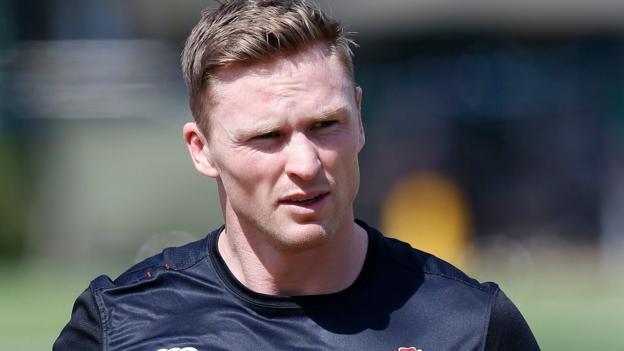
Chris Ashton has scored 19 tries in 39 games for England

England and Sale winger Chris Ashton is facing a ban after punching Castres’ Rory Kockott in a pre-season friendly.

Ashton, 31, was sent off along with Kockott by referee Romain Poite after the incident early in the second half of Sale’s 20-17 win on Friday.

The referee is set to deliver his report to the RFU on Monday.

Ashton could miss the first three games of the new Premiership campaign, as suspensions for punches to the head usually start at four weeks.

The red card came in only his second game for the Sharks, having joined from Toulon in the summer.

Sale begin their league season on 1 September against Harlequins at the Twickenham Stoop, followed by fixtures against Worcester and Exeter.

Ashton was named in England’s training squad earlier this month after a four year absence from international rugby.

In 2016 he was banned for 13 weeks after being found guilty of biting Northampton prop Alex Waller.

Read More

from Trendy News Day https://ift.tt/2L8zxfe
via IFTTT

Men arrested after allegedly stealing $192,800 from Alabama casino

news image

CLOSE

Wind Creek Montgomery Hotel Opens on Monday Dec. 21, 2015.

Federal prosecutors have arrested two men, including a former employee, for allegedly stealing $192,800 from Wind Creek Montgomery casino last week after an employee left keys on top of a gaming kiosk.

The former employee Jory D’Michael Travunn Dumas and Timothy Dean Pettiway were arrested Tuesday and are both charged with theft from a gaming establishment on Indian lands for the Aug. 10 heist, according to federal court documents.

The cash was stolen from two kiosks, or cash machines, after a casino employee checked out the keys and left them atop a kiosk.

UPDATE: Former casino employee dismissed; other suspect denied bond in Wind Creek Montgomery casino heist case

Dumas, Pettiway’s nephew, was dismissed from the case Friday after prosecutors said the initial investigation had incorrectly identified him as the one who picked up the keys from the kiosk.

CLOSE

Reporter Gabe Hauari didn’t have that much fun this morning. The FBI’s Louisville field office let local media to take the test, and it was intense.
Marty Pearl, Special to Courier Journal

An FBI review of Wind Creek’s security footage found that Pettiway was the one to take the keys.

But U.S. Magistrate Judge Gray Borden on Friday advised Dumas that though his charge had been dismissed, the prosecution could still present charges against him to a future grand jury. 

Court documents allege casino employee Courtney Stanton checked out keys to kiosks 8 and 19, while surveillance footage showed her leaving the keys on top of a machine and walking away before Pettiway retrieved the keys. 

Footage in court Friday showed a man alleged to be Pettiway taking one cash box from kiosk 19. While the kiosk houses multiple cash boxes with bills of different denominations, court testimony revealed, Pettiway allegedly removed the box of $100 bills.

Pettiway then took the box into a restroom Dumas was known to be in. Pettiway later exited, walked to kiosk 8, and repeated the procedure.

Around the same time, another casino employee noticed Machine 8 wasn’t working properly. Stanton told tribal police she reported her keys missing to her supervisor and notified security. 

Casino security entered the restroom to find empty cash boxes in the handicapped stall from machines 8 and 19. 

“Financial records obtained from the Casino reflect $100,800 in $100 bill denominations are unaccounted for from the dispenser cassette assigned to Kiosk machine #8 and $92,000 in $100 bill denominations are unaccounted for from the dispenser cassette assigned to Kiosk machine #19,” court documents state.

CLOSE

Do you know what to do if you see something bad happening? Here are some tips.
Wochit

Read more local news:

Read or Share this story: https://ift.tt/2L1QzvC

Read More

from Trendy News Day https://ift.tt/2vYVIjr
via IFTTT

This viral Twitter story is the perfect reminder that it’s never too late to chase a dream

news image

Kathryn Joosten (left) in 'Desperate Housewives'.
Kathryn Joosten (left) in ‘Desperate Housewives’.

Image: Danny Feld/ABC via Getty images

It’s all very well and good when people go on about chasing your dreams, but surely all that stuff is just wishful thinking, right? Don’t the realities of life often mean that ambitions are too often simply not practical to achieve?

Well, maybe. But not always.

On Sunday, writer Charlotte Clymer shared the story of Kathryn Joosten, who began her acting career at the age of 40. 

Here’s the thread, in full:

So there you have it. No matter how far out of reach a goal may seem, it doesn’t mean it’s unattainable.

Https%3a%2f%2fvdist.aws.mashable.com%2fcms%2f2018%2f3%2ff1e21783 3eba fba2%2fthumb%2f00001

Read More

from Trendy News Day https://ift.tt/2Laf7me
via IFTTT

Lebanese FM: No reason for Syria refugees to stay in Lebanon

news image

Lebanon’s Foreign Minister Gebran Bassil has said parts of neighbouring Syria are peaceful and stable, adding that his country sees no reason for Syrian refugees to remain on its territory.

Bassil’s remarks at a news conference on Monday came after talks with his Russian counterpart Sergei Lavrov in Moscow.

Several thousand Syrian refugees in Lebanon have started to return to their homes in Syria voluntarily in recent months. About one million Syrian refugees have been registered by the United Nations in Lebanon.

Some Lebanese officials have been pushing for speedy returns, but the UN and human rights groups say conditions are still not safe in Syria.

US ends Syria stabilisation plan worth more than $200m

The Middle Eastern country also said it wanted Russian companies to compete in a new tender to develop oil and gas deposits in Lebanon.

The project would encourage regional stability if a Russian company successfully secured the tender, Bassil said.

He also said Lebanon should serve as a platform for the economic revival of Syria, and ensured Beirut would coordinate its efforts with Moscow, the Interfax news agency reported.

Lavrov has also asked the secretary general of the United Nations why the organisation is not participating in Syria’s reconstruction.

Russia has been attempting to garner international support for the reconstruction of war-torn Syria.

On Saturday, Russian President Vladimir Putin spoke about international reconstruction efforts and the humanitarian situation in Syria with German Chancellor Angela Merkel in Berlin.

“It’s important to help those areas that the refugees can return to,” said Putin, whose decision for Russia to militarily intervene in Syria’s conflict in 2015 tilted the odds in favour of Syrian President Bashar al-Assad who has regained large swathes of land from armed rebel groups.

“I think it’s in everyone’s interests, including Europe’s,” Putin had said.

SOURCE: Al Jazeera and news agencies

Read More

from Trendy News Day https://ift.tt/2MsL2Uw
via IFTTT

Jimmy McIlroy: Former Burnley & Northern Ireland forward dies

news image

Jimmy McIlroy scored 10 goals in 55 caps for Northern Ireland

Former Burnley and Northern Ireland forward Jimmy McIlroy has died at the age of 86.

McIlroy played 497 games for the Clarets between 1950 and 1962, winning the old First Division title in 1960.

He made 55 appearances for his country, scoring 10 goals between 1951 and 1965, and helped them reach the World Cup quarter-finals in 1958.

Burnley said they were “deeply saddened to learn of the death of our greatest ever player”.

A club statement added: “A giant of a man. The thoughts of everyone connected with the club are with his family and friends at this sad time.”

McIlroy started his career at Northern Irish club Glentoran in 1949 before moving to England with Burnley one year later. He went on to score 131 goals during a time the club describe as their “golden age”.

Having won the league the year before, the Clarets reached the quarter-finals of the European Cup in 1961, losing 5-4 on aggregate to Hamburg, and in the following season they finished as league and FA Cup runners-up.

After leaving Burnley in 1962, McIlroy made 116 league appearances for Stoke before moving to Oldham and retiring from playing in 1967.

He was appointed Oldham manager in 1965 but left in 1968, and also took charge of Bolton for a brief period in 1970.

At the World Cup in 1958, McIlroy and his Northern Ireland team-mates, captained by Tottenham great Danny Blanchflower, were beaten 4-0 by France in the last eight.

An Irish Football Association statement read: “The association is saddened to hear of the death of Jimmy McIlroy, one of Northern Ireland’s greatest ever players. He was one of the heroes of the 1958 squad.”

Burnley’s Turf Moor stadium has a stand named after McIlroy and he was given a testimonial by the club in 2009.

In 2011, he was made an MBE for services to football and to charity, deciding to receive the honour at Turf Moor instead of travelling to Buckingham Palace.

In the years following his retirement from football, he worked as a writer for local newspaper the Burnley Express.

‘An Italian villa? I’d rather stay in Burnley’

McIlroy, pictured here at home in Burnley in 1963, said he “even had a chance to go to South America”

In an interview with the Belfast Telegraph in 2008, McIlroy revealed he turned down lucrative offers to leave Burnley, including one from Sampdoria.

He said the Italian club’s manager met him on the morning of the 1962 FA Cup final, which the Clarets lost 3-1 to Tottenham, and “promised me all sorts; a villa overlooking the Mediterranean, an international school for my children, wages way beyond what I was getting in England”.

McIlroy added: “But when I went back to the hotel and told my wife she said to me: ‘What would we want to leave Burnley for?’

“I even had a chance to go to South America, River Plate in Argentina, at the age of 31 when I went on tour with Stoke there.

“Again I rang my wife and said there’s good money here etc and she just said: ‘Sure, but what would we want to leave Burnley for?’

“I’ve never regretted it. From the moment I arrived it felt like home and it has been home.”

Read More

from Trendy News Day https://ift.tt/2nTzH0S
via IFTTT

In Donald Trump era, a GOP leader looks to recast his party’s image with black voters

news image

CLOSE

Rep. Mark Walker, chair of the Republican Study Committee, is looking beyond Trump and building a GOP on the 2012 “autopsy report” recommendations.
USA TODAY

WASHINGTON – At an elite gathering of Republicans in the resort town of Jackson Hole, Wyoming this month, Rep. Mark Walker gave a speech urging the party to do more to reach out to African-Americans, Hispanics and other people of color.

At the forum attended by influential conservatives such as House Speaker Paul Ryan and former presidential adviser Karl Rove, Walker elaborated on a message he has delivered in other private conversations with Republicans. Walker’s message resonated enough with the audience that after the event, Rove reached out to talk further.

But the next morning, Walker’s party was dealing with fallout from a different message on race, when President Donald Trump called his former aide Omarosa Manigault Newman, a black woman, a “dog.” 

“That would not be my terminology,” Walker said of Trump’s comment during a telephone interview late last week with USA TODAY.

The uproar over Trump’s comment highlighted a central challenge for Walker, who leads the Republican Study Committee, the largest group of conservatives in the House. He said he is intent on building bridges between the party and African-Americans. But many of Trump’s remarks could help to energize black voters to go to the polls to vote against the GOP in this year’s midterm elections. 

Walker, an affable former pastor, represents a North Carolina district that is one-fifth African-American. He is championing criminal justice reform and adequate funding for historically black colleges and universities, issues that are high priorities for many African-American voters.

Walker spokesman Jack Minor said the lawmaker is working on legislation that would allow student athletes – many of whom are black – to be compensated for their publicity rights. Walker also has hosted two Washington summits with HBCU leaders, meetings that helped pave the way for year-round Pell grants for HBCU students. He teamed up with North Carolina Democratic Rep. Alma Adams to establish an internship program for students from HBCUs.

Walker also was the first Republican in years to give a keynote address at the North Carolina Legislative Black Caucus Foundation dinner in June. All of the group’s members are Democrats.

Uphill battle

But Walker’s quest is an uphill battle given the antipathy toward Trump among black voters and the fact that they overwhelming identify as Democrats.

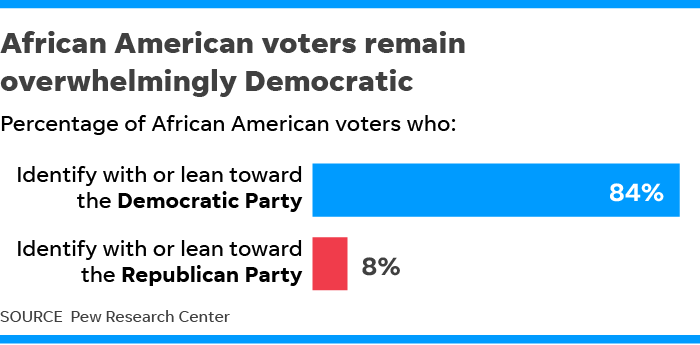
According to Pew Research data, African-American voters are overwhelmingly Democratic, with 84% identifying or leaning left. Only 8% of black voters identify with the Republican Party. 

“We’re in a place where we are kind of in a hole digging out when it comes to how we deliver our message,” Walker told USA TODAY, acknowledging the challenges for his party. While Walker’s district has a larger proportion of African-Americans than those of many other GOP lawmakers, he said that’s not the only reason he cares about the outreach.

“This is much larger than my district. I’m trying to lead by example,” he said. Walker won his last election by 18 percentage points and is heavily favored to win re-election in November.

Walker is not the first senior Republican to call for reaching out to minority communities, which are a growing share of the population. Following Mitt Romney’s defeat in the 2012 election, the national party commissioned the “Republican National Committee’s Growth and Opportunity Project,” also known as the “autopsy report.” Its findings showed the GOP needed to diversify to survive.

Walker took the findings to heart during his first run for Congress in 2014, when he sought the support of local Democratic leader the Rev. Odell Cleveland. It took three meetings for Walker to win over the pastor, including a chat in Cleveland’s office, coffee together at McDonald’s and a small group lunch they attended together. 

“I’m a lifelong Democrat and proud of it, but I just believe we have to find common ground,” Cleveland said. He added he still “vehemently” disagrees with some of Walker’s votes, like one to repeal the Affordable Care Act, but he likes him.

Trump won big among white working-class voters in the 2016 presidential election. But even before his campaign began, he had angered many people of color with his effort to prove President Barack Obama was not born in the United States. Then during his campaign he made racially charged comments, such as suggesting that Mexican immigrants were rapists. 

Since taking office the president has further fanned racial flames by questioning why the U.S. would let in people from “shithole countries,” referring to Haiti and African countries, and said that “many sides” were to blame after a white supremacist rally turned deadly in Charlottesville, Virginia, last year.

Arizona Sen. Jeff Flake – a frequent Trump critic who is retiring – was the only Republican to immediately speak out about Trump’s “dog” remark about Manigault Newman on Tuesday.

Walker weighed in later in the week during the USA TODAY interview but said he didn’t think it was the responsibility of Republican lawmakers to criticize every comment the president makes.

“I think on a lot of racial things, a lot of us have pushed back, but is a member of Congress’ responsibility to re-correct and address every statement the president makes?” Walker said. ”I don’t know if that’s part of our responsibility, especially when there are enough things that have come out of the White House.”

Some African-Americans say that unless Republican lawmakers strongly disavow Trump’s comments about minorities, their efforts to reach out will go nowhere.

“We have a commander in chief that is clearly racist,” said Avis Jones-DeWeever, a Democratic consultant who works on minority outreach. “We’re not seeing Republicans in Congress – through very critical moments like these – stand up and say anything.”

GOP ‘autopsy’ report

Jones-DeWeever said Walker’s biggest problem is that his party has a “lack of credibility” on whether it truly wants to do what it takes to attract black voters.

Ari Fleischer, who co-wrote the 2012 GOP “autopsy” report and served as President George W. Bush’s press secretary, told USA TODAY he was “heartened to hear” about Walker’s work. Fleischer said “it is vital” that the party grow its base to include blacks, Hispanics and other minorities.

Right now, he said the party isn’t doing a great job. Trump’s election expanded Republican voters, Fleischer said, but it was in “a different direction.” The president brought in white blue-collar voters, but that boost doesn’t negate the need to also bring in minorities.

Fleischer said despite record unemployment for African-Americans and Hispanics, the president’s rhetoric “has not been helpful.”  (Part of the reason for the drop in the unemployment rate is that some people have stopped looking for jobs.) 

Michael Steele, former chairman of the Republican National Committee and an African-American, said he admires what Walker is doing, but he still doesn’t have much hope his party will improve relationships with minorities.

“Since Trump stepped all over that document in 2016, you haven’t heard boo-hiss about it,” Steele said about the GOP “autopsy” report.

“You have guys like Mark and others who take it upon themselves to try to exemplify those values and back them up with action … but that’s not something that is a concerted push by the party as a whole and it won’t be in this particular era at this particular time,” Steele said.

Walker and other Republicans may find an opening with African-Americans who feel the Democratic Party is taking their vote for granted and parachuting in at the last minute to get their support. Sabrina Singh, a spokeswoman for the Democratic National Committee, said the party learned in 2016 that it needs to start organizing in minority communities earlier and has been since.

For her part, Anita Estell head of CELIE, a nonprofit focused on civic engagement, said she didn’t think the focus on Trump should prevent people from listening to Walker. Estell said she’d be happy to engage with Walker on diversity.

“I come from an era where Democrats and Republicans worked together,” Estell said. “If Mark Walker is trying to be a public servant for all of the residents of North Carolina, God bless him.”

Read or Share this story: https://usat.ly/2Lbbdtb

Read More

from Trendy News Day https://ift.tt/2ORd5JP
via IFTTT

J.K. Rowling’s latest Trump burn is one of her most brutal so far

news image

J.K. Rowling's Twitter parodies are sort of magical.
J.K. Rowling’s Twitter parodies are sort of magical.

Image: Walter McBride/ERIC BARADAT/AFP/Getty Images/mashable

When it comes to shutting down the President on Twitter, J.K. Rowling is something of a wizard.

She’s done it countless times over the past few years, and it doesn’t look like she’s planning to stop anytime soon.

Her latest barb came in the form of a parody of a tweet Trump posted on Sunday about his favourite target: the “Fake News” media.

Here’s how Rowling responded later that afternoon:

Judging by the 24,000 retweets and 125,000+ favourites at the time of writing, her tweet seems to have gone down pretty well.

Given the number of Twitter feuds Trump gets involved in, it’s sort of amazing that he still hasn’t ever tweeted anything back at the Harry Potter author.

Maybe she’s The Only One He Fears?

Https%3a%2f%2fblueprint api production.s3.amazonaws.com%2fuploads%2fvideo uploaders%2fdistribution thumb%2fimage%2f85879%2f6a75eefd da67 4c38 a7fe e9d5068a29a9

Read More

from Trendy News Day https://ift.tt/2nOqQ0m
via IFTTT

Greece graduates from EU bailout, but needs work

news image

Athens, Greece – On June 22, at three o’clock in the morning, Eurozone finance ministers meeting in Brussels declared a victory for the Eurozone’s last intensive care patient after eight years of public spending cuts, and cleared Greece to borrow from markets after August 20.

Austerity has brought some important results. Greece balanced its budget, so it is living within its means, perhaps for the first time.

Its exports are rising, so it is bringing in much-needed foreign revenue. The assurance of creditworthiness from the International Monetary Fund and the European Stability Mechanism – the sovereign distress fund that now owns most of Greece’s debt – is an important signal to markets.

It should mean that Greece can start to rebuild its credit history and refinance its debt.

Other aspects of the deal are less reassuring.

Bank of Greece Governor Yannis Stournaras, who balanced the budget as finance minister in 2014, warned of the challenges ahead: “Important problems remain, such as the high public debt, the country’s low credit rating, the high rate of non-performing loans, high unemployment and the investment gap.”

Greece’s debt stands at 288.7bn euros – almost twice the size of its economy, and this month its credit rating was upgraded by Fitch to BB from B – a far cry from the AAA rating it enjoyed before 2008.

Its official unemployment rate is 19.5 percent, but the Labour Institute, a think tank attached to the General Confederation of Greek Workers, believes real unemployment is closer to 27 percent.

In other words, the Greek economy is still fragile – one reason why supervision of public spending will persist for the next 40 years.

As economist Plamen Tonchev points out, ‘monitoring’ is now replaced by ‘enhanced surveillance’. During those two generations, Greece must set aside an average of 2.2 percent of its economy to repay its creditors – a rare feat. Even if it succeeds, it is likely to remain belaboured by high taxes.

Workers have been protesting austerity measures adopted to end Greece’s bailout package [AP]

According to the Center for Liberal Studies “Markos Dragoumis,” a think tank, Greeks worked 198 days – from January 1 to July 26 this year – to pay taxes.

That represents an increase of 50 days during the eight-year crisis, putting Greeks on a par with Germans among the most highly taxed Europeans.

Unlike German taxpayers, however, Greeks register the lowest rate of satisfaction from public services – especially health, education and the delivery of justice – in the developed world.

Competitiveness

Greece’s competitiveness rankings tell the story. Despite lowering its labour costs dramatically, Greece still ranks below all its EU partners for productivity in the World Economic Forum’s competitiveness survey.

It beats only Romania, Bulgaria and Hungary in Transparency International’s corruption perception index.

In short, after eight years of unprecedented reform and belt-tightening for a developed economy, Greece underperforms countries that have had the benefits of democracy, market economies and EU membership for a fraction of the time Greece has had them.

Some economsists have warned that Greece could go bankrupt again in under a decade [File: AP]

Banks

Banks would normally be relied upon to finance a private sector recovery and boost consumption, but 92.4bn euros of their capital is still tied up in non-performing debt.

The banking system plans to recover 25bn of its money by the end of next year by collecting or selling loans and liquidating collateral.

Some of that money should go to new lending, but much will be needed to refinance 14bn euros in write-offs.

Demography

Greece’s ageing demographic enhances over-taxation. Its labour force is just 4.8 million in a population of 11 million, and only 3.8 million of those people are in work.

The crisis contributed to this as hundreds of thousands of public servants in their late fifties and early sixties rushed to retire, rightly judging that the retirement age would rise (it is now 68).

Greece cannot even afford to pay out pensions for all those who have applied. Some 300,000 are on a waiting list. Once they are approved, Greece will have about three million retirees – a third of the population.

At the same time the birth rate has plummeted by a fifth, as young people shrink from the cost of a second child. In 2011, it dropped below the death rate.

Measured together with the emigration of young people to healthier job markets, Greece is losing an average of 75,000 people a year – 0.7 percent of its population.

Both the rush to retirement and the loss of new blood suggest a narrowing tax base for the foreseeable future.

Most economists agree that it is unlikely that Greece can achieve high rates of growth under these circumstances. Greece defied expectations of 2.5 percent growth last year to achieve 1.4 percent. This year it is expected to achieve a little below 2 percent.

They also agree that a fast-growing economy is the most effective way to reassure markets about the manageability of its debt.

When Greece was forced out of markets in 2010, its debt was about 130 percent of its economy. Today it stands at 177 Percent, because austerity caused its economy to shrink by a quarter – the worst depression in any developed postwar economy.

Unless that process is reversed, some economists say, Greece could go bankrupt again in under a decade.

Plumetting birthrate and retirements suggest a narrowing tax base for the foreseeable future [File: AP]

What next?

The crisis may have paved the way for future success by changing attitudes. Realising how much they are paying for poor services has awakened Greeks out of their statism, believes Alexandros Skouras, who heads the Center for Liberal Studies.

“The crisis has shifted the climate of ideas in Greece from support for big government to support for entrepreneurship and innovation,” he says.

“[This] replaces what I call the formerly Greek dream… a seat in the public sector, job security for ever, vastly better benefits than in the private sector. Every parent wanted their kid to join the public sector. That’s no longer the case…

“Three years ago the majority of Greeks wanted more government programmes even if it meant more taxes. Now, the situation is reversed. Sixty percent of Greeks want lower taxes and only 35 percent of Greeks want bigger government.”

Others disagree that Greece is on the right path. Former finance minister Yanis Varoufakis still believes that Greece would have been better off ditching the euro.

“For the most part of this past decade Greece has lived through the biggest peacetime economic catastrophe since the Great Depression,” he said.

“It is therefore absolutely necessary that the country be prepared to return to its national currency.”

Varoufakis famously confronted his Eurozone colleagues in early 2015 with a challenge to reschedule Greece’s unsustainable debt and lower its annual repayment costs to between one and 1.5 percent of GDP.

Led by Germany, they refused and the newly elected Syriza government, unwilling to return to the drachma, was forced to accept more austerity measures, overruling 62 percent of the electorate which voted against austerity in a referendum.

Claus Regling, who heads the European Stability Mechanism, believes that through his stance, Varoufakis was responsible for between 68bn and 200bn euros of increased costs to Greece.

The debate over whether austerity was the right policy for Greece – and the rest of the Eurozone – is likely to continue while low growth and high unemployment persist.

Greece may have been saved from profligacy and official bankruptcy, but it has yet to find prosperity and confidence.

Read More

from Trendy News Day https://ift.tt/2OLNMsD
via IFTTT

Design a site like this with WordPress.com
Get started