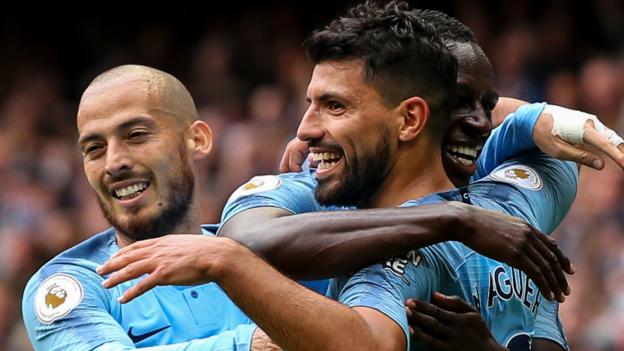
Sergio Aguero has now scored 13 hat-tricks for Manchester City
Sergio Aguero scored a superb hat-trick as Manchester City continued their strong start to their Premier League title defence by thrashing Huddersfield at Etihad Stadium.
Pep Guardiola’s side, who beat Arsenal 2-0 in their opener, lost only once at home all of season and victory never looked in doubt against the Terriers, who have two defeats from their first two matches of the campaign.
Huddersfield did manage to hold City at bay for 25 minutes but were undone when goalkeeper Ederson superbly picked out Aguero with a pinpoint pass and the striker drew out Terriers keeper Ben Hamer before lifting the ball into the net.
Gabriel Jesus added a second seven minutes later with a crisp low strike from the edge of the area, before Aguero pounced on a Hamer error to stab in his second soon after.
Jon Gorenc Stankovic gave the visitors the slightest glimmer of hope before half time when he poked in from Steve Mounie’s flick-on, but any optimism was snuffed out early in the second half by a brilliant free-kick from David Silva.
Aguero then wrapped up his hat-trick with a smart flick from Benjamin Mendy’s cross – before a Terence Kongolo own goal sealed an emphatic win for an impressive City.
Guardiola’s side are top of the table and have scored eight goals in two games, conceding just one. Huddersfield, meanwhile, drop to the bottom of the standings on goal difference.
Guardiola’s experiment a worry for his rivals
How do you stop a team like Manchester City? That was a question pondered by the 19 other Premier League managers last season, with many opting for the tactic of ‘parking the bus’.
City usually managed to find a way through but sometimes not until very late on – winning goals against Huddersfield, Southampton, Bournemouth and West Ham last term did not come until after the 80th minute.
That has perhaps prompted Pep Guardiola to find an alternative tactic to deal with defensive sides, as BBC Radio 5 live pundit Leon Osman observed during Sunday’s game.
“Pep Guardiola has made a number of changes and left out Leroy Sane, Raheem Sterling and Kyle Walker,” said the former Everton midfielder.
“He’s taken out all the guys with pace and got his footballers on. Guys with quick feet that can operate in small spaces.”
The result was that Huddersfield could barely get the ball off their hosts as City skilfully crafted opportunities from the limited space they had.
Manchester City enjoyed near total dominance against Huddersfield. The hosts had 77% possession and 32 shots on goal
Even at 6-1, City did not ease up their attacking intent. In truth, Huddersfield can consider themselves fortunate that a repeat of the 10-1 defeat they suffered at City 31 years ago did not materialise.
Guardiola will surely have been happy with what he saw. Usually so tense on the touchline, he was seen sharing a joke with coach Mikel Arteta towards the end of the game.
His side now have a couple of ways they can successfully approach a game – an ominous sign for the rest of the Premier League.
Man of the match – Sergio Aguero (Manchester City)
Sergio Aguero scored his ninth Premier League hat-trick but could easily have scored more. He finished the game with nine shots on goal, more than any other City player.
What next?
Manchester City travel to newly promoted Wolves on Saturday, 25 August (12:30 BST), while Huddersfield are at home to Cardiff at 15:00 on the same day.
SportsPulse: Trysta Krick and USA TODAY Sports’ fantasy football expert Steve Gardner give you their studs, duds and sleepers for the 2018 season. USA TODAY Sports
LANDOVER, Md. — Week 2 of the NFL preseason is nearly complete. It featured Jets rookie quarterback Sam Darnold’s first start, Alex Smith’s debut with the Redskins, some notable injuries, more national anthem rumblings and continued consternation regarding the league’s new rule designed to eliminate dangerous tackles involving the helmet. Now that 30 teams have played this weekend (the Ravens and Colts will meet Monday night), here are 30 things we learned:
2.Don’t sleep on Washington. Smith looked very sharp — he may be a better fit for this scheme than Kirk Cousins was — and the defense could make a huge leap with Crimson Tide brothers Jonathan Allen and Daron Payne.
3. New Monday Night Football analyst Anthony “Booger” McFarland gets to view games from a sideline crane. Down in front, Booger.
4. Players, coaches and preseason TV announcers are still railing against the NFL’s highly legislated helmet rule. “I’m as baffled as anyone else,” said Vikings veteran Brian Robison. “At the end of the day, it’s a very confusing rule.”
5. Tom Brady played the first half Thursday night. After missing most of the Patriots’ offseason … he looks perfectly ready for Week 1.
6. Aaron Rodgers is a crier. “To be back at Lambeau was a thrill and the ovation touched me,” Rodgers said Thursday, his first start in Green Bay since he missed most of last season with a busted collarbone. “I have to kind of wipe away some tears in my eyes.”
8. The Vikings provided a nice tribute Saturday to late assistant coach Tony Sparano, who died suddenly last month from heart disease. His family, including Jaguars assistant offensive line coach Tony Sparano Jr., was in attendance.
9. Panthers RB Christian McCaffrey had a 71-yard TD run against Miami. He didn’t rush for more than 66 yards in any game during his rookie season.
10. Memo to Chiefs WR Tyreek Hill: Twerking will cost you 15 yards.
Come for Tyreek Hill’s TD, stay for his celebration
11. Even in the remote event that both Nick Foles and Carson Wentz are unavailable for the regular-season opener, the Eagles are better off with third-string QB Nate Sudfeld (5 preseason TD passes) than pursuing another veteran.
12. The NFL should really avoid preseason games that replicate regular-season contests. The Rams hosted the Raiders on Saturday, and starters on both sides sat in a contest that was drab even by the measure of NFL football in August. The teams meet again in 23 days as the marquee matchup of ESPN’s Week 1 MNF twinbill.
13. However Raiders RB Chris Warren III — son of former Seahawks star RB Chris Warren — took the opportunity to rush 18 times for 110 yards and a score. Take note, Money Lynch and Doug Martin.
14. Even though Rams stars Todd Gurley and Jared Goff got the day off, they’re ready for Showtime, courtesy of LeBron James and the Lakers.
15. Buccaneers QB Jameis Winston looked crisp in relief of Ryan Fitzpatrick. But that won’t do Tampa Bay much good in the season’s first three weeks.
16. Backup QB battle to watch: Davis Webb vs. Kyle Lauletta in a bid to hold the clipboard for Giants’ Eli Manning.
18. Oft-suspended Cowboys DE Randy Gregory played for the first time since the 2016 season. “He looked quick and explosive. He looked like himself. He certainly looks like he is comfortable and confident,” said Dallas coach Jason Garrett.
19. Vikings RB Latavius Murray fumbled twice, losing one, on six carries. Dalvin Cook must have cracked a smile.
20. Steelers rookie QB Mason Rudolph’s first (ill-advised) pass Thursday was returned for a pick-six by Green Bay’s Tramon Williams. Ben Roethlisberger must have cracked a smile, too. To Rudolph’s credit, he hooked up for a TD with JuJu Smith-Schuster five minutes later.
21. Note to Le’Veon Bell: Second-year Pittsburgh RB James Conner looked nice while ripping off 57 yards on five carries.
22. Timing is everything. Browns fans got to boo Bills WR Corey Coleman, Cleveland’s first-round pick two years ago, who was traded two weeks ago for buffalo wings.
23. Chargers WR Mike Williams, the seventh pick of the 2017 draft, scored on a 25-yard reception Saturday. Good news for a player whose rookie season was wasted by injuries.
24. It appears Cowboys Pro Bowl G Zack Martin avoided a major knee injury Saturday. “I just want to say we’ve got more to gain from (an MRI), but from what we’ve seen, I’ll sleep good tonight on Martin,” said Dallas owner Jerry Jones.
25. In a league where things change overnight, Bills rookie QB Josh Allen suddenly and surprisingly has much better odds to start a meaningful game soon after AJ McCarron went down with a broken collarbone Friday.
27. The Saints are probably sunk if Drew Brees gets hurt. But shouldn’t they get a better insurance policy than Taysom Hill or Tom Savage?
28. Seattle may have lost first-round RB Rashaad Penny for a month to a broken finger, but the run game is in good hands with Chris Carson. Teammates have raved about his camp, and he showed why Saturday on a 23-yard TD run … that was negated by a penalty.
29. Broncos fans are infatuated with new backup QB Chad “Swag” Kelly … but they’re on the other end of the spectrum when it comes to 2016 first rounder Paxton Lynch, who heard lusty boo birds when he entered the game.
30. LB Alexander Johnson played his first game in four years Saturday, just five days after signing with Denver and three weeks after he was acquitted of rape charges. Johnson was kicked off Tennessee’s football team after he was arrested during his senior season. GM John Elway declined Thursday to speak to the specific homework the Broncos did on Johnson beyond speaking to his former coaches.
Twitter CEO Jack Dorsey is still trying to convince conservatives that his service treats them fairly.
Speaking to CNN’s Brian Stelter in an interview that aired Saturday, Twitter’s top executive again reiterated that the social media company does not make content decisions on the basis of political views, even though Twitter itself has a “more left-leaning” bias.
“But the real question behind the question is, are we doing something according to political ideology or viewpoints? And we are not. Period,” Dorsey said in response to a question about “shadow bans,” Twitter’s practice of using algorithms to limit the visibility of certain tweets. “We do not look at content with regards to political viewpoints or ideology, we look at behavior.”
“We need to constantly show that we are not adding our own bias, which I fully admit is… more left-leaning,” Dorsey added. “But we need to remove all bias from how we act and our policies and our enforcement.”
“We do not look at content with regards to political viewpoint or ideology,” @Jack told me. But he knows some people do not believe him. “I think we need to constantly show that we are not adding our own bias, which I fully admit is left, is more left-leaning,” he says… pic.twitter.com/1i8jJunhfz
The interview highlights just how thorny these questions have become for Twitter. Dorsey is in the midst of a media blitz, which has included interviews with Sean Hannity and other Fox News hosts. He has also reportedly held quiet meetings with conservative leaders, like Ted Cruz.
Each time, the CEO faces questions about Twitter’s treatment of conservatives, as well as the network’s alleged “shadow bans.”
What Dorsey and Twitter say is a necessary step to limit the visibility of toxic behavior has become a sort of rallying cry for members of the far-right, who believe the social media company is censoring conservatives with whom it disagrees.
Dorsey’s latest comments appeared to add fuel to those theories, as many Twitter users latched onto his comments about Twitter’s “left-leaning bias” as proof there is in fact a widespread effort to censor conservatives.
The Glenn Beck-backed conservative site The Blaze quickly labeled it a “stunning admission,” while Twitter users, some of whom have been adding the emoji to their Twitter names in order to indicate their supposed shadow ban status, quickly piled on.
But Dorsey said it was necessary to reckon with the company’s own bias in order to improve transparency with users.
“I haven’t done enough of articulating my own personal objectives with the service,” he said. “I think people see a faceless corporation that has… they don’t assume that humans are in it. They just assume based on what the output is. That’s on us, that’s on me.”
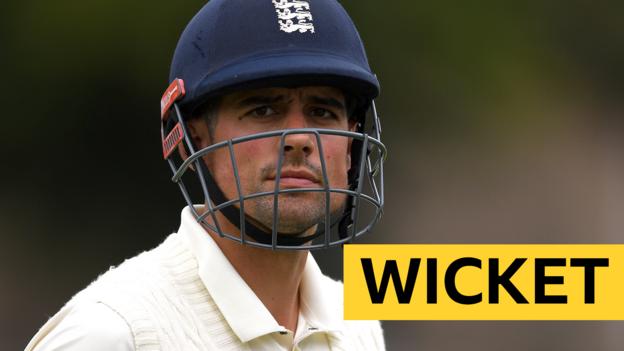
Opener Alastair Cook edges behind to wicketkeeper Rishabh Pant off the bowling of Ishant Sharma as England lose their first wicket on day two of the third Test at Trent Bridge.
Brett Kavanaugh’s seat on the Supreme Court could mean abortion opponents are closer than they’ve been in 45 years to overturning _Roe v. Wade. USA TODAY
WASHINGTON – If he wins confirmation to the Supreme Court, Brett Kavanaugh‘s impact could extend from cradle to grave.
Because he would replace retired justice Anthony Kennedy, who occasionally sided with the court’s liberal wing, Kavanaugh particularly could shift the balance on cases involving abortion, capital punishment, racial discrimination and gay rights.
A review of cases in which Kennedy cast the deciding vote over the dissent of his fellow conservatives – combined with a review of Kavanaugh’s rulings and writings – reveals the areas of law most likely to change.
Kennedy’s fifth vote struck down state bans on same-sex marriage in 2015. The following year, he upheld the limited use of racial preferences in college admissions and struck down excessive restrictions on abortion rights.
Sprinkled throughout his 30-year high court career were votes in favor of criminal defendants, notably those on death row. Together with the court’s four liberal justices, he spared juveniles and people with intellectual disabilities from the death penalty.
In some of those cases, there are indications from Kavanaugh’s opinions, speeches and articles that he would have been on the other side.
“With Kavanaugh, it is extremely unlikely that he would do anything like what Justice Kennedy has done,” says David Cohen, a law professor at Drexel University.
In other cases, the jury is still out. Justin Walker, a University of Louisville law professor who clerked for Kavanaugh at the U.S. Court of Appeals for the District of Columbia Circuit and for Kennedy at the Supreme Court, notes Kennedy and his high court colleagues endorsed Kavanaugh’s opinions or dissents 13 times.
“For people wondering where they’re going to disagree, they’re going to have to look elsewhere,” Walker says.
Abortion, death penalty
Kennedy’s alliance with the high court’s liberals waxed and waned over the years. Three years ago, he sided with them in eight cases decided 5-4, compared to five in which he joined the other four conservatives. This past year, however, he joined the conservatives 14 times in 5-4 cases and didn’t once side with the liberals.
Here’s a look at cases in which Kennedy joined the liberals – and where Kavanaugh might not follow suit.
Abortion
Kennedy voted in 2016 to strike down restrictions on abortion clinics and doctors in Texas that had created hardships for thousands of women, without sufficient health benefits. The case was decided 5-3 following Justice Antonin Scalia’s death. A generation earlier, Kennedy also helped preserve abortion rights in the 1992 case Planned Parenthood v. Casey, decided 5-4.
Kavanaugh’s only abortion ruling came last year, when he dissented from the appeals court’s decision allowing an undocumented teenager in federal custody to get an abortion. He said the government “has permissible interests in favoring fetal life, protecting the best interests of a minor, and refraining from facilitating abortion.”
In a speech last year, he heaped praise on the late chief justice William Rehnquist, citing among other things Rehnquist’s dissent from the 1973 Roe v. Wade decision legalizing abortion. Rehnquist, he said, “stated that under the court’s precedents, any such unenumerated right had to be rooted in the traditions and conscience of our people.”
Death penalty
Five times in the last four years, Kennedy provided the deciding vote for criminals on death row pleading special circumstances, including intellectual disability, judicial bias and prosecutorial misconduct.
“The death penalty is the gravest sentence our society may impose,” Kennedy said in his 2014 opinion striking down Florida’s rigid method of discerning disability. “Persons facing that most severe sanction must have a fair opportunity to show that the Constitution prohibits their execution.”
Robert Dunham, executive director of the Death Penalty Information Center, says cases based on an “evolving standard of decency” under the 8th Amendment hinged for many years on “whatever Justice Kennedy thought it meant.”
In that same speech about Rehnquist, Kavanaugh cited approvingly the chief justice’s dissent from the Supreme Court’s 1972 decision striking down state death penalty statutes. He cited this passage from the dissent:
“The most expansive reading of the leading constitutional cases does not remotely suggest that this court has been granted a roving commission, either by the founding fathers or by the framers of the 14th Amendment, to strike down laws that are based upon notions of policy or morality suddenly found unacceptable by a majority of this court.”
Race and gay rights
In just the past three years, Kennedy provided the deciding vote to allow some use of racial preferences in college admissions, make it easier to prove housing discrimination, strike down election districts that packed in black voters and overturn a conviction because of a juror’s racist comments.
“The nation must continue to make strides to overcome race-based discrimination,” Kennedy said in the latter case, decided last year. “It is the mark of a maturing legal system that it seeks to understand and to implement the lessons of history.”
Kavanaugh in 2012 voted to delay but uphold a South Carolina law requiring that voters have photo IDs, even though minorities more often lack them. He reasoned that the law allowed for exceptions that would ease its burdens on racial groups.
But Kavanaugh also told the Senate Judiciary Committee that among his 10 most significant opinions was one siding with a Fannie Mae worker who complained after being called the “n-word.”
“No other word in the English language so powerfully or instantly calls to mind our country’s long and brutal struggle to overcome racism and discrimination against African-Americans,” he wrote in that case.
Kennedy is best known for several opinions that expanded the rights of gays and lesbians, culminating in the 2015 decision that legalized same-sex marriage nationwide. Two years earlier, he was the deciding vote in striking down the federal Defense of Marriage Act, which denied federal benefits to same-sex couples already married in some states.
“Their hope is not to be condemned to live in loneliness, excluded from one of civilization’s oldest institutions,” Kennedy said in 2015. “They ask for equal dignity in the eyes of the law. The Constitution grants them that right.”
Kavanaugh has no judicial record in gay rights cases, leaving his supporters and detractors to speculate how he would vote. He served as White House staff secretary at the time President George W. Bush sought a constitutional amendment banning same-sex marriage, but documents from that time have not been released.
Still, Kavanaugh’s speech last year on Rehnquist may offer guidance. He praised the former chief justice for saying that rights not enumerated in the Constitution could be recognized by courts only if they were “rooted in the nation’s history and tradition.”
He said Rehnquist’s 5-4 opinion in 1997, which said assisted suicide did not reach that threshold, “stands to this day as an important precedent, limiting the court’s role in the realm of social policy.”
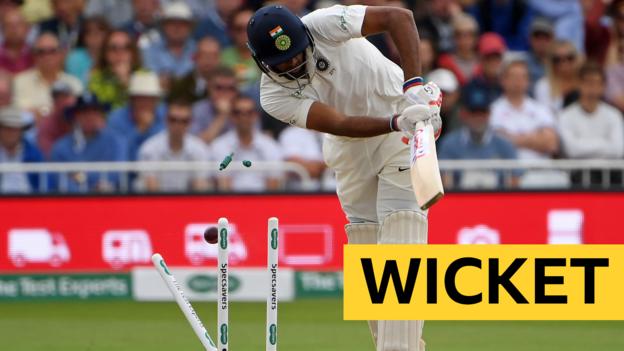
Stuart Broad removes Ravichandran Ashwin as India lose their final four wickets for 22 runs in just 45 minutes on day two of the third Test at Trent Bridge.
President Donald Trump refused to say whether he would pardon Paul Manafort, calling him a “very good person” as he left the White House for New York. Trump also again called out Turkey, saying the country has been a “problem for a long time.” (Aug. 17) AP
WASHINGTON — A jury is still deliberating Paul Manafort’s future but even if he’s acquitted, his legal battle will only be halfway over.
The former campaign chairman for President Donald Trump is due to be back in court in Washington next month for a second trial centered on allegations of lying to the FBI, money laundering and foreign lobbying.
This time prosecutors say they have even more evidence — more than double the amount they showed jurors in Virginia.
In a court filing Thursday, Manafort’s attorney said special counsel Robert Mueller’s office has supplied “well over 1,000” exhibits for the trial. In the Virginia case, his office had about 400 exhibits.
The trial is slated to begin in front of U.S. District Judge Amy Berman Jackson on Sept. 17, about a month from now.
The reasoning for the two separate trials stems from where prosecutors say the alleged crimes were committed. The cases in Virginia and Washington could have been combined but Manafort’s attorneys elected to keep them separate.
The New York Times notes this decision could have been made because Virginia leans more conservative, thus possibly more sympathetic to him, and Washington more liberal. The most serious charges Manafort faces are in Virginia for alleged bank fraud.
He could spend the rest of his life in federal prison if convicted on all of the 18 counts lodged against him there. Jury deliberations began late last week.
The charges include five counts of subscribing to false income tax returns, four counts of failing to file foreign bank account reports, four counts of bank fraud and five counts of bank fraud conspiracy.
He could face a maximum of 20 years behind bars if convicted in Washington.
Manafort has denied all the allegations and elected to take on the charges in court while his campaign deputy and close associate Rick Gates pleaded guilty and agreed to cooperate with Mueller’s team, even testifying against his former boss in Virginia.
Federal prosecutors alleged in the indictment filed in Washington against Manafort that he secretly enlisted a group of “former European politicians,” including a former European chancellor to advocate on behalf of the pro-Russian faction Manafort represented in Ukraine.
Prosecutors have asserted that Manafort wired the unnamed officials more than 2 million euros from his off-shore accounts and tried to cover up their work even while holding a senior role in Trump campaign.
Manafort’s case has been the first taken to trial by the special counsel’s office. The trial in Washington is slated to be the second trial by Mueller’s office.
It’sSummer Lovin’ Weekhere at Mashable, which means things are getting steamy. In honor of the release of Crazy Rich Asians, we’re celebrating onscreen love and romance, looking at everything from our favorite fictional couples to how Hollywood’s love stories are evolving. Think of it as our love letter to, well, love.
In hindsight, Zosia and I were never meant to be.
We met one night at a friend’s party and had one of those mutual lightning crash moments. Instant connection. I liked her free spirit and her nerdy librarian vibe, and she was drawn to my long, blonde hair and my laugh.
When we met the next day for our first real date, it was immediately apparent that we had backed into an “opposites attract” kind of scenario. I just wanted a nice, quiet lunch where we could sit and talk. She wanted to have us act like tourists and see the sights.
Still, the relationship developed from there. We had plenty of happy moments, far fewer sad moments, some knockdown arguments and tense showdowns. Typical relationship stuff. But in the end, we didn’t make it. Our life goals, or destinies, as some might say, didn’t quite align. And that was that.
That failed love story isn’t an event pulled from my own life (my hair is neither long nor blonde, for starters). It was actually the “Sunday Morning Date” tutorial scenario from an intriguing tabletop game called Fog of Love.
Image: adam rosenberg / mashable
This “romantic comedy as a board game” (as the website describes it) is a two-player game that mixes role-playing with the randomness of card draws and blind mutual decision-making. Each player assume the role of a character they create and role-play in the context of a relationship driven by shifting desires and secret goals, defined in the game as “Destiny.”
It’s a neat idea on the surface: Most adults can relate on some level to the experience of leaping into and nurturing a love relationship. Fog of Love turns that into an actual story-driven game, with each scenario broken into chapters made up of multiple, randomly selected scenes.
A typical scene presents one or both players with a choice to make. When both choose, they do so blindly. Each scene is resolved using a multiple-choice format, and the relationship typically benefits when both players land on the same choice — though that doesn’t also mean that at-odds choices are a dealbreaker.
A full scenario plays out across the arc of a love relationship. Winning is a matter of fulfilling one’s Destiny, a goal that can change over the course of a game (though your choices narrow as you reach later chapters). One or both players can win, or lose, just like real life.
Fog of Love is a two-player game that mixes role-playing with the randomness of card draws and blind decision-making.
The actual game is more complex to play than I’m describing here, and that’s where Fog of Love‘s tremendous tutorial comes in. I’ve frankly never seen anything like it in another tabletop game. The tutorial is printed across a set of 30 numbered cards, all sprinkled into the various card decks that make up the core of the game.
The first time you play, it’s best to set up the board and place the card decks down without shuffling them; all the cards are arranged in a specific order for your first playthrough. Once everything’s set, ditch the instruction manual and grab the first tutorial card on top of the “Sweet” deck.
The game takes care of the rest from there. On the first card, you’ll learn how players assemble the collection of scene cards they can choose from whenever it’s their turn. The next tutorial card, which the first one will tell you is on top of the “Traits” deck, begins teaching the process of character creation.
During this early stretch, you’re encountering tutorial cards every few minutes, as different aspects of the game setup — card selection and character creation — play out. Once the actual game starts, the tutorial loosens up, letting you play multiple scenes at a time before hitting you with new rules to factor in.
All throughout, the language on the cards constantly encourages players to use their imaginations and come up with details that fill out the different aspects of their individual and shared lives.
For example, when you get to Features — literally, the physical features that led to an initial mutual attraction — the tutorial card emphasizes the fact that you should “tell what it was about this Feature that your character fell for.” (Fittingly, you choose your partner’s features rather than your own by selecting five cards from that deck and choosing the three you like most.)
Image: adam rosenberg / mashable
The tutorial continues all the way through its 30th card, which congratulates you on finishing your first scenario. It also tells you to shuffle all the card decks (sans tutorial cards, of course) for future games, and suggests the best order in which to tackle the game’s three included story scenarios.
The tutorial is unbelievably player-friendly, even for those whose tabletop background goes no further than Monopoly. That said, Fog of Love is a difficult game to master. The reason became clear to me only after my IRL wife and I finished our first game together, and we both lost: It’s so easy to play this game wrong.
At its core, Fog of Love is a role-playing game. Too often, my wife and I both let our own, personal impulses rule the moment as we made choices from scene to scene. The key is remembering to play the character you’ve created as she or he is defined by the cards on the table and the Destiny you’re chasing.
This is something that started to click as the tutorial game wound on, but it was a situation where we’d both effectively sabotaged ourselves in the long run by making bad choices early on in the relationship. We didn’t build up a strong enough foundation for our love, and so when the finale eventually arrived, we weren’t satisfied enough — either individually or as a couple — to make our relationship last.
But isn’t that just how things are? The choices we made too often sprung out of our IRL identities, neither of which much resembled our in-game personae. Again and again, playing against the character we’d created worked against us.
Or to put it more succinctly: We weren’t our authentic selves, and the relationship suffered as a result. That’s as true in real life as it is in Fog of Love.
Iraq’s Supreme Court has ratified the results of the May 12 parliamentary election, its spokesman said, setting in motion a 90-day constitutional deadline for the winning parties to form a government.
“The court has issued a decision to ratify the results of the parliamentary election,” the spokesman said in a statement on Sunday.
Iraq: Manual recount shows few changes to May election results
A nationwide recount of votes showed on August 10 that populist Shia leader Muqtada al-Sadr retained his lead, positioning him to play a central role in forming the country’s next government.
Many Iraqis, including Kurdish and Sunni Arab groups, disputed the results of the vote, alleging widespread electoral misconduct.
In June, a huge fire destroyed a warehouse housing boxes containing ballots from the May vote.
The fire came just days after parliamentarians ordered a recount of all 11 million of the votes cast.
MPs also sacked the nine-member independent electoral commission that oversaw the process and replaced the body with judges.
The recount did not change the number of seats Sadr’s bloc won. According to the commission, only one seat from Iraq’s Baghdad Coalition had moved to the Al-Fatih Bloc, which is part of a Hashd al-Shabi-led coalition, giving the latter 48 instead of 47 assembly seats.
After the initial result, Sadr and Abadi formed an alliance in the aftermath of the vote, in which the former’s Sairoon Alliance won 54 seats to become the largest bloc in Iraq’s 329-seat parliament.
Abadi’s alliance – once seen as a frontrunner – came in third, with just 42 seats.
Incoming MPs will now hold a first session to elect a new assembly speaker. Within 30 days of that first session, the assembly will elect- by a two-thirds majority- the country’s next president.
The president will then task the largest bloc in parliament with drawing up a government, which must be referred back to parliament for approval.


/https%3A%2F%2Fblueprint-api-production.s3.amazonaws.com%2Fuploads%2Fcard%2Fimage%2F830586%2F40fa9ef5-eee9-430f-962c-db66a9084323.jpg)

 emoji to their Twitter names in order to indicate their supposed shadow ban status, quickly piled on.




 trendynewsday