Black Friday is out and Cyber Monday is in — and before you ask, yes, Instant Pots are still on sale.
The fast-and-furious multicookers that took the world by storm were one of the items that everyone was racing toward this past sale weekend — but if you somehow let the Black Friday deals slip through the cracks, you’re not out of luck.
Much to our surprise, we’re seeing deals on more unique models that are rarely on sale. While Black Friday was all about the 7-in-1 Duo, Cyber Monday deals offer options of the best-selling Duo Plus, the rectangular Gem, and more. Skipping Black Friday may have been a blessing in disguise.
If you need more details on which Instant Pot is best before you take the plunge, check out our guide to Instant Pots to find the one that’s right for you.
Here are our favorite Instant Pot deals for Cyber Monday:
Hello, Amazon’s best-selling Instant Pot, we’ve missed you. The Duo Plus is the upgraded version of the fan favorite 7-in-1 Duo, and one of the most souped-up Instant Pots in the entire line (soup pun intended). With nine built-in appliance features (cake, egg cooker, and sterilizer are the added value features here), plus a shiny, spaceship look, the Duo Plus is the ultimate addition to any hardcore foodie’s kitchen. You can save $50 and get it for $79.95 at Amazon for Cyber Monday.
Don’t mind us, just drooling over a kitchen appliance. As the name implies, the Instant Pot Ultra is easily the most badass of the line, offering 10 built-in features, an “Ultra” button for personalized programming, a steam release button for upped safety, and more precise cooking times with the altitude adjustment and cooking indicator features. Instant Pot refers to it as the next generation of kitchen appliances, and once you see how teched-out it looks, you’ll agree. Regularly $119.95 for the 3-quart Mini or $179.95 for the large 8-quart, you can save $40 and get the Mini for $79.95 or save $60 and get the 8-quart for a rare $119.95 at Walmart on Cyber Monday.
We love Instant Pots, we really do — but one gripe that some could have with the popular cylindrical models is that they’re just not ideal for baking or large roasts. The Instant Pot Gem is your answer: It’s the hidden gem of the line, with a rectangular shape that’s ace for cooking larger chickens or other roasts, as well as casseroles and bakes that need to be flat. Luckily, it’s still the multicooker that everyone loves, with eight appliance features like the rest of its fam (except for bake, which is exclusive to the gem). Regularly $79, you can save $24 and get it for $55 at Walmart today — this hasn’t happened since Cyber Monday 2017.
Sometimes, you don’t need all of that extra shit. Whether you’re balling on a budget or are a novice and just need an Instant Pot for simpler recipes (raises hand), the 6-in-1 Instant Pot Lux is your guy. It’s a pressure cooker, slow cooker, rice cooker, steamer, warmer, and sauté pan, and is one of two Instant Pots that does not make yogurt — but hey, that’s still a hell of a lot. Regularly $79.95, you can save $20 and get it for $59.95 at Walmart on Cyber Monday.
Indian police trying to recover the body of John Allen Chau, the American man killed while trying to tell a remote tribe “Jesus loves you,” withdrew their boat over the weekend in fear they’d be attacked.
On Saturday, a police boat about 437 yards away from the off-limits island in North Sentinel turned back after seeing tribesmen on the beach armed with bows and arrows, according to the Agence France-Presse.
“They stared at us and we were looking at them,” regional police chief Dependra Pathak told AFP.
Officials believe they have a general idea of where Chau’s body is buried, because of information provided by fishermen who took the 27-year-old near the island on Nov. 17. The fishermen, who Chau paid $325 to take him close to the island, say they saw the tribespeople drag Chau’s body along the beach and bury his remains.
Seven people accused of helping Chau reach the island were arrested.
Indian government regulations forbid interaction with the Sentinelese, who are known to shoot arrows at outsiders. P.C. Joshi, an anthropology professor at Delhi University who has studied the islands, said the isolated tribe has little resistance to diseases and could die from contact with outsiders.
Chau was a graduate of Oral Roberts University, a Christian college in Oklahoma. In diary entries he left behind, he said he felt called to “declare Jesus to these people.”
In 2006, the bodies of two fishermen killed by the tribespeople were buried, and days later dug up and propped upright. Authorities apparently never recovered those bodies and there is a fear that Chau’s remains might never be brought back.
Chau’s family said in a statement that they forgive those who are responsible for his death.
Contributing: The Associated Press. Follow Ashley May on Twitter: @AshleyMayTweets
For literal pocket change, you’ll be able to watch thousands of TV shows and movies, including full seasons of exclusive series like Hulu originals The Handmaid’s Tale and Difficult People, plus full seasons of classic shows like Seinfeld or South Park—all with minimal commercials.You’ll also have access to tons of hit movies, kids shows, and more.
Considering a normal subscription is $7.99 per month, this new offer is seriously too good to pass up.
When it comes down to it, we’ll all be doing a lot of marathoning this winter—and I don’t mean the kind that involves sneakers. So take advantage of this ridiculously generous holiday offer from Hulu and shamelessly fuel your binge-watching season for less than a buck.
Sign up through Monday while the deal lasts here — just click on the Hulu logo at the top left to access the deal.
Kim Kardashian revealed to People magazine she hires models with the ‘exact same measurements’ as her to test out and photograph clothing before she decides what to wear. Buzz60’s Mercer Morrison has the story. Buzz60
Blame it on the ecstasy.
Kim Kardashian West says she was under the influence when she made some decisions in her past, including her first marriage – to music producer Damon Thomas when she was just 19 – and a sex tape with her ex, singer Ray J.
“I got married on ecstasy,” the reality admitted on “Keeping Up with the Kardashians” Sunday, referencing “the first time” she walked down the aisle in 2000.
“I did ecstasy once, and I got married,” she elaborated to her younger sister, Kendall Jenner, and the father of her sister Kourtney Kardashian’s children, Scott Disick.
“I did it again, I made a sex tape,” she said. “Like, everything bad would happen.”
“You were high on ecstasy when you (made) that sex tape?” asked Disick, seemingly in disbelief.
“Like, my jaw was shaking, like the whole time,” she added of the video that made its way to the public in 2007.
The KKW Beauty mogul and Thomas divorced in 2004. She wed basketball player Kris Humphries in front of cameras in 2011 and famously filed for divorce 72 days later, though the split wasn’t finalized until 2013.
Forget self-driving cars. The future is all about self-parking cars.
For anyone still traumatized from learning how to parallel park, a new patent from Bay Area-based electric vehicle company SF Motors will soothe your bumper-filled nightmares.
The company’s approved patent for design and methodology for a self-parking system takes sensors, cameras, and LIDAR (a laser system to measure distance between objects) to supply data to a computer that can direct the car on how to park. The system with sensors is mounted on the car at bumper level for prime parking data collection.
A look at the patent application approved last month shows how the sensors tell the parking system about objects that may exist as well as how far away they are. In the patent, SF Motors says the cameras can identify pedestrians, cyclists, cars, parking spot lines, markers, signs, curbs, trees, roads, and other things you’d find on a street or in a parking lot.
How the self-parking feature works.
It’s like that self-docking boat from Volvo, but way more useful for all of us who actually have a car. SF Motors says the self-parking feature can work in most conditions regardless of the weather or visibility outside. “Hand, facial or body gestures or cues to signal intentions between human operators can be limited or impossible under poor visibility conditions such as at night or during poor weather,” the patent reads, knocking humans abilities to gauge whether you’ll actually fit into that spot or not.
This also seems like a swipe at Tesla’s self-parking and summon features available on its driver assistance system, Autopilot. Tesla’s autonomous parking capabilities are fairly limited to clear-cut spots like those in lots or in garages.
Now that SF Motors has the patent, they want to incorporate it into their vision for an intelligent electric vehicle that has other autonomous features, like those that help with safe driving.
The company plans to have its first vehicle equipped with features like this autonomous parking sensor available in China toward the end of next year.
Just to let you know, if you buy something featured here, Mashable might earn an affiliate commission.
Image: ShiftCam
By Team CommerceMashable Deals
One could argue that “Kodak moments” are going out of style: With 75% of all pictures being taken with phones nowadays, it would be more appropriate to refer to memorable occasions as “iPhone moments.” And whether you’re pursuing professional smartphone photography to capture those moments or just doin’ it for the ‘gram, the RevolCam multi-lens kit is your ticket to better shots.
The RevolCam features a revolving design that rotates with a single tap, making it simple to switch between its wide angle, fisheye, and macro lenses during a shoot. Besides those three lenses, the RevolCam kit also includes a selfie mirror and an adjustable LED light; the latter’s magnetic backing can be detached from your phone and set up for perfect lighting in virtually any environment.
Valued at $59, the RevolCam is usually sold in the Mashable Shop for $34.99. But this Cyber Monday, we’re lowering that price even further: You can snag a RevolCam for only $29.99 plus an extra 20% off when you enter the coupon code CMSAVE20 at checkout.
HONG KONG – A Chinese researcher claims that he helped make the world’s first genetically edited babies – twin girls born this month whose DNA he said he altered with a powerful new tool capable of rewriting the very blueprint of life.
If true, it would be a profound leap of science and ethics.
A U.S. scientist said he took part in the work in China, but this kind of gene editing is banned in the United States because the DNA changes can pass to future generations and it risks harming other genes.
Many mainstream scientists think it’s too unsafe to try, and some denounced the Chinese report as human experimentation.
The researcher, He Jiankui of Shenzhen, said he altered embryos for seven couples during fertility treatments, with one pregnancy resulting thus far. He said his goal was not to cure or prevent an inherited disease, but to try to bestow a trait that few people naturally have – an ability to resist possible future infection with HIV, the AIDS virus.
He said the parents involved declined to be identified or interviewed, and he would not say where they live or where the work was done.
There is no independent confirmation of He’s claim, and it has not been published in a journal, where it would be vetted by other experts. He revealed it Monday in Hong Kong to one of the organizers of an international conference on gene editing that is set to begin Tuesday, and earlier in exclusive interviews with The Associated Press.
“I feel a strong responsibility that it’s not just to make a first, but also make it an example,” He told the AP. “Society will decide what to do next” in terms of allowing or forbidding such science.
Some scientists were astounded to hear of the claim and strongly condemned it.
It’s “unconscionable … an experiment on human beings that is not morally or ethically defensible,” said Dr. Kiran Musunuru, a University of Pennsylvania gene editing expert and editor of a genetics journal.
“This is far too premature,” said Dr. Eric Topol, who heads the Scripps Research Translational Institute in California. “We’re dealing with the operating instructions of a human being. It’s a big deal.”
However, one famed geneticist, Harvard University’s George Church, defended attempting gene editing for HIV, which he called “a major and growing public health threat.”
“I think this is justifiable,” Church said of that goal.
In recent years scientists have discovered a relatively easy way to edit genes, the strands of DNA that govern the body. The tool, called CRISPR-cas9, makes it possible to operate on DNA to supply a needed gene or disable one that’s causing problems.
It’s only recently been tried in adults to treat deadly diseases, and the changes are confined to that person. Editing sperm, eggs or embryos is different – the changes can be inherited. In the U.S., it’s not allowed except for lab research. China outlaws human cloning but not specifically gene editing.
He Jiankui (HEH JEE’-an-qway), who goes by “JK,” studied at Rice and Stanford universities in the U.S. before returning to his homeland to open a lab at Southern University of Science and Technology of China in Shenzhen, where he also has two genetics companies.
The U.S. scientist who worked with him on this project after He returned to China was physics and bioengineering professor Michael Deem, who was his adviser at Rice in Houston. Deem also holds what he called “a small stake” in – and is on the scientific advisory boards of – He’s two companies.
The Chinese researcher said he practiced editing mice, monkey and human embryos in the lab for several years and has applied for patents on his methods.
He said he chose embryo gene editing for HIV because these infections are a big problem in China. He sought to disable a gene called CCR5 that forms a protein doorway that allows HIV, the virus that causes AIDS, to enter a cell.
All of the men in the project had HIV and all of the women did not, but the gene editing was not aimed at preventing the small risk of transmission, He said. The fathers had their infections deeply suppressed by standard HIV medicines and there are simple ways to keep them from infecting offspring that do not involve altering genes.
Instead, the appeal was to offer couples affected by HIV a chance to have a child that might be protected from a similar fate.
He recruited couples through a Beijing-based AIDS advocacy group called Baihualin. Its leader, known by the pseudonym “Bai Hua,” told the AP that it’s not uncommon for people with HIV to lose jobs or have trouble getting medical care if their infections are revealed.
Here is how He described the work:
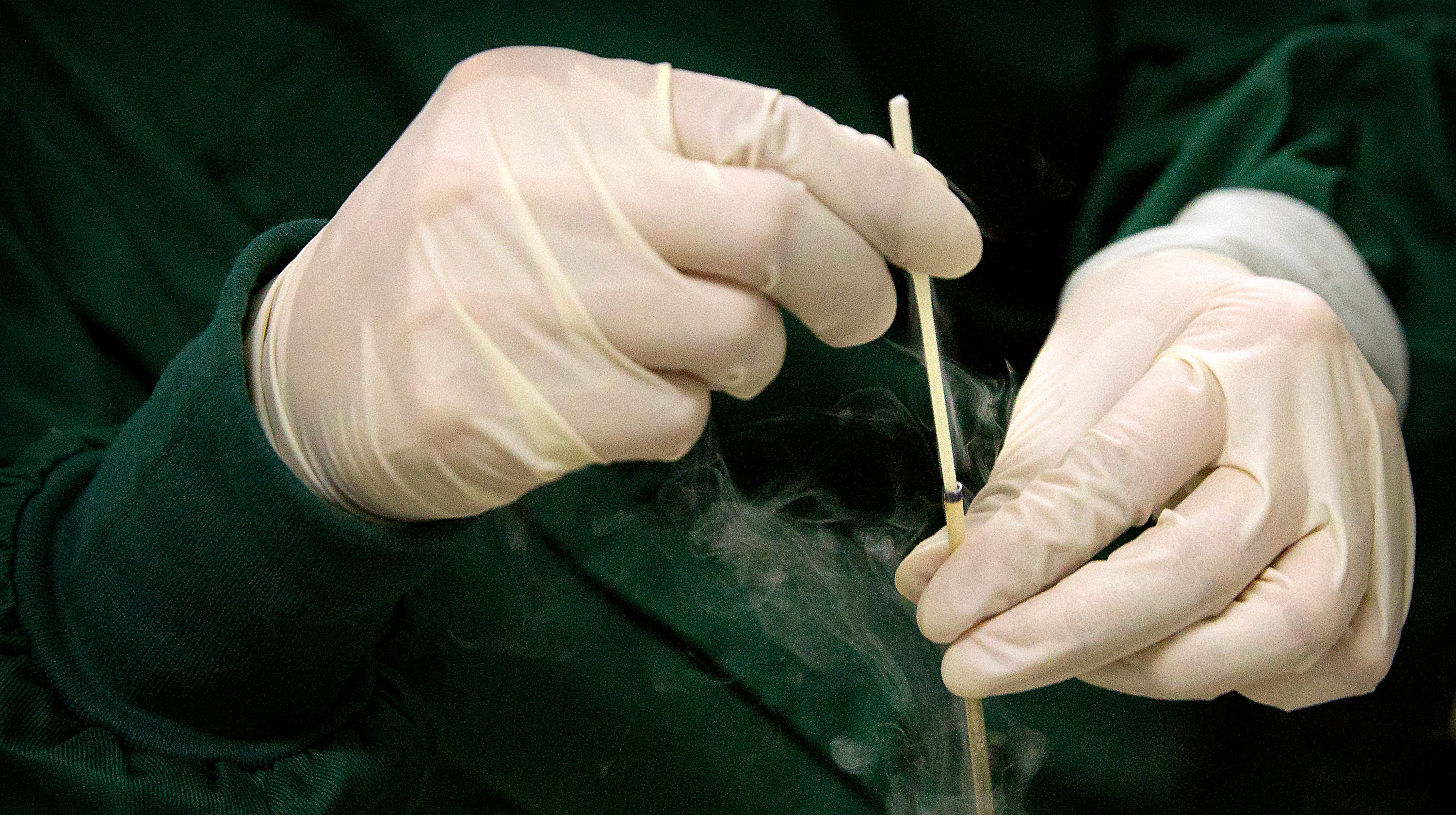
The gene editing occurred during IVF, or lab dish fertilization. First, sperm was “washed” to separate it from semen, the fluid where HIV can lurk. A single sperm was placed into a single egg to create an embryo. Then the gene editing tool was added.
When the embryos were 3 to 5 days old, a few cells were removed and checked for editing. Couples could choose whether to use edited or unedited embryos for pregnancy attempts. In all, 16 of 22 embryos were edited, and 11 embryos were used in six implant attempts before the twin pregnancy was achieved, He said.
Tests suggest that one twin had both copies of the intended gene altered and the other twin had just one altered, with no evidence of harm to other genes, He said. People with one copy of the gene can still get HIV, although some very limited research suggests their health might decline more slowly once they do.
Several scientists reviewed materials that He provided to the AP and said tests so far are insufficient to say the editing worked or to rule out harm.
They also noted evidence that the editing was incomplete and that at least one twin appears to be a patchwork of cells with various changes.
“It’s almost like not editing at all” if only some of certain cells were altered, because HIV infection can still occur, Church said.
Church and Musunuru questioned the decision to allow one of the embryos to be used in a pregnancy attempt, because the Chinese researchers said they knew in advance that both copies of the intended gene had not been altered.
“In that child, there really was almost nothing to be gained in terms of protection against HIV and yet you’re exposing that child to all the unknown safety risks,” Musunuru said.
The use of that embryo suggests that the researchers’ “main emphasis was on testing editing rather than avoiding this disease,” Church said.
Even if editing worked perfectly, people without normal CCR5 genes face higher risks of getting certain other viruses, such as West Nile, and of dying from the flu. Since there are many ways to prevent HIV infection and it’s very treatable if it occurs, those other medical risks are a concern, Musunuru said.
There also are questions about the way He said he proceeded. He gave official notice of his work long after he said he started it – on Nov. 8, on a Chinese registry of clinical trials.
It’s unclear whether participants fully understood the purpose and potential risks and benefits. For example, consent forms called the project an “AIDS vaccine development” program.
The Rice scientist, Deem, said he was present in China when potential participants gave their consent and that he “absolutely” thinks they were able to understand the risks.
Deem said he worked with He on vaccine research at Rice and considers the gene editing similar to a vaccine.
“That might be a layman’s way of describing it,” he said.
Both men are physics experts with no experience running human clinical trials.
The Chinese scientist, He, said he personally made the goals clear and told participants that embryo gene editing has never been tried before and carries risks. He said he also would provide insurance coverage for any children conceived through the project and plans medical follow-up until the children are 18 and longer if they agree once they’re adults.
Further pregnancy attempts are on hold until the safety of this one is analyzed and experts in the field weigh in, but participants were not told in advance that they might not have a chance to try what they signed up for once a “first” was achieved, He acknowledged. Free fertility treatment was part of the deal they were offered.
He sought and received approval for his project from Shenzhen Harmonicare Women’s and Children’s Hospital, which is not one of the four hospitals that He said provided embryos for his research or the pregnancy attempts.
Some staff at some of the other hospitals were kept in the dark about the nature of the research, which He and Deem said was done to keep some participants’ HIV infection from being disclosed.
“We think this is ethical,” said Lin Zhitong, a Harmonicare administrator who heads the ethics panel.
Any medical staff who handled samples that might contain HIV were aware, He said. An embryologist in He’s lab, Qin Jinzhou, confirmed to the AP that he did sperm washing and injected the gene editing tool in some of the pregnancy attempts.
The study participants are not ethicists, He said, but “are as much authorities on what is correct and what is wrong because it’s their life on the line.”
“I believe this is going to help the families and their children,” He said. If it causes unwanted side effects or harm, “I would feel the same pain as they do and it’s going to be my own responsibility.”
–––
AP Science Writer Christina Larson, AP videographer Emily Wang and AP translator Fu Ting contributed to this report from Beijing and Shenzhen, China.
–––
This Associated Press series was produced in partnership with the Howard Hughes Medical Institute’s Department of Science Education. The AP is solely responsible for all content.
The UK government has seized documents from a software company as part of an ongoing inquiry into the way Facebook handles its users’ data.
The documents from Six4Three apparently contain emails between Facebook senior executives including Mark Zuckerberg, according to The Observer, who first broke the story.
MP Damian Collins, the Chair of the Digital, Culture, Media and Sport select committee, has said they believe the documents contain “important information” about the way Facebook has shared its users’ information with developers.
The @CommonsCMS has received the documents it ordered from Six4Three relating to Facebook. I have reviewed them and the committee will discuss how we will proceed early next week. Under UK law & parliamentary privilege we can publish papers if we choose to as part of our inquiry
After the documents were seized, Richard Allen, Facebook’s public policy vice president, sent a letter to Damian Collins.
In the letter, Allen refers to the context of Six4Three’s legal action against Facebook, which stems from an app the software firm developed — Pikinis — to allow users to quickly find swimsuit photos on the social network.
“This case has become a matter of public debate and it is important that participants in this debate understand its context,” he wrote.
Collins shared his reply on Twitter:
“The Committee’s interest in the documents we have requested relates to their relevance to our ongoing inquiry into disinformation and fake news,” Collins wrote. “As you know, we have asked many questions of Facebook about its policies on sharing user data with developers, how these have been enforced, and how the company identifies activity of bad actors.
“We believe that the documents we have ordered from Six4Three could contain important information about this which is of a high level of public interest.”
As Collins also makes clear early on in the letter, that the committee could use parliamentary privilege to publish the documents, if they want to do so.
A Facebook spokesperson sent the following comment to Mashable:
“Six4Three’s claims are entirely meritless — Facebook has never traded Facebook data for anything and we’ve always made clear that developer access is subject to both our policies and what info people choose to share. We operate in a fiercely competitive market in which people connect and share. For every service offered on Facebook and our family of apps, you can find at least three or four competing services with hundreds of millions, if not billions, of users.”
All eyes will now be on Damian Collins’ Twitter feed to see what the committee’s next move will be.
Vladimir Isachenkov, Associated Press
Published 3:41 a.m. ET Nov. 26, 2018 | Updated 5:52 a.m. ET Nov. 26, 2018
CLOSE
Ukraine’s navy said six Ukrainian seamen were wounded when Russian coast guard vessels opened fire on three Ukrainian ships near the Kerch Strait and then seized them late Sunday. The two nations blame each other. Video shown on Russian TV shows two ships colliding. (Nov. 26) AP
MOSCOW – Ukrainian lawmakers were set to consider a presidential request for the introduction of martial law in the country on Monday following an incident in which Russian coast guard ships fired on Ukrainian navy vessels.
An emergency meeting of the United Nations Security Council was also called for Monday. The European Union and NATO called for restraint from both sides.
The Ukrainian navy said six of its seamen were wounded when Russian coast guards opened fire on three Ukrainian ships near the Kerch Strait and then seized them late Sunday.
The two nations traded blame over the incident that further escalated tensions that have soared since Russia annexed Ukraine’s Crimean Peninsula in 2014 and backed a separatist insurgency in eastern Ukraine.
Ukraine said its vessels were heading to the Sea of Azov in line with international maritime rules, while Russia charged that they had failed to obtain a permission to pass through the Kerch Strait separating Crimea from the Russian mainland.
The narrow strait is the only passage between the Black Sea and the Sea of Azov. It’s spanned by a 19-kilometer (11.8-mile) bridge that Russia completed this year.
Ukraine’s president, Petro Poroshenko, chaired an emergency meeting of his Cabinet early Monday and asked parliament to introduce martial law in response to what he described as Russian aggression.
“We consider it as an act of aggression against our state and a very serious threat,” the president said. “Unfortunately, there are no ‘red lines’ for the Russian Federation.”
The Ukrainian military said that six of the 23 crew on board its three vessels were wounded. Russia’s Federal Security Service that is in charge of the coast guard said that three Ukrainian sailors were lightly injured and given medical assistance. It said the Ukrainian boats were towed to the nearby port of Kerch.
Russia closed the Kerch Strait for sea traffic Sunday by positioning a tanker under the bridge spanning it. It reopened the route early Monday.
The seizure of the Ukrainian ships followed a tense situation in which the three Ukrainian vessels were maneuvering near the Kerch Strait for hours shadowed by Russian coast guard boats.
The incident came after months of tensions and incidents in the Sea of Azov that involved inspections and seizures of ships.
While a 2003 treaty designates the Kerch Strait and Sea of Azov as shared territorial waters, Russia has sought to assert greater control over the passage since the annexation of Crimea.
–––
Yuras Karmanau in Minsk, Belarus, contributed to this report.
More than half of all female homicide victims worldwide – 137 every day – were killed by a member of their own family last year, according to a new United Nations study.
Research published by the UN’s Office on Drugs and Crime (UNODC) found that of the approximately 87,000 women and girls intentionally killed in 2017, about 58 per cent died at the hands of someone who was either an “intimate partner” or a relative.
This amounts to six women being killed every hour by people they know, the report said. It was released Sunday to coincide with the UN’s International Day for the Elimination of Violence against Women. The campaign brought thousands of people to the streets of nations around the globe to raise awareness of gender-based violence.
Yury Fedotov, the UNODC’s executive director, noted that while the vast majority of worldwide homicide victims are men – accounting for 8 out of 10 homicides in 2017 – women bear the greatest burden in terms of violence perpetrated by intimate partners.
In 2017, roughly 82 per cent of victims of homicide perpetrated by intimate partners or family members were female. The corresponding figure for men: 18 per cent.
“Women continue to pay the highest price as a result of gender inequality, discrimination and negative stereotypes,” Fedotov said. “Targeted criminal justice responses are needed to prevent and end gender-related killings,” he added.
Africa and the Americas were the regions where women are most at risk of being killed by intimate partners or family members, the study found. In Africa, the rate was around 3.1 victims per 100,000 female population. In the Americas, it was 1.6 victims. The lowest rate was found in Europe, with 0.7 victims per 100,000 female population.
In Madrid on Sunday, demonstrators chanted “No more victims!” as they marched through the center of Spain’s capital city. In Istanbul, police fired several rounds of tear gas at protesters during an event against domestic violence. There were also marches and rallies in support of women’s right in Greece, France and Italy.
During a diplomatic summit in Brussels over the weekend, Antonio Tajani, the president of the European Parliament, smeared red make-up under his eye in a symbolic act intended to express empathy with women. “Violence against women is unacceptable. I learned this from my mother and I’m teaching it to my children,” he later tweeted.

/https%3A%2F%2Fblueprint-api-production.s3.amazonaws.com%2Fuploads%2Fcard%2Fimage%2F888382%2Fbda085c9-275f-442b-9a35-8cbb0117b0ac.jpeg)


/https%3A%2F%2Fblueprint-api-production.s3.amazonaws.com%2Fuploads%2Fcard%2Fimage%2F888060%2Fa7330866-1741-489d-8c28-37a479d6cab1.png)




/https%3A%2F%2Fblueprint-api-production.s3.amazonaws.com%2Fuploads%2Fcard%2Fimage%2F887955%2F1405ecfc-5b38-4b02-bf69-0b15db19404d.jpg)

/https%3A%2F%2Fblueprint-api-production.s3.amazonaws.com%2Fuploads%2Fcard%2Fimage%2F888182%2Fcb48ea26-3ea4-4591-a237-a272461afcf9.jpg)


 trendynewsday