An Arizona jury on Wednesday acquitted a United States Border Patrol agent of involuntary manslaughter in the killing of a Mexican teen through a border fence, sparking a protest in downtown Tucson following another loss for federal prosecutors in the second trial over the 2012 killing.
Jurors in Tucson found Lonnie Swartz not guilty of involuntary manslaughter but didn’t come to a decision on voluntary manslaughter. The verdict comes months after Swartz was acquitted of second-degree murder by another jury that had deadlocked on manslaughter charges, allowing prosecutors to pursue the case again.
Border Patrol agents are rarely criminally charged for using force. But the killing of 16-year-old Jose Antonio Elena Rodriguez sparked outrage on both sides of the border and it came at a time when the agency was increasingly scrutinised for its use of force.
Outside the court on Wednesday, a small group of activists protested the verdict, and one man was detained, local media outlets reported.
The protest grew later in the day as scores of demonstrators shut down an intersection, snarling traffic in downtown and prompting authorities to briefly close several freeway ramps.
Family of Jose Antonio Elena Rodriguez, killed by @cbp agent Lonnie Swartz in cross border shooting 2012. If the agent returns to work he will kill again—- mother. pic.twitter.com/GnD8w9oaXm
One sign protesters carried said, “Abolish Border Patrol”, while another read, “No justice, no peace”.
A spokeswoman for the US attorney’s office said prosecutors haven’t decided whether to try Swartz again on the voluntary manslaughter charge.
“We fully respect the jury’s decision, and we thank every member of the jury for the time and attention given to this trial,” Elizabeth A Strange, first assistant US attorney for the District of Arizona, said in a statement.
Sean Chapman, Swartz’s lawyer, said his client was relieved. “He has had to live with the burden of this case hanging over his head for years. He is glad that it is finally over,” Chapman said in an email to the Associated Press.
Shot 10 times in back and head
During the trial, prosecutors said Swartz was frustrated over repeated encounters with people on the Mexico side of the border fence who throw rocks at agents to distract them from smugglers. They say he lost his cool and fatally shot Elena Rodriguez. Swartz fired about 16 rounds, and the teen was hit at least 10 times in the back and head.
Swartz had then said he was following his training and defending himself and other law enforcement officers from rocks, which he said could be deadly.
Prosecutors acknowledge that Elena Rodriguez was throwing rocks at agents while two smugglers made their way back to Mexico, but they said that wasn’t justification for taking his life. Members of Elena Rodriguez’s family maintain he wasn’t throwing rocks and was killed while walking home.
Speaking to Al Jazeera earlier this year, Elena Rodriguez’s grandmother Taide questioned how officials would have reacted had it happened the other way around. “What if a Mexican official had fired into the US, killing a US citizen. This would have been an international crisis,” she said.
On Thursday, Taide expressed disappointment in the verdict, saying that the possibility for getting justice now seems small.
“We will keep on waiting and like before we will hope to see a miracle happen,” she told Al Jazeera by phone after the Wednesday’s verdict. “But that is what it will be: a miracle. That’s what we always hoped for.”
Swartz still faces a civil rights lawsuit from the American Civil Liberties Union on behalf of the teen’s mother.
A US pro-migration activist holds a candle and a picture of slain Mexican youth Jose Antonio Elena Rodriguez through the border fence between Mexico and the US in Nogales [File: Alonso Castillo/Reuters]
Wednesday’s verdict comes as President Donald Trump has deployed troops to the border to support US authorities in response to thousands of Central American migrants and refugees who have made their way to the US border as part of a caravan, dubbed the Central American exodus. The troops have been given authority to protect Border Patrol agents and other personnel, even though there have been no instances of violence against US authorities.
Trump on Thursday, renewed his threats to close the border if things get to a “level where we are going to lose control”, adding that he has given troops the “ok” to use lethal force against migrants and refugees “if they have to”.
This is an updated version of a story that first ran in August 2017
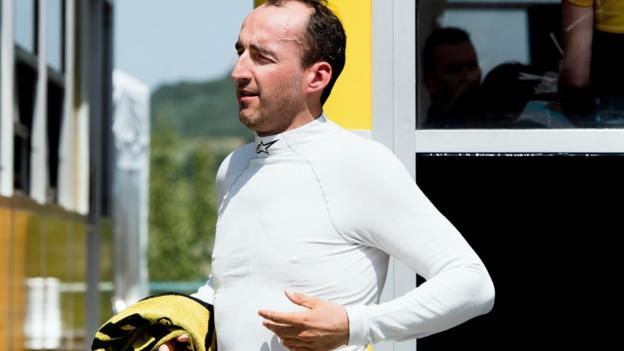
The power of the story and the resilience of its subject are unmissable – Robert Kubica will race in Formula 1 next year eight long years after he was nearly killed, and with what can only be described as a disability.
The 33-year-old Pole’s withered right arm is a testament to the brutal battle Kubica has fought since much of the right side of his body was smashed by a road-side barrier that penetrated his car on a rally in northern Italy in February 2011.
At the time, he was one of F1’s brightest stars, poised to start his second season with Renault, and had already signed to join Ferrari as Fernando Alonso’s team-mate in 2012.
But that possible future was torn away from him when he lost control on a chilly mountain road, hit that barrier end on and was left fighting for his life, with a partially severed right arm and multiple fractures.
That arm and hand bear the effects of that accident to this day – visibly atrophied, held awkwardly, it has clearly limited strength and partial movement.
This is clear from in-car shots of him driving his Williams in practice sessions this year; he cannot bend the fingers on his right hand, so sort of wedges it against the wheel, effectively using not much more than friction to turn on that side.
And yet Kubica has now been announced as a Williams driver for the 2019 Formula 1 season.
It is one of the most remarkable comeback stories in the history of sport.
What happened to Kubica?
Kubica suffered life-changing injuries during the high-speed crash shortly after the start of the Ronde di Andora Rally in Liguria, Italy, in 2011
One can only imagine the difficulties Kubica has faced, the determination and mental fortitude it has taken to get to this point.
When he crashed his rally car in February 2011, he was weeks away from starting his fifth full F1 season and was regarded as a talent in the same bracket as superstar world champions Lewis Hamilton and Alonso.
He was driving in the rally because he enjoyed it, but also because he believed it would make him a better driver. But then things went wrong, and the pictures of the aftermath of the accident tell their own story.
It took an hour to get him out of the car. Once in hospital, the first operation – he has since had 17 more – was seven hours long.
“The reality was the first big moment I was fighting to be alive,” Kubica said in a BBC Sport interview in 2017.
“People are concentrating only on my arm because it is the biggest limitation. But the reality is I had fractures from my feet up to my shoulders on the right-hand side.
“I had many fractures and that’s why it was so complicated and takes so long to recover. But of course my arm was the most damaged.
“The first two months were tough. I was lucky I was a sportsman and driving F1. That’s probably why my arm is still there.
“But on the other hand there are moments when you have to forget who you are but you are a human being. This is maybe something where the situation was not easy to cope.”
Eighteen months after the accident, Kubica was back in a rally car – and he won the first event he took part in.
“People were seeing me and concentrating on getting me as fast as possible back to the car,” he said. “In the end, I decided first I have to wake up in the morning happy, then I can start to be a racing driver.
“It probably took me over two years to get back to a reasonable level. I had for months, even a full year, pain everywhere depending on the conditions I was in.
“You have to first of all feel good with yourself before doing something which requires being fast or driving a racing car. It is not that I lost my biggest passion – it is still racing.
But also my general life has changed a lot and this was crucial.”
Kubica raced in the WRC Wales Rally Great Britain in 2013 (pictured) but went on to win the inaugural WRC-2 title
The long road back to F1
By 2013, Kubica’s arm was sufficiently recovered for him to do some work in the Mercedes F1 simulator, but it did not have the necessary movement for him to drive an F1 car. He was not able to rotate his wrist enough – he could turn left only by lifting his elbow, which is not possible in an F1 cockpit.
Instead, he turned to rallying, and spent three seasons competing in the world championship, proving blisteringly fast and brave, but prone to big crashes.
By the end of 2015, the money had run out.
“I didn’t know if I would get the chance to return to F1,” Kubica said, “but after rally time I had a difficult period. I was weighing 10kg, perhaps 15kg, over normal weight. So I started preparing.”
Kubica emerged in F1 as Sauber’s test driver in 2006, with Jacques Villeneuve (left) and Nick Heidfeld the main drivers
He systematically tried a range of racing cars to see if he could be competitive in them, explored the idea of returns in DTM German touring cars and the World Endurance Championship.
The turning point was around December 2016, when he spent some time in the simulator at the Italian racing car constructor Dallara, and realised an F1 return might now be a realistic possibility.
“I needed to get back in a proper rhythm of my life and if the chance will come I need to get the maximum out of it,” he said. “In most of the cars I was able to achieve what was my target and four months ago nobody could expect this and that’s why I really appreciate the chance Renault are giving me. But I want to do my best.”
The guys at Renault had kept in touch, and they suggested a one-off test in a 2012 F1 car.
That came in Valencia in June 2017. It was about completing the circle more than anything else, just to give him a chance to try it again after so long. But he impressed so much – completing more than 100 laps, quicker than the team’s reserve driver – that a second test, this time much more serious, was arranged.
That test came at Paul Ricard in the south of France, after which hopes were still alive of a comeback. But then, after a third test in the team’s 2017 car at the Hungaroring, Renault cooled – he had not been quick enough.
Williams, though, were interested, and started talks. They got to the verge of him signing a contract to race in 2018, but then another test put a spanner in the works.
In Abu Dhabi last year, immediately after the end of the season, Kubica drove and so did Williams race driver Lance Stroll and Russian hopeful Sergey Sirotkin.
Once they had stripped out the variables of fuel load, tyre type and car set-up, Williams found that Kubica, while faster than Stroll, was slower than Sirotkin. And the Russian had more than double the amount of sponsorship he could bring to the team, which made the decision easy. Sirotkin it was; Kubica was offered the role as reserve driver.
Kubica drove for Renault at in-season testing in Budapest in 2017
So what has changed a year on?
Kubica has done a number of tests for Williams this year, as well as work in the simulator. In the virtual world, the word is he is quicker than Stroll and Sirotkin. This has been less immediately apparent in the real world, but events have turned in Kubica’s favour.
Stroll and his money are off to Force India, now run by his father after a mid-season takeover.
Sirotkin, meanwhile, has not been especially impressive in his debut season – he has out-qualified the Canadian 12 times in 20 races, but his advantage has not been as great as the team or his backers had hoped. As a result, he has less money available than last year, and Kubica has been able to find more.
At the same time, Kubica is well-liked within the team, has excellent technical feedback, his promotion has a feel-good factor about it as well as a positive PR effect, and there is the hope that with more time in the car he will be able to recover his former abilities.
Alongside him, hopes are very high for new signing George Russell, a British driver poised to win the Formula Two title this weekend, a Mercedes protege and one of the most highly rated prospects in the sport.
Why the keenness on Kubica?
Kubica took victory at the Canadian Grand Prix in 2008 finishing 16.495 secs ahead of his BMW Sauber team-mate Nick Heidfeld
Kubica won just one race in his F1 career – the 2008 Canadian Grand Prix. So why, some may wonder, is there such a fuss about his comeback?
On one level, the answer to that is obvious. If a man with this sort of disability, after going through so much, can return to F1 after eight years and be competitive, it is awe-inspiring.
But beyond that, there is the possibility of a mega-talent being back in F1.
“Robert’s one of the quickest drivers I’ve ever raced against,” said Hamilton. “He’s one of the best drivers I’ve driven against.
“Just raw, natural talent, which I think as a sport it’s a shame we don’t have here with us – because there’s not a lot that comes through. Not a lot of great, great drivers come through. You have some that are much better than the rest, but still not the greatest, and then you have real special drivers like him.”
Kubica’s last season was his finest. In the Renault, not a fully competitive car, he put in some stunning performances, the best ones at the three greatest drivers’ circuits on the calendar – Monaco, Spa and Suzuka.
He qualified second, third and fourth at those races, places the car had no right to be. And was equally impressive in the grands prix.
Kubica had to stop his TV interviews immediately after qualifying in Japan because he found he could not speak. He went away to sit by himself for 10 minutes while he contemplated what he had just done.
Renault sporting director Alan Permane, who was instrumental in organising Kubica’s tests for the team in 2017, says: “Suzuka qualifying in 2010 was a lap like I’ve never seen from anyone else, ever. He came in absolutely white, having scared the life out of himself.”
From a man who has been in F1 for more than 25 years and worked alongside Michael Schumacher and Alonso, that is quite a compliment.
How do his limitations affect him?
In 2007, Kubica escaped with a minor concussion and a sprained ankle from a horrific crash at the Canadian GP
Seeing Kubica in the paddock, his right arm clearly limited in movement, and watching on-board footage from his car, it seems incredible that he can drive close to the absolute pace of F1.
But as he says: “I drive like my body and my limitations leave me to do it. After my accident, I discovered that to do a roundabout in the road car, you don’t have to grab the steering wheel, you can use friction to turn.
“F1 is not a road car, but I have been also in school where they give you a bird in the hand and you have to hold it [so] that it doesn’t fly away but you cannot hold it too much that it gets scared. This is the way you have to hold the steering wheel.
“When I was racing in the past, in Malaysia on one of the first weekends I did in 2006 [as BMW test driver], there was footage when you see me driving with three fingers open. And the engineers were shocked.
“They said, ‘Why?’ I said: ‘I don’t know. Probably you don’t need to use all the power you have. You just need to use what is enough.’
“Then, that it looks different than 10 years ago and to the others, I know. But the outcome is probably the same or nearly the same.”
As Mark Webber, a former rival, says: “What a warrior he is.”
Kubica finished third in the 2010 Monaco Grand Prix behind Mark Webber
President Donald Trump got his holiday tweet-a-thon rolling early on Thursday with a Thanksgiving Day reminder that it’s a “mean & nasty world out there” before charging that some judges are making the country unsafe.
In a tweet at 6:58 a.m. from his iPhone from Mar-a-Lago, the president was actually quoting Secretary of State Mike Pompeo about U.S. relations with Saudi Arabia, underscoring that the grim state of the world applies “in particular” to the Middle East.
Without mentioning his decision on Wednesday to not let the murder of Washington Post columnist Jamal Khashoggi interfere with U.S. arms sales to Saudi Arabia, Trump pointed to Pompeo’s reference to a “long and historic commitment” with the Saudis, adding that it is one that is “absolutely vital to America’s national security.”
Noting his “100%” agreement with his secretary of state, the president added that “many Billions of Dollars of purchases made in U.S., big Jobs & Oil!”
The tweet appeared to respond to widespread criticism, including from key Republican senators, over his downplaying — “it is what it is” — the Oct. 2 killing of the U.S.-based journalist and the likely involvement of Saudi crown prince Mohammed bin Salman.
Justice Roberts can say what he wants, but the 9th Circuit is a complete & total disaster. It is out of control, has a horrible reputation, is overturned more than any Circuit in the Country, 79%, & is used to get an almost guaranteed result. Judges must not Legislate Security…
Three minutes after this opening salvo, Trump was back in trademark Trump all-caps and exclamation-points mode to mark the holiday:
“HAPPY THANKSGIVING TO ALL!”
While Twitter followers soaked up the salutation for 20 minutes, Trump was back in attack mode, reviving his back-and-forth with Supreme Court Justice John Roberts, who rebuked the president on Wednesday for referring to an “Obama judge” in defending the integrity of all federal judges.
….and Safety at the Border, or anywhere else. They know nothing about it and are making our Country unsafe. Our great Law Enforcement professionals MUST BE ALLOWED TO DO THEIR JOB! If not there will be only bedlam, chaos, injury and death. We want the Constitution as written!
Roberts, from his perch in the third branch, asserted that there were no “Obama judges” or “Trump judges,” rather “an extraordinary group of dedicated judges doing their level best to do equal right to those appearing before them.”
Trump, for the second day running, begged to differ.
“Justice Roberts can say what he wants, but the 9th Circuit is a complete & total disaster,” Trump tweeted.”It is out of control, has a horrible reputation, is overturned more than any Circuit in the Country, 79%, & is used to get an almost guaranteed result. Judges must not Legislate Security…”
After leaving his readers hanging for nine minutes, Trump weighed back in by adding that judges also must not legislate about “safety at the border, or anywhere else.”
“They know nothing about it and are making our Country unsafe. Our great Law Enforcement professionals MUST BE ALLOWED TO DO THEIR JOB! If not there will be only bedlam, chaos, injury and death. We want the Constitution as written!”
“It would not be a relaxing evening at the theater,” Radcliffe told Seth Meyers on Late Night. “I feel like I would be being watched for my reaction.”
“Maybe that is completely conceited and egotistical and people wouldn’t care,” Radcliffe added about his paranoia, “but I do feel if I was just surrounded by Harry Potter fans, I’d feel like…it would be a little odd.”
He also assured Meyers that he isn’t avoiding the play because it might “throw me into some sort of existential crisis” (it might, though).
Meyers suggested Radcliffe go see the show in disguise. Might we suggest a character?
President Donald Trump is threatening to close the US border with Mexico for an undisclosed period of time if his administration determines that its southern ally has lost “control” on its side.
The repeated threat, which came on Thanksgiving Day in the US, is in response to thousands of migrants and refugees who have arrived in border town of Tijuana, many hoping to apply for asylum.
“If we find that it’s uncontrollable,” Trump said, “we will close entry into the country for a period of time until we can get it under control. The whole border.”
Thousands of Central Americans, fleeing violence, extreme poverty and political persecution, have made their way to the border over the last month as part of a caravan, dubbed the Central American exodus. Thousands more are following behind.
Caravans from the region are not rare, but this one is unusual for its size. Migrants and refugees often prefer to travel in groups to avoid the dangerous journey through Mexico to the border.
According to Mexico’s Baja California state governor, more than 5,600 migrants and refugees have arrived in the Tijuana in recent days, and the stadium sheltering individuals is now over capacity.
Migrants and refugees stand in line for a meal after arriving in Tijuana, Mexico [Jorge Duenes/Reuters]
Central Americans who are part of the collective exodus have shared harrowing stories of being forced to leave their homes due to threats or violence. Others, including those with or caring for individuals with disabilities or health conditions, are hoping to find work in the United States to afford medical treatment.
Since the initial collective exodus set off from Honduras in October, Trump has sought to sow fear, often falsely labelling the group as an “invasion” and saying, without giving evidence, the caravan is full of “criminals”.
Authority to use lethal force
The president also deployed thousands of troops to the border, and this week gave the US defence chief expanded powers to use the military to protect US Border Patrol agents. On Thursday, Trump confirmed that he gave troops the “ok” to use lethal force against migrants and refugees “if they have to”, even though there have been no signs of violence towards US authorities.
US Customs and Border Protection (CBP) is set to hold a “large-scale operational readiness exercise” at the San Ysidro port of entry in Tijuana on Thursday.
A boy, part of a caravan of thousands travelling from Central America en route to the United States, walks through a makeshift camp in Mexico City [Hannah McKay/Reuters]
The administration also implemented new asylum rules on the border, which were temporarily blocked by a US judge.
Under the new rules, individuals crossing the border between official ports of entry would not be eligible for asylum. Rights groups call the rules a violation of US and international laws.
On Monday, US District Judge John Tigar issued a temporary nationwide restraining order prohibiting the enforcement of the policy, saying “Whatever the scope of the president’s authority, he may not rewrite the immigration laws to impose a condition that Congress has expressly forbidden.”
Many of those who have arrived in Tijuana say they want to apply for asylum at an official port of entry. Asylum seekers, however, have been told they may have to wait weeks before submitting their application.
Additional reporting from Sandra Cuffe in Tijuana, Mexico.
Winds and record low temperatures raised concerns
for balloons and show floats in Macy’s Thanksgiving Parade, but show went on. USA TODAY
The annual Macy’s Thanksgiving Day Parade mounted its annual trek through the heart of Manhattan Thursday, despite record low temperatures and winds close to the danger level for high-flying Charlie Brown and SpongeBob balloons.
Hundreds of thousands of onlookers, some arriving hours ahead of time, huddled under blankets and behind guardrails as the eye-catching floats, balloons and marchers wound their way for 46 blocks, from the west side of Central Park to Macy’s flagship store in midtown Manhattan.
The parade, which began in 1924 to promote the venerable department store, featured some 8,000 marchers, including high school bands from across the country, and two-dozen floats setting the stage for the arrival of Santa Claus.
[Prelim Stat for Thanksgiving] The low temp this AM at Central Park was 19° tying Nov 28, 1901 & Nov 30, 1876 for the 2nd coldest low temp for Thanksgiving Holiday. The coldest low (15°) occurred on Nov 30, 1871. Updated info will be provided once the final high & low occurs.
Diana Ross, John Legend, Martina McBride and the Muppets from “Sesame Street” performed, despite an extreme cold weather alert for performers and onlookers alike.
A New York City advisory urged anyone going outside to wear hats, scarves, gloves and layered clothing and to keep their fingertips, earlobes and noses covered to prevent frostbite.
The temperature dipped to 19 degrees at 11 a.m. EST, breaking the previous record low for the event of 21 degrees, marked in 1930, 1938 and 1972.
The low temperature this morning at Central Park tied Nov 28, 1901 and Nov 30, 1876, for the 2nd coldest low temp for Thanksgiving. The coldest low, 15°, happened on Nov 30, 1871, according to the National Weather Service for New York.
The critical factor for the parade, however, is not the cold but the wind. With 16 helium-filled balloons of animated characters floating at the end of long cables above the parade route, wind can quickly turn a parade into a danger zone.
In 2013, the giant “M&M’s Chocolate Candies” balloon got caught on a street lamp in Times Square, knocking off part of the top. Two sisters were hit by the falling debris, with one requiring stitches.
The balloons are grounded if winds are stronger than 23 mph and wind gusts higher than 34 mph. Less than two hours before the parade, the winds were clocking 15 to 20 mph with gusts of 30 mph.
If conditions worsen, police said they are ready to order the balloons to a lower altitude or scrubbed entirely.
In fact, some of the balloons seemed closer to the ground than in past years, soaring only a few feet above those holding their tethers. The outstretched hand of the “Diary of a Wimpy Kid” balloon appeared to hit some of his handlers on their wool cap-covered heads.
Temperatures aside, Police Commissioner James O’Neill said thousands of officers will be stationed along the parade route to keep an eye out for other potential trouble spots. Counterterrorism teams with long guns are on hand, with plainclothes officers mixing into the crowd.
A new squad of K-9 teams that can sniff out explosives from a few hundred feet away will also be surveying the scene.
On the entertainment front, the parade also features Bad Bunny, Kane Brown and Ella Mai, Pentatonix, Rita Ora, Sugarland, Anika Noni Rose, Barenaked Ladies, Leona Lewis, Fifth Harmony’s Ally Brooke, Bazzi, Ashley Tisdale and Carly Pearce.
Facebook is carefully walking back statements it made about hiring a Republican opposition-research group to investigate billionaire George Soros.
In a blog post published late Wednesday, right before many Americans left work to begin the Thanksgiving holiday, Facebook admitted to asking an opposition-research company to investigate billionaire George Soros over his public criticism of the social network.
Elliot Schrage, Facebook’s outgoing head of communications and policy, explained the company’s decision to hire Definers Public Affairs and essentially took the blame for the decision.
“In January 2018, investor and philanthropist George Soros attacked Facebook in a speech at Davos, calling us a menace to society,” said Schrage.
“We had not heard such criticism from him before and wanted to determine if he had any financial motivation. Definers researched this using public information.”
“Later, when the Freedom from Facebook campaign emerged as a so-called grassroots coalition, the team asked Definers to help understand the groups behind them,” he added.
“They learned that George Soros was funding several of the coalition members. They prepared documents and distributed these to the press to show that this was not simply a spontaneous grassroots movement.”
Schrage’s admission flies in the face of statements previously made by CEO Mark Zuckerberg and COO Sheryl Sandberg, who both denied having any knowledge of hiring Definers until the news was made public by a New York Times investigation last week.
Sandberg said in a comment attached to the bottom of Schrage’s post that she initially did not remember hiring the Republican opposition-research firm when she read the New York Times story.
But Sandberg inevitably walks back her denial of knowing about Definers, admitting that the work “crossed her desk.”
Sandberg emphasized that the company did not intend to play into anti-Semetic conspiracy theories about Soros.
“I also want to emphasize that it was never anyone’s intention to play into an anti-Semitic narrative against Mr. Soros or anyone else,” she said.
“Being Jewish is a core part of who I am and our company stands firmly against hate. The idea that our work has been interpreted as anti-Semitic is abhorrent to me — and deeply personal.”
But Facebook’s response to the scandal, and the many scandals that have predated this, suggest that the company is trying scuttle the admission that it did indeed hire a Republican-opposition research company to conduct a smear campaign against its critics, as first reported by the New York Times.
Still, despite all of this drama, Facebook does not have any major leadership changes planned. Zuckerberg told CNN Tuesday he has no plans to step down as chairman, and that he supports COO Sheryl Sandberg, who feared she may lose her job according to a Wall Street Journal report.
So it seems that despite all the public backlash, Facebook remains an unsinkable and unshakeable network. We just hope that some of the more savvy users will finally consider deleting their accounts.
The wife of a British student who was sentenced to life in prison for spying in the United Arab Emirates (UAE) has condemned the United Kingdom government for putting diplomatic relations before an “innocent man’s freedom”.
Daniela Tejada told the BBC on Thursday that UK Foreign Office officials bungled the 31-year-old PhD student Matthew Hedges’ case.
Tejada, who is due to meet the UK Foreign Secretary Jeremy Hunt, said British officials gave “the impression they were putting their interests with the UAE above a British citizen’s rightful freedom and his welfare”. She added that they were “stepping on eggshells instead of taking a firm stance”.
Britain views the UAE as a strategic Middle East ally which it supplies with arms.
WATCH: UAE appeals court sentences Matthew Hedges to life in prison (2:55)
Hedges was arrested at Dubai airport on May 5 and has been held in detention since. His sentencing on Wednesday shocked the UK and put political pressure on the foreign secretary.
He was researching the UAE’s foreign and internal security policies after the Arab Spring revolutions of 2011, studies that Britain insisted were entirely innocuous, but which the UAE said threatened its political and economic security.
‘Serious diplomatic consequences’
On Thursday, Hunt warned the UAE of “serious diplomatic consequences” over the case.
Prime Minister Theresa May also told a session of the parliament she was “deeply disappointed” and instructed the Foreign Office to “continue to press this matter at the highest level with the Emiratis”.
Al Jazeera’s Paul Brennan, reporting from London, said the sentence may have come as a shock to the Foreign Office, especially after they had a meeting with a UAE leader 10 days ago.
“Apparently [Hunt] was given assurances about Hedges’ fate and the likely outcome of the proceedings, those assurances appear to have been worthless,” Brennan said, adding that Tejada has also been critical of the UAE’s handling of the case.
“The family are extremely unhappy with the process that was followed, that he was held without being told what the charges against him were.”
‘Not their duty’
Tejada said she pleaded with the Foreign Office to force the UAE to release Hedges from solitary confinement throughout his pre-trial detention.
“They just disregarded my requests. They said that it wasn’t part of their job, that it wasn’t part of their duty.”
Her voice broke down several times as she described the fear that gripped her husband during the sentencing.
“He was very, very scared when he was standing in front of the judge,” said Tejada. “He started shaking when the translator told him the sentence. He actually had to ask to double-check if he had heard right.”
In a separate interview with the Reuters news agency, Tejada called on the Emirati authorities to free him.
“Handing a life sentence to an innocent researcher who held the UAE in high regard speaks volumes about their lack of tolerance and respect for human life,” she said. “They must review their sentence and release my husband who has already had more than six months taken away from us.”
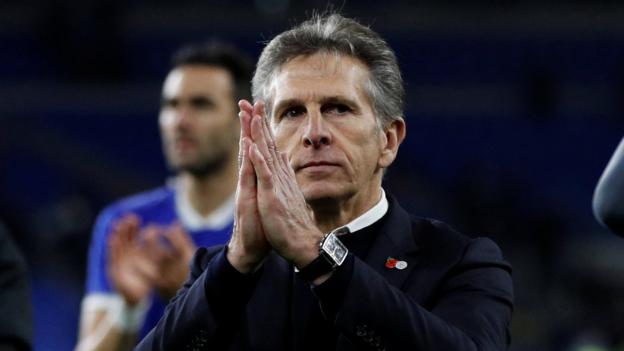
Claude Puel has been Leicester City manager for just over a year
Leicester City manager Claude Puel says it is time to “restore all focus on football” as they move on from the death of their owner.
The Foxes have played two emotional games since Vichai Srivaddhanaprabha and four others died when his helicopter crashed following a 1-1 draw with West Ham.
“Our tributes for the chairman are in our minds but now it is important to speak about football,” said Puel.
Leicester visit Brighton on Saturday.
Puel thinks the international break came at the right time for the club.
“It was a good thing for us, for some players, for their bodies, their minds and for the international players – it was important to have this,” Puel said.
“During two weeks, they can forget a little and have their mind with other thoughts. The international players come back with a smile and are happy to come back.”
The Foxes are 10th in the Premier League after a 1-0 win at Cardiff and 0-0 home draw with Burnley following the tragedy.
“It’s not pressure,” Puel said. “It’s a responsibility to continue Vichai’s vision. I was very proud of my team in the last two games.”






/https%3A%2F%2Fblueprint-api-production.s3.amazonaws.com%2Fuploads%2Fcard%2Fimage%2F887401%2F98f0b449-253f-4aea-ba77-61532c2f5df6.jpg)


 trendynewsday