‘Planet Zlatan’ – Ibrahimovic on Pogba, life in LA and his ‘ugly’ feet

news image

They said I was too old, I made the Premier League look old – Ibrahimovic

Listen to the full ‘Zlatan is Football Daily’ podcast on BBC Sounds

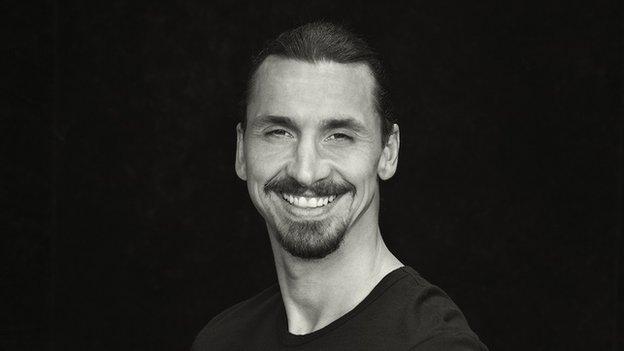
In the space of one sentence during his interview with BBC Sport, Zlatan Ibrahimovic refers to himself in the third person three times.

Other footballers – other people – wouldn’t be able get away with such a self-aggrandising habit, but Zlatan can because, well, he’s Zlatan.

The Swedish striker’s CV includes many of Europe’s biggest clubs – Ajax, Juventus, Barcelona, both Milan sides, Paris St-Germain and Manchester United. He has scored goals in spectacular number and nature, and has spoken just as explosively and freely wherever he has been.

He has won 25 major club trophies during his career, is his country’s all-time record goalscorer and has an individual honours list on Wikipedia that is 43 entries long.

The latest of these solo gongs come from his debut season in Major League Soccer (MLS), where his typically superb displays for LA Galaxy earned him a place in the league’s best XI and the newcomer of the year award. He also claimed the goal of the season for a truly stunning 40-yard strike. On his debut. In the LA derby. To level the score at 3-3. Just to ensure everyone was paying attention, he then scored the game’s winner in the 91st minute.

“I am not arrogant, I am confident,” Zlatan said at a news conference this week

BBC Radio 5 live’s Football Daily spoke to the 37-year-old about scoring goals, his time at Manchester United, choosing LA and hanging pictures of his “ugly” feet on the wall…

Zlatan on scoring goals

Zlatan Ibrahimovic: LA Galaxy striker scores 500th career goal with spinning volley

“In the beginning it was not about scoring goals, it was about who had the best skills, the best technique and I brought that with me wherever I went. A certain point came when it was: ‘Listen, this is high level, you need to perform, you are a striker you need to give us goals and if you don’t score I don’t need you’.

“That changed when I came to Juventus. Everything was new for me. I was like, ‘Wow, big club, big players, big coach, big history’.

“From the first day after training I heard [then coach] Fabio Capello scream ‘Ibra!’ and he just pointed. He had taken guys from the academy and youth team and I trained with them. They gave crosses and I scored.

“Every day for 30 minutes sometimes I just wanted to go home because I was tired and did not want to shoot any more – I didn’t want to see the goal or the goalkeeper. I would just hear ‘Ibra!’ and I knew what it was. I was shooting, just shooting, good shots, bad shots.

“In the end I became a machine, in front of goal, score a goal, especially in Italy as a striker it is the most difficult position because they are so tactically good.

“I remember a game against Paolo Maldini and Alessandro Nesta [AC Milan] – you only get a half chance and behind them you have Dida and you have a world-class goalkeeper, but I had that luck that I had Gianluigi Buffon as a training partner and in front of him was Lilian Thuram and Fabio Cannavaro. If you ever got past them you had pain and then you had to get past Buffon, so I had a good environment to score goals and the goals would come as long as you trained.”

Ibrahimovic has a new book out in November called I Am Football, featuring pictures from his career

On moving to England

“When I went to England I was talking to different players that I knew well and trusted that would give me an honest opinion. From all of them everyone said do not do it, they said it would not be good for my career because you put your whole career on one season. If you do not do a good season people will say the rest of the things you did before were useless because you didn’t make it in England, but that triggered me and that’s the challenge I wanted.

“I went against everyone and said that’s what I wanted to do. They thought I was too old, I was 35 and I made the Premier League look old. It took me three months to convince everyone who I was. That was the challenge and I never turn down a challenge.”

Jose Mourinho called Ibrahimovic “an extension of my right arm”

On Paul Pogba and the Premier League

“I miss all of them. I had a fantastic time at United. Wazza [Wayne Rooney], Michael Carrick, then the young guys that wanted to show the world who they are by playing football and they had a lot of hunger to show. I had a good time because I got to know everyone, I was the mature guy with all these guys who were not mature.

“Paul Pogba, I had never played with him before and I didn’t know him as a person. We have the same management and when I got to know him I got to find a fantastic person and a fantastic footballer, but someone who needs to be guided.

“He is a professional guy that works every game and never misses training or a game. Those are all the things that people do not see, you only get judged by what you can see on television or the 90 minutes in the stadium, that’s where you have to perform.

“When you click with someone it just clicks. The connection on the field was amazing, we helped each other very well, I needed him and he needed me. The first year at United we had a fantastic year.

“They made me feel like Benjamin Button. I was getting younger and younger, then unfortunately I got my injury.

“The Premier League should be happy I did not come 10 years ago because it would’ve been a different story. You see all my numbers [of goals] and all of these numbers would’ve been in the Premier League. I came to the right club in United. It was the club and the shirt that I was supposed to shine in and I did it.”

On injury

Ibrahimovic suffered a serious knee injury in a Europa League game against Anderlecht in April 2017

“When it happened I did not understand what I was going through, I had never had a serious injury. I was like Superman, I was unbreakable and no-one could break me, only Zlatan could injure Zlatan.

“I said, ‘This is not the way I want to stop playing football. The way I walked in is the way I will walk out, not by limping or someone saying it’s over’. This was a new challenge for me and I said I would come back when I was ready and I would play exactly as I did before. When I cannot do that I will not continue in football because I’m not here for charity.

“After my injury, when I was selected, I said to Jose Mourinho, ‘I do not want to disappoint you or my team-mates. You had a Zlatan before the injury and you had one after the injury and I cannot give you the Zlatan that you are used to, that’s why I will not give you this Zlatan because I’m not ready.’

“My second year at United, I was not feeling ready, I was feeling different, it was like I was starting at zero and I had to teach my knee how to play football again. After a while my confidence grew, I needed a new environment to feel that I was comfortable.”

On life in LA

Ibrahimovic has been a hit with MLS fans

“We [Ibrahimovic and his wife] had talked about it and she said one day I would like to see how it is to live in LA, that was one of the many factors when I chose LA. LA did not choose me, I chose LA.

“They are happy to be here, there’s less stress, if I can be negative the time difference is too big because of all my family from Sweden and I only have a short time to connect with them.”

On arriving in LA, Ibrahimovic took out a full-page advert in the LA Times which read, “Dear Los Angeles. You’re welcome”.

“I felt I was giving them something they did not have before and I gave myself as a present to them. They did understand what I was and all the things I said would happen. It took 10 minutes to present myself in a way I did in my first game at the Galaxy and they understood what I had given them.”

On his feet

An image of Ibrahimovic’s feet is included in his book I Am Football

“My wife does not allow me to have pictures of myself. She says, ‘There is already enough talk of you and I don’t want to see you on the walls, it is enough that I see you in real life’.

“There is one of my feet on the wall. That is what has given us what we have, it is a reminder for the family, not for me, of what we have. That is what has created the whole situation, the whole buzz around me – the two feet.

“I play this beautiful sport with my feet. Even if it is ugly toes, we don’t care – we put it on the wall just as a reminder, we have food to eat thanks to those feet so you should kiss those feet every day – no, I’m joking. Every footballer’s toes and feet around the world are ugly – there is no beautiful out there.”

On Planet Zlatan

“I came from my own planet, with something that no one has seen. I’m a guy from this area that they think is the ghetto. They saw me differently, they did not make me feel welcome, they did not make me feel like everyone else, but I came with something else and now they follow that. I came from my own planet – Planet Zlatan.”

Read More

from Trendy News Day https://ift.tt/2DV8nt8
via IFTTT

Jimmy Fallon’s duet with Sophia the robot is as sweet as it is unsettling

news image

One of the most tender, or creepy duets ever performed on The Tonight Show features a robot.

Hampton Robotics’ famous humanoid robot, Sophia, the first citizen robot in the world, joined Jimmy Fallon for a song on Wednesday night.

After introducing her robot sister, the forthcoming Little Sophia, Sophia used her AI voice to sing a rather lovely, if not undeniably unsettling rendition of A Great Big World and Christina Aguilera’s “Say Something,” with Fallon.

Sophia appears around the 4:30 mark, after a slew of other robots from around the globe, including MIT’s Mini Cheetah, a ‘blind’ robot dog great for hunting you on a moonless night, and Tomatan, a wearable tomato-feeding robot.

Ah, the future.

Read More

from Trendy News Day https://ift.tt/2S4FTQB
via IFTTT

Julian Assange: The battle to save freedom of press

news image

Last week it became clear that what WikiLeaks founder Julian Assange and his lawyers have been warning for seven years has already happened: He has been charged in a criminal case in the United States. The fear of being extradited and tried in the US has forced him to seek refuge at the Ecuadorian embassy in London since 2012. 

This news hardly came as a surprise to those of us who have been following his case or have been convinced that Assange’s fate is of profound and historical importance and could define the future of the freedom of the press.

What happens if Assange is tried in US

There are some in the West who are fully convinced that Assange deserves to be tried and thrown in jail for “threatening” US national security and “undermining” its democratic processes. Former US presidential candidate Hillary Clinton and former Vice President Joe Biden have called him a “terrorist”, US Secretary of State Mike Pompeo, then the director of the CIA, has described WikiLeaks as a “non-state hostile intelligence service” and US Attorney General Jeff Sessions has said prosecuting Assange is a “priority” for him. 

Many have also come to see him as a political player who purposefully sought to influence the outcome of the 2016 US presidential elections, while others consider him a stooge of Russian President Vladimir Putin, although no evidence for this was ever found. It is more likely that Assange’s indictment is coming not as part of Special Counsel Robert Mueller’s investigation into Russia’s role in the 2016 US election, but in response to WikiLeaks publishing the biggest leak in the history of the CIA called #Vault7

Whatever Assange’s political leanings or views, his case is not about whether you like him or not, but about freedom of the press. As Edward Snowden rightly said: “You can despise WikiLeaks and everything it stands for. You can think Assange is an evil spirit reanimated by Putin himself, but you cannot support the prosecution of a publisher for publishing without narrowing the basic rights every newspaper relies on.”

If Assange is eventually arrested, extradited to the US and stands trial there, he is almost certainly going to be found guilty – just as Chelsea Manning was – and he would probably end up in a Guantanamo-like prison. His prosecution and jailing would have global repercussions for whistle-blowers, publishers and journalists.

According to US lawyer and civil liberties advocate Ben Wizner at the American Civil Liberties Union (ACLU): “Any prosecution of Mr Assange for WikiLeaks’ publishing operations would be unprecedented and unconstitutional, and would open the door to criminal investigations of other news organizations”. 

In other words, a lawsuit that tries to make it illegal or a form of “espionage” to publish documents would set a dangerous precedent for publishers and journalists who routinely violate foreign secrecy laws to deliver information vital to the public’s interest. It would endanger the very foundation of free press. 

Why this is important for all of us

We already live in a world in which politics and distribution of information are being profoundly transformed. Not only do dangerous populists and authoritarian leaders come to power by “manufacturing consent”, backed by the use of “perception management” methods by tech companies or organised fake news campaigns, but they also come to power by openly spreading misinformation and concealing information of public interest. 

While it became “natural” for politicians to employ such questionable methods to reach power, it is the job of journalists, the media and whistle-blowers to keep such behaviour in check. Punishing them for doing their job – uncovering uncomfortable truths that those in power would like to keep away from the public – means removing one of the most important checks on executive political power.  

How would we know today of the wiretapping of the Democratic Party headquarters if it hadn’t been for the hard work of American investigative reporters uncovering information the Nixon administration wanted to hide? How would we know about all the offshore accounts and money laundering activities of politicians across the world if a whistle-blower hadn’t leaked the Panama papers? How would we know how many Reuters journalists were killed by the US army in Iraq, as revealed by the “Collateral Murder” video leaked by Chelsea Manning and published by WikiLeaks? And how would we know how the Democratic Party treats some of its most progressive members, such as Bernie Sanders, if WikiLeaks hadn’t released the files from the hacked Democratic National Committee email server?

Assange had in his hands information of immoral political behaviour by a party and he published it. One can argue about timing and political consequences, but it is hard to deny that it was in the interest of the American public to know these facts. The information was not fake or fabricated; it was the truth.

A criminal trial for Assange in the US would be another blow to journalists, the media and publishers who are already suffering from increasing pressure across the world. So far this year, 45 journalists have been killed across the world. 

In March, Slovak investigative journalist Jan Kuciak and his fiancee were shot in their home. In April, nine Afghan journalists were killed in a bombing in Kabul: Abadullah Hananzai, Ali Saleemi, Ghazi Rasooli, Maharram Durrani, Nowroz Ali Rajabi, Sabawoon Kakar, Saleem Talash, Shah Marai and Yar Mohammad Tokhi. In July, three Russian journalists were shot dead in the Central African Republic while investigating the presence of Russian mercenaries: Aleksandr Rastorguyev, Orkhan Dzhemal and Kirill Radchenko. And just over a month ago, Saudi journalist Jamal Khashoggi was killed and dismembered in the consulate of his own country in Istanbul. 

Clear signals are being sent to media professionals across the world that doing their jobs could cost them their freedom or their lives. Feeding this hostile environment instead of standing up to it could be dangerous not only for journalists and whistle-blowers but also for all of us.

Walter Lippmann, the father of modern journalism who coined the phrase “manufacturing consent” (which Noam Chomsky made famous in his 1988 book) wrote back in 1919 in a thin volume called Liberty and the News that “there can be no liberty for a community which lacks the means by which to detect lies”.

Fighting the extradition of Assange to the US is not just about protecting his individual rights, but it is also about protecting the very means by which we are able to detect lies. It is about protecting freedom of the press and our ability to keep checks on political power.

Whatever you might think of WikiLeaks, it is a fact that as a publisher who protects its sources it has always been detecting and revealing lies. 

And as Lippman wrote in Liberty and the News 100 years ago: “Not what somebody says or somebody wishes to be true, but what is so beyond all opinions, constitutes, the touchstone of our sanity.”  

Without WikiLeaks and Julian Assange, without the courageous whistle-blowers and journalists who are revealing the dirty secrets and immoral acts of powerful regimes, who are opposing or criticising authority, truth would quickly lose value. And it would be then that we would also lose the touchstone of our sanity. 

The views expressed in this article are the author’s own and do not necessarily reflect Al Jazeera’s editorial stance.

Read More

from Trendy News Day https://ift.tt/2DSTU0S
via IFTTT

Topics to avoid during Thanksgiving dinner, courtesy of Stephen Colbert

news image

If you’re hoping for a harmonious Thanksgiving dinner in the current political climate, it might be an idea to avoid certain topics, according to Stephen Colbert.

“Another beloved Thanksgiving tradition is stronger than ever: arguing at the dinner table,” pointed out The Late Show host, referencing a 2017 Pew Research Center study that suggests Americans are more divided along party lines than ever.

“So, I would avoid controversial subjects like politics, religion, sports, movies, and how much voter I.D. you need to buy cereal,” said Colbert.

“Also, for god’s sake, do not open up the yam/sweet potato debate,” he added, before diving right into the yam/sweet potato debate.

Read More

from Trendy News Day https://ift.tt/2AbfQ36
via IFTTT

Watching dab melts is such oddly satisfying stoner ASMR

news image

Image: mashable/vicky leta

This post is part of our High-tech High series, which explores weed innovations, and our cultural relationship with cannabis, as legalization in several U.S. states, Canada, and Uruguay moves the market further out of the shadows. 


Move over, slime videos. There’s a more lit ASMR niche to fill.

Aside from the joys of actually getting high, the wave of marijuana legalization has also ushered in something almost as satisfying: dab melt videos. The golden, bubbly THC extracts are like psychedelic honey — watching a live resin dab light up will scratch your ASMR itch in such a satisfying way. 

Dubbed “melt shots,” the videos feature live resin being heated up so they melt into a glorious gooey THC-laden dab. Whether you consume it through a bubbler or a bong, live resin has the potential to get you insanely ripped — so if you do dab, do so carefully. 

Each cannabis leaf is coated in a waxy substance called trichomes, which contain cannabinoids — the THC and CBD — and terpenes that make up a well-rounded experience. The traditional weed harvesting method, which involves curing and drying the plant before it’s sent out for consumption, can strip the plant of many of the terpenes that give it flavor and aroma — and can compliment the cannabinoid’s psychological effects. 

Live resin is unique because it’s extracted from fresh cannabis plants, instead of dried or cured ones, and flash frozen. This reportedly retains the terpenes. Freezing the plants also locks out moisture, which can get in the way of the purity of the extraction, according to Precision Extraction

In a process similar to isolating water and vinegar, the resin is extracted with the aide of a solvent. It leaves behind a gorgeous, vibrant yellow liquid that’s then dried, hardened, and distributed in crystalline cubes. 

The videos of people melting the live resin dabs are freaking satisfying. Here are a few dab melts for you to watch late at night when you should be sleeping instead. 

Even if you aren’t ready to dab yourself, at least you can watch these sweet, sweet videos. 

Https%3a%2f%2fblueprint api production.s3.amazonaws.com%2fuploads%2fvideo uploaders%2fdistribution thumb%2fimage%2f86947%2fef8ecfd6 67aa 4dd5 b653 f0c8f51fa398

Read More

from Trendy News Day https://ift.tt/2qYzrz7
via IFTTT

Apple reportedly looked at a lower-priced streaming TV dongle

news image

Apple reportedly looked into a lower-priced streaming TV solution.

Image: Tomohiro Ohsumi/Getty Images

Apple is lacking a low-priced streaming TV competitor, but that could’ve potentially changed.

According to a report published by The Information, Apple looked at a streaming TV dongle-like device to capture that lower end of the market, citing people familiar with the project.

The dongle could’ve helped put the company’s potential streaming service in the hands of more people. 

It’s reported that the streaming service will only be available on Apple devices and could launch globally as soon as the first half of 2019. Original Apple shows will be free for owners of the company’s products.

A lower-priced product from Apple would be a change in tack from the company’s strategy of leaning toward the high-end, raising the prices considerably on its newly unveiled iPad Pro and the latest iPhones.

At $149, the basic Apple TV (without 4K) costs significantly more than the likes of Amazon’s Fire TV, Roku, and the Google Chromecast, devices which all are being marked down to as little as $20 for Black Friday.

These kinds of devices get the job done, and perhaps Apple recognised that customers don’t always want all the bells and whistles. 

Https%3a%2f%2fblueprint api production.s3.amazonaws.com%2fuploads%2fvideo uploaders%2fdistribution thumb%2fimage%2f87048%2f4cb11a73 a87e 4017 b4f2 901d129e3452

Read More

from Trendy News Day https://ift.tt/2QkDzbf
via IFTTT

Nicklas Bendtner: Ex-Arsenal striker drops appeal against jail sentence

news image

Nicklas Bendtner (left) with his lawyer Anders Nemeth at a court in Copenhagen earlier this month

Ex-Arsenal striker Nicklas Bendtner has dropped his appeal against a 50-day jail term for assaulting a taxi driver.

Bendtner will serve the sentence at his home in Denmark, under “intensive surveillance” with an electronic tag.

The 30-year-old, who plays for Rosenborg in Norway, agreed with the attorney general in Copenhagen to drop his appeal, said lawyer Anders Nemeth.

“Even though he disagrees with the verdict, he would rather focus on his club and family,” Nemeth told the BBC.

When he will serve the sentence has not yet been decided.

Rosenborg’s league season finishes on 24 November and they play in the Norwegian Cup final on 2 December. They have Europa League games against Celtic on 29 November and RB Leipzig on 13 December.

“Nicklas has regretted the incident and he is taking his sentence,” said the club’s general manager Tove Moe Dyrhaug.

“If we make mistakes, it is important that we take responsibility for our actions. Bendtner has his employment relationship with Rosenborg. The verdict from Denmark does change that. We are supportive and take care of our employee.”

The incident took place in September. At trial, the City Court of Copenhagen was shown CCTV footage in which it appeared Bendtner struck the driver in the face.

The Denmark international admitted hitting the taxi driver but said it was because he felt threatened.

He said the driver threw a bottle or a can towards him and his girlfriend when they left without paying.

Bendtner, who played for Arsenal between 2005 and 2014, scoring 45 goals in 171 games, missed out on a place in Denmark’s squad for the 2018 World Cup because of injury.

He had loan spells at Sunderland, Birmingham City and Juventus while at Arsenal, before making a permanent move to German club Wolfsburg.

He moved back to England to join Championship side Nottingham Forest in September 2016 before joining Rosenborg in March 2017.

Read More

from Trendy News Day https://ift.tt/2DRjsLK
via IFTTT

Here are our favorite Dyson products

news image

Disclosure

Every product here is independently selected by Mashable journalists. If you buy something featured, we may earn an affiliate commission which helps support our work.

Give the gift of air, in one form or another.

Image: lili sams/mashable

Dyson doesn’t just make high-end vacuums anymore. The company branched into other categories a while ago. 

Started by James Dyson back in 1991, the British company has since created several household products that innovate through the use of air. Its current line includes fans, air purifiers, hair dryers, and even a hair styling device. 

Here’s a list of our favorite Dyson products that would make great holiday gifts. Each are solid contenders for the “gift that keeps on giving” award. 

This is a stylish air purifier that should fit your needs.

This is a stylish air purifier that should fit your needs.

Image: Pete Pachal/mashable

This device isn’t for everyone, but it’s rife with benefits that anyone can use. The Pure Cool Air Purifier is similar to the other tall oval like fans that Dyson has become known for. This one’s different, though – not only can it blow out cool air, but it can also clean the air. 

From smog to pollen, it can help take impurities out of the air to help you breathe better. If you suffer from allergies or have issues with the air quality inside your home, you might want to add it to your holiday wishlist. 

Plus, it isn’t a home appliance you need to constantly ping. It’s app connected, but after setup, you’re pretty much golden – that is, until you have to replace the filter.

This blow dryer should get hair dry in record time.

This blow dryer should get hair dry in record time.

Image: Lili Sams/Mashable

Sure, a regular old blow dryer gets the job done, but it’s nowhere near as cool as the Dyson Supersonic Blow Dryer. It’s a lot more expensive than a traditional dryer at $399.99, but there’s good reason for that. 

Unlike regular hair dryers that turn up the heat without much regulation, the Supersonic intelligently metes out heated air in a much safer way. It doesn’t burn your hair and works to minimize damage. It also looks really sleek, with an aluminum finish that comes in several colors.

The AirWrap looks suspiciously like a lightsaber handle.

The AirWrap looks suspiciously like a lightsaber handle.

Image: Pete Pachal/Mashable

The most recent product from Dyson is a reinvention of the curling iron. Rather than making the user wait for it to heat up and risk injury, the AirWrap uses air to curl hair. Yes, it pushes out air to curl your hair. It may sound crazy, but it’s actually really cool. 

While we’ve had mixed results, it’s definitely a viable option for anyone with luscious locks looking for a new way to style them. It’s pricey, with a price tag close to $499. But the tech inside is as high-end as it comes, as it can blow air at 110,000 RPM.

This bagless vacuum means business.

This bagless vacuum means business.

Image: Dustin drankoski/mashable

Of course, no Dyson gift guide is complete without an actual vacuum – it’s the category that put the company on the map, after all. The Dyson Cyclone V10 is an expensive and excellent handheld vacuum. It packs a punch with its proprietary technology. 

Like all other Dyson vacuums, it’s a bagless unit. That means no-mess clean-ups, and less costly bag purchases. Even better, thanks to different nozzle attachments, it can also work as an upright vacuum in addition to acting as a handheld. 

Https%3a%2f%2fvdist.aws.mashable.com%2fcms%2f2018%2f9%2f0d9a0d0f e558 209b%2fthumb%2f00001

Read More

from Trendy News Day https://ift.tt/2S3FX32
via IFTTT

Q&A: Hizbul Mujahideen leader: ‘We will never surrender’

news image

Riyaz Naikoo is one of the most wanted armed Kashmiri fighters with a bounty of 12 lakh ($163,000) on his head.

The 31-year-old former mathematics teacher is the commander of Hizbul Mujahideen (HM), a pro-Pakistan armed separatist group that opposes Indian rule in Kashmir.

The HM group, founded in 1989, is regarded as a terrorist organisation by India as well as the United States and the European Union.

The Himalayan region is home to seven decades of conflict, with more than half a million Indian forces deployed to fight rebel groups demanding either independence or merger with Pakistan.

Since the armed rebellion erupted in 1989, more than 70,000 people have been killed, according to estimates by a local human rights federation, Jammu Kashmir Coalition of Civil Society (JKCCS).

In 2010, mass protests erupted again, during which more than 100 civilians were killed – the worst violence in a decade that saw stone-throwing Kashmiri youths hitting the streets against Indian rule.

The killing of popular HM commander Burhan Wani in 2016 sparked the current phase of deadly protests that has pushed a growing number of youths towards armed rebellion.

Al Jazeera spoke to Naikoo over the phone to discuss whether he would consider negotiating with India, the strategy behind armed struggle and his vision for Kashmir’s future.

Al Jazeera reached out to the Indian government for comment but was yet to receive a response at the time of publication.

Al Jazeera: Why did you decide to take up arms, what convinced you to join HM?

Riyaz Naikoo: In 2003, a cousin of my mother was martyred. This was when the reality of Kashmir touched me personally for the first time. I was in class 11 (eleventh grade).

My parents wanted me to go outside Kashmir to complete higher education, but I was attracted to the idea of resistance and knew that I will not be able to serve on the ground if I went away.

I worked as a teacher for more than three years and was also involved in social work in Pulwama district. During this time, I came in touch with a senior fighter, Parvaiz Musharraf.

I used to talk to him a lot and would ask him questions about why he had joined and how they would succeed even though they were outnumbered. He would explain my queries, and he also gave me his personal diary, which I would often read, [it] is still with me.

On March 21, 2010, he was martyred. I finally became an active fighter on 1 June 2012 under my code name, Zubair. Those days, it was not easy to survive, as our numbers were low. From the threats to our lives to pangs of hunger, we saw it all. Since then I have met and lost many fellow fighters and friends.

My family has suffered a lot and are routinely harassed since I joined the armed rebellion. Our house has been attacked so many times, and my brother, uncles, and father have been arrested many times.

Al Jazeera: Do you still believe in the strategy of armed resistance?

Naikoo: Allow me to quote the great Nelson Mandela, who wrote the following words in his autobiography, Long Walk to Freedom: “A freedom fighter learns the hard way that it is the oppressor who defines the nature of the struggle, and the oppressed is often left no recourse but to use methods that mirror those of the oppressor. At a point, one can only fight fire with fire.”

The Indian military occupation of Jammu and Kashmir which we are fighting against is the longest-running and the most brutal occupation in the contemporary era, which compares with the occupation of Palestine in its scope and intensity, yet the reality of abuses here is much less known.

Yes, we have chosen the path of armed struggle, but primarily, we are for peace, not war.

It is the nature of the occupying Indian state that has compelled us to resort to violent methods of resistance. Kashmiri people did not pick up arms for more than 40 years since occupation began in 1947. It was only after continuous repression and scuttling of all peaceful means of resistance that we were compelled to do so.

There are many United Nations resolutions that call for a plebiscite to determine the will of the people of Jammu and Kashmir.

But the Indian state has repeatedly refused to recognise or implement them, and they keep labelling Kashmir as their internal matter, which goes against the legality and history of the dispute.

Armed struggle is not exactly our first choice, but it is a difficult choice that some of us have made, and we will remain steadfast on our chosen path.

You must know that this scenario is not unique in history. Such has been the case with all freedom struggles against colonial rule, be it the Indian freedom struggle against the British, or the Algerian movement against the French, or the struggle of the Libyan people against Italian rule. The people of Kashmir are the life-blood of our resistance.

Al Jazeera: Given that many young men are being killed, what makes you continue to take up arms?

Naikoo: By raising our guns against Indian rule in Kashmir, we want to let them know that we will not accept the occupation of our land under any circumstance. We will respond to their force with force since that seems to be the only language they understand.

We will continue to stand up for our right to self-determination and we are ready to fight until our last breath. Most of all, we want to let them know that we might die in the struggle, but we will never surrender.

No colonial occupation has continued forever, and it is our firm belief that the Indian rule in Kashmir will also collapse sooner or later, until then, we will fight.

Obviously, such resistance comes at a cost, and Indian forces continue to kill Kashmiri people with impunity.

The determination, resistance and sacrifices of our people – men and women, old and young, widows and orphans, half-mothers [mothers whose children have disappeared] and disappeared sons, those in prisons and in torture centres, motivate us to carry on.

Al Jazeera: What are your demands? Do you see Pakistan as part of what you want?

Naikoo: Our demand is very simple – freedom. Freedom, for us, means the complete dismantling of India’s illegal occupation of Kashmir and all the structures that support it, be they military or economic.

We want to get rid of the structures that have enslaved not just the territory of Kashmir but also the free expression and social and economic well-being of our people. We want our freedom with justice and dignity.

We consider Pakistan as our ideological and moral friend. Pakistan is the only country which has consistently supported our cause and raised the concerns of Kashmiri freedom struggle at international forums.

Pakistan’s creation as the homeland for Muslims of the Indian subcontinent links us to it historically as we were a Muslim majority region whose geography was contiguous with Pakistan. Most importantly, even if the Pakistani state’s support for Kashmir cause has, at times, wavered circumstantially, the people of Pakistan have always stood by us and our cause.

Al Jazeera: Would you ever engage in negotiations or back-channel talks with India?

Naikoo: We are not against negotiations with India. But negotiations can only lead to a fruitful outcome when they take place between parties that recognise each other as equals.

Negotiations cannot happen between a master and a slave or, as the great thinker of Palestinian armed struggle, Ghassan Kanafani, very aptly put it, as “the conversation between the sword and the neck”.

Some Indian leaders insist that we must talk within the ambit of the Indian constitution; what they really mean is capitulation. They are not interested in honouring our legitimate political demands. They are only interested in pushing for policies and mechanisms that further entrench the occupational apparatus.

Al Jazeera: What is the ideology behind your struggle? Are you interested in connecting with other armed groups fighting occupation in different countries?

Naikoo: Our ideology is of peace with justice. But our struggle is for each and every citizen of occupied Jammu and Kashmir who lives and suffers under the shadow of occupation.

As followers of Islam, we are taught by our religion to fight all forms of oppression till oppression is decimated. Islam motivates us to sacrifice for the cause of universal justice.

To the people all over the world who might be reading this, let me assure them that we are in solidarity with all those people, irrespective of their religion and their geography, who are living under occupations and are fighting struggles for their freedom.

We understand their plight, their challenges, their hopes and their desires as only an oppressed can understand the pain of other oppressed.

Having said that, Hizb-ul-Mujahideen is an indigenous Kashmiri organisation which derives its cadres and logistics locally and, in that, we are self-sufficient. Thus, we do not need support of any armed group in military terms, but we do encourage diplomatic, moral, and activist solidarity from those who would recognise the legitimacy of our struggle for liberation.

Al Jazeera: What kind of Kashmir do you want? Do you want a religious state?

Naikoo: Freedom struggle is a long drawn out process and it evolves over a period of time. Our immediate goal is to end the Indian occupation and drive its military and political apparatus out of our land.

As for our future, we envision the creation of a free space whereby the nature of the state can be deliberated upon freely. The paradigms of this debate can, and will change with time.

Having said that, as you know, Kashmir is a Muslim majority region and therefore the people have a special affinity with the laws, principles and ethos of Islam.

I must mention here that we, very much based on our religion, envision a system that encompasses the protection of minorities, which appreciates dialogue and tolerance, which has a great tradition of free thinking, which does not tolerate slavery, and which strives for equality.

We seek guidance from Allah, to whom sovereignty belongs, to strive for peace and justice, and unlike the forces of oppression, we are not guided by the egos of the power hungry.

Al Jazeera: When civilians come out on the streets to protect the fighters from Indian forces, they end up being killed, arrested or hurt. Do you feel this will end up fermenting bitterness and have your own supporters turn their backs on you?

Naikoo: Kashmiri people are not new to the streets of Kashmir. They have been protesting the Indian occupation since 1947, and the oppressive Dogra rule [in the 20th century] before that.

While earlier, people used to run away from entire villages the army was about to cordon, now times have changed and we are seeing that people especially our youth are continuously putting their lives at risk.

We are extremely thankful to all those people who in one way or other are fighting this illegal occupation. We must also understand that we as armed fighters are not different from people. We are different organs of the same body.

There is no essential binary of difference between armed fighters and common people. Occupation’s bullets do not make a distinction between civilians and fighters, nor do its prisons. We are united with our people in life and death.

Read More

from Trendy News Day https://ift.tt/2DPfLX5
via IFTTT