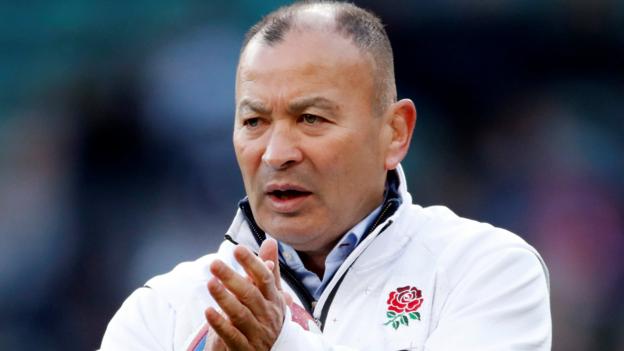
England’s Eddie Jones: ‘Fired-up’ Japan was what we wanted

news image

England 35-15 Japan: Second-half tries from Cokanasiga and Hartley give England victory

England head coach Eddie Jones says he was pleased Japan were “fired up” by his pre-match claim that they should “pray, pray, pray”.

England came from 15-10 down to win 35-15 in their penultimate autumn international at Twickenham.

Japan coach Jamie Joseph said his players were “highly motivated” by Jones, adding: “It fired me up a bit.”

“That is exactly what we wanted. We wanted Japan to be at their best,” Jones told BBC Radio 5 live.

“We didn’t underestimate them at all. We knew it was a tough game.”

“That helped us and helped our motivation.”

Earlier this week, Jones told Japan, whom he coached for three years from 2012, to “go to the temple”, and that England would be “absolutely ruthless”.

Japan – ranked seven places below England and 60-7 losers in the teams’ only previous Test meeting – led at half-time before England scored 20 unanswered second-half points.

“Perhaps we got seduced a bit by the start,” said Jones, whose side led through scrum-half Danny Care’s third-minute try.

“If you score with the your first touch of the ball, then perhaps players subconsciously think that this is not going to be as hard as we thought it was going to be.”

England’s autumn Tests
All matches at Twickenham
3 November Beat South Africa 12-11
10 November Lost to New Zealand 16-15
17 November Beat Japan 35-15
24 November Australia

Australian Jones, 58, said his half-time team talk was not particularly ferocious.

He said: “It’s different these days. Once you get past 55, you tone it down.

“We just talked about the fact we needed more effort and needed to get stuck in. We weren’t getting stuck in but started doing that in the second half.

“It’s really pleasing and our players will learn a lot about that.”

George Ford called England’s players into a huddle at half-time

England made 11 changes to the team that lost 15-16 to New Zealand last weekend, and shortened their preparation time to replicate the short turnarounds involved in the World Cup.

Before the players returned to the dressing room at half-time, fly-half George Ford – captain on his 50th cap – called them into a huddle on the pitch.

“I asked the players whether that was good enough to play like that for England in a Test match and there was a resounding ‘no’ from everyone,” he told BBC Radio 5 live.

“We needed an attitude change and a different mindset in the second half, to bring more energy and life to our performance, particularly defensively.

“The pleasing thing is we got that response in the second half.”

Analysis

Former England fly-half Paul Grayson on BBC Radio 5 live

If Jones’ comments last week were aimed at making sure that Japan’s players were as fired up as they could be, he could have said it in a better way.

If you are going to go into the depths of the World Cup, you are going to have to rely on some fringe players. When you call a team out and say you are going to stand and deliver and fail to do so, that is some cause for concern.

Former England wing Ugo Monye on BBC TV

The scoreline doesn’t tell the whole story. Japan have been brilliant today; their skill level and creativity was brilliant to watch.

England’s lack of fluency seemed to be down to their indiscipline. It seems to be a running theme in 2018, whether it be the Six Nations, the tour to South Africa or during these autumn internationals. They gave away almost 10 penalties in that first half offering up territory and possession.

England should not have to rely on Owen Farrell to set the bar in terms of physicality, leadership and game management. Kyle Sinckler and Sam Underhill also lifted the intensity when they came off the bench.

England dug themselves out of a hole and it’s that grit that will help them in the pool stages of next year’s World Cup.

Read More

from Trendy News Day https://ift.tt/2QSKipR
via IFTTT

Bollywood and MeToo: Film industry lifts sexual abuse taboo

news image

Mumbai, India – The 2005 Bollywood drama Aashiq Banaya Aapne (You have made me your lover) saw its lead actress, Tanushree Dutta, reach celebrity status.

Her fame rested on one song sequence in the film, where she is seen kissing her co-star multiple times. 

Physical intimacy on screen was unusual for Indian cinema at the time.

The former Miss Universe finalist was then cast in several B-grade movies, where her characters were expected to wear revealing clothing and dance suggestively.

“I’d often wonder, Angelina Jolie can be a sex symbol in a film like Gia and yet win awards for it,” she tells Al Jazeera. “Why don’t these morons get the point?”

In 2008, one of her co-actors allegedly touched her inappropriately while shooting a dance scene. 

Dutta left the set, only to be berated by her director and choreographer as “unprofessional” and “uncooperative”.

A right-wing politician, reportedly close to the perpetrator, called for Dutta to be blacklisted as his henchmen vandalised her car. 

Dutta quit acting soon after and spent years recovering from the trauma before eventually moving to the United States. 

This September, while on a trip to India, Dutta recalled the incident to a few journalists.

Her interviews went viral. Social media users and many of her peers expressed solidarity and recounted their own experiences of abuse, intimidation and widespread sexism. 

The media industry was hit the hardest. Several actors, comedians, journalists and filmmakers were “outed” for their misogynist, predatory ways.

“I’ve been repeating the same story since 2008,” Dutta told Buzzfeed news. “The only thing that’s changed is that people suddenly want to listen.”

Actress Aishwarya Rai Bachchan attends the Variety and UN Women’s panel discussion on gender equality at 68th Cannes Film Festival [Andreas Rentz/Getty Images for Variety]

Physical and sexual harassment in Bollywood, as in Hollywood, is common.

High-profile actresses, from 1970s superstar Zeenat Aman to 1994 Miss World Aishwarya Rai Bachchan, had shared harrowing personal accounts years before Dutta. 

These stories prompted heated debates at the time but little corrective action – Rai Bachchan’s former co-star and partner Salman Khan, who had allegedly assaulted her, remains one of India’s highest-paid actors.

In most cases, survivors are dismissed or threatened with legal consequences and professional boycott.

In a strange development last year, for example, veteran choreographer Saroj Khan said that “casting couch” behaviour – offering women work in the industry for sexual favours – was rampant in Bollywood, but added it was one way to earn a living. 

“At least they [the perpetrators] don’t leave someone after raping them,” she said.

Dutta says: “I’d seen in parties that girls were willing to do anything [to get a foothold in Bollywood]. They’d take it for granted, that this was something they had to do.” 

Her unwillingness to cater to the powerful, she adds, had her labelled as arrogant. 

She claims to have lost out on a film with a leading production house after the casting agents found her “cold and stuck-up”.

‘Women’s experience is undervalued’

An analysis of Wikipedia entries on 4,000 Bollywood movies between 1970 and 2017 by IBM and two Delhi-based organisations showed that male characters are mentioned nearly twice as many times as their female counterparts. 

Female characters are mostly described as “beautiful” and “attractive” whereas men are called “strong” and “successful”. 

While most women go on to marry or love, men were likely to kill or shoot, the study found.

A popular trope of romantic stories features the male character stalking, bullying and berating his paramour, after which they live happily ever after. 

In 2015, an Indian expat in Australia accused of stalking argued that Bollywood had made it seem “quite normal” for men like him to target their object of desire obsessively. 

The judge was convinced and the man received only a restraining order. 

Paromita Vohra, filmmaker, columnist and a gender rights activist, says that the #MeToo movement was waiting to happen. 

“Classically, women’s experience is undervalued but, for the first time, a large number of women were speaking up, naming names, overcoming the shame associated with being a victim,” she told Al Jazeera.

The self-reflection started with the gang rape of Bhanwari Devi by upper caste men in 1992, followed by numerous criminal and legal cases, reaching a crescendo after the gang rape of a medical student in New Delhi in 2012.

In the month following Dutta’s interview, there were nearly 1.2 million #MeToo tweets, many from India.

“The algorithm associated joined points of commonality and created filter bubbles,” says Vohra. “So at the moment of sharing, you understood that it’s not just happening to you but everybody.” 

Following the backlash this time, a union minister accused of harassment was forced to step down, a production house accused of complicity was dissolved and the film artists’ union finally set up a sexual harassment committee last month to investigate allegations.

Indian women shout slogans during a protest against sexual harassment in the workplace in New Delhi [File: Manish Swarup/The Associated Press]

In recent years, changing attitudes have been reflected in Bollywood’s output. 

A 2016 study by Oxfam India showed that although many films continue to objectify women, there was “a decisive turn for women-centric and socially themed films”.

Rachel Dwyer, professor of Indian Cultures and Studies at SOAS, University of London, told Al Jazeera: “One of the big shifts in the recent years is that a Bollywood heroine can be now seen as much more sexually active. She has multiple partners, goes partying and makes mistakes. She’s not seen as a bad character.”

In other Indian films, there are also strong female leads in historical fiction features and stories about female sporting talents.

Dutta says a lot has changed since she stopped making films.

But the wage gap continues to be gendered, most top actors still get to choose which actress they work with and hit song sequences, known as “item songs”, in spite of featuring several mainstream actresses, continue to objectify women.

“Someday, I hope to evolve into an actress where I’m running around trees doing an item song and also have [a serious] role in the same film,” says Dutta. “Everything has its own place. You don’t have to judge it.”

Read More

from Trendy News Day https://ift.tt/2PBjePj
via IFTTT

Paulo Lopes: The most successful third-choice goalkeeper of all time?

news image

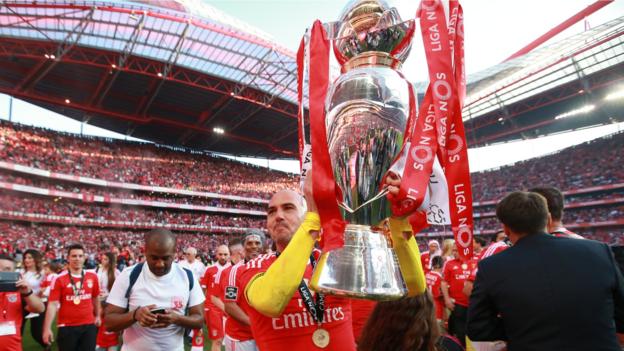
Paulo Lopes started and finished his career at Benfica, rejoining the club in 2012 after a decade away

Twelve trophies in only 11 games in more than a decade at Benfica – Paulo Lopes might be the most successful third-choice goalkeeper of all time.

The quirky statistic came to light when the Portuguese retired in July after a 21-year playing career.

“Yes, they are correct,” the 40-year-old tells BBC Sport, adding jokingly: “I was born to win.”

Robert Green at Chelsea, Richard Wright at Manchester City, Lee Grant at Manchester United and the evergreen Stuart Taylor – all famous third-choice keepers, but none has a trophy haul to rival Lopes.

“I feel happy getting these numbers along my career,” says Lopes. “They are part of my achievements and show important and special moments of my career.

“I feel great pride and great satisfaction, because when I look at them [the trophies and medals], I feel it was a work, mostly a team work, but also they demonstrate my achievements as a goalkeeper.”

Lopes played for Benfica’s youth team, but never made a first-team appearance before he was released in 2002.

He spent the next decade alternating between the top two divisions in Portugal, making more than 200 appearances and helping Trofense and Feirense achieve promotion to Primeira Liga.

Then, aged 34, came the call to rejoin Benfica in 2012.

“I thought it was a joke,” says Lopes, recalling a phone call with director of football and Portugal legend Rui Costa.

Lopes playing a rare first-team game at Benfica

Lopes finally made his senior debut for Benfica on 8 October 2012, the start of his most prolific season with the club when he played five games. That figure dropped over the following seasons, although he did play in the Champions League against Zenit St Petersburg in 2014.

“It was an enormous pleasure to get back to Benfica,” says Lopes. “It was the recognition of my work as a goalkeeper throughout my career and of my value as a football professional. There are few players chosen to represent Benfica.

“When I accepted the invitation, of course my will was to play more and it was with that goal that I got back. The best ones play for Benfica and only the best get the longevity to work for a space on the team.

“I’ve managed to do that for a long time. I felt happy. Those were years of success, being in the first string or not.”

Lopes says the decision not to play was out of his hands, but he “always respected the coach’s decision”.

In a decade at Benfica, he was behind goalkeepers such as Ederson, now at Manchester City, former Brazil and Inter Milan keeper Julio Cesar, and current Atletico Madrid number one Jan Oblak.

Lopes with Julio Cesar (left) and Bruno Varela (centre)

He was part of the squad that won the Primeira Liga four seasons in a row from 2014 to 2017, plus two Portuguese Cups (Taca de Portugal), three League Cups (Taca da Liga) and three Supertaca Candido de Oliveira (Community Shield).

“In my modest opinion, I’ve done a good job and have always performed my work in the best way,” says Lopes.

“It’s obvious that I wanted to play more, but it’s important to consider that I was in one of the best teams in Europe, with the best players, so the inside competition is very strong.”

After retiring, Lopes became goalkeeping coach for Benfica’s under-23 side. Manager Jose Henrique, a legendary Benfica keeper, said Lopes is an “idol”.

“My connection with Benfica is strong,” adds Lopes. “There are few players that spend so much time on the same team and that return after many years.

“It’s been essentially arriving as a kid and leaving as an adult. Benfica is where I spent a big part of my life, where I learnt what it meant to be a football player and where I’ve developed a lot as a person.”

Asked to reflect on his career, he says: “With much pride in what I did, what I gave to football and the joy of having fulfilled the dreams I had when I was a kid, when I thought that one day I’d be a football player.”

Lopes is now goalkeeping coach for Benfica Under-23s

Read More

from Trendy News Day https://ift.tt/2OQhRHc
via IFTTT

North California fire: Death toll at 76, more than 1,000 missing

news image

The death toll from wildfires in Northern California has risen to 76, with thousands left homeless from the deadliest blaze to hit the US state in a century.

As hundreds of rescue workers sifted through the rubble in the affected areas, the remains of five more people were found on Saturday, including four in the decimated town of Paradise and one in nearby Concow.

Northern California’s Camp Fire has destroyed nearly 10,000 homes and torched 233 square miles (603 square kilometers). It is 55 percent contained.

US President Donald Trump toured the area, as nearly 1,300 people still remain unaccounted for more than a week after the fire sparked in Butte County, Sheriff Kory Honea announced on Saturday night.

Trump also visited Southern California, where firefighters were making progress on a wildfire that tore through communities west of Los Angeles from Thousand Oaks to Malibu, killing three people.

“We’ve never seen anything like this in California, we’ve never seen anything like this yet. It’s like total devastation,” Trump said as he stood amid the ruins of Paradise, which has a population of about 26,000.

He met with state officials who have been critical of him and pledged federal assistance for Californians.

‘Where are we going?’

In Paradise, at a makeshift camp, shell-shocked families took stock of their losses.

Amy Bravo-Robertson and her family were among the 50,000 who were forced to flee their homes as the wildfires closed in around them. Her trailer home and place of employment were destroyed.

“A million things are going through my head. We are just trying to figure out where we are going and what we are doing,” she told Al Jazeera.

Rain was forecast for midweek, which could help firefighters but also complicate the search for remains.

“The efforts are still very active,” said Daniel Ramey, a Cal Fire officer. “We also we have units like search and rescue and the National Guard is assisting us with the recovery.”

Trump, downplaying the role of a changing climate in fuelling the fires, said the management and maintenance of forest lands will be the focus moving forward, and he announced $500m for that effort in the Farm Bill.

“I want a great climate,” he said. “We’re going to have that and we’re going to have forests that are very safe because we can’t go through this every year.”

Butte County Sheriff Kory Honea expressed hope that Trump’s visit would help with recovery, saying the tour by the Republican president and California’s Democratic leaders “signals a spirit of cooperation here that ultimately benefit this community and get us on a path toward recovery.”

Honea pleaded with fire evacuees on Saturday to review the list of those reported as unreachable by family and friends and call if they are safe.

Trump tours a neighbourhood destroyed by the wildfires in Paradise, California [Evan Vucci/AP]

SOURCE:
Al Jazeera and news agencies

Read More

from Trendy News Day https://ift.tt/2zeYx1c
via IFTTT

Katie Ormerod: Olympic snowboarder on how a broken heel led to ‘dark days’

news image

Katie Ormerod had her first operation in Pyeongchang before flying home for more surgery in the UK

Pain is the only word Katie Ormerod associates with Pyeongchang.

The physical pain of breaking her heel bone clean in two. The mental pain of not being able to show the world her ability on a snowboard on the biggest stage of all.

Yet this comes from someone who has experienced her fair share of pain. A snapped anterior cruciate ligament and a broken back are among her extensive list of injuries, and she’s had seven operations on this one alone.

“They were all paper cuts compared to this one,” says the 21-year-old. “Up until my last operation, I was in pain every day just walking about.”

Ormerod – an X-Games and multiple World Cup medallist – was one of Great Britain’s greatest hopes before the Winter Olympics in South Korea, having won bronze at the test event.

However, she came off a rail too early in training and her Games were over before they had even started – a fractured right heel ruling her out three days before she was due to compete.

In the nine months since, Ormerod has endured some of her darkest days – but at last she is pain free, physically and mentally.

Here, she tells BBC Sport about her battle with depression, how she plans to grow women’s snowboarding, and how pig and shark skin came into the equation.

Reflections on a nightmare day

Ormerod training in Pyeongchang on the day she broke her heel

Ormerod had already broken her wrist out in Pyeongchang – and it was on the same rail the following day that she snapped her heel in two.

“Straight away I knew my Olympics was over. It was the most horrendous pain I have ever felt and it was very traumatic,” she says.

Medics took more than an hour to remove her boot – they tried to cut through it but in the end were forced to pull it off – and it was her boyfriend, former New Zealand snowboard coach Lachie Good, who had to inform her of the severity of the injury.

“I was gutted because of all the hard work I had put in over the past four years and for it all to be taken away from me so quickly, in the most painful way possible, was awful,” she adds.

“I just think it wasn’t meant to be for me in Pyeongchang. I feel like it was always meant to happen.”

Fighting for her career

Ormerod had her first operation in South Korea to pin her heel back together, and she thought that would be her last.

“I felt so confident that I could do well and bring a medal back,” she says. “For that to be taken away from me in an instant was so hard for me to come to terms with.

“I struggled with it for a few months after.”

Those struggles turned into depression for a “sad and confused” Ormerod, who kept her emotions to herself and questioned her future.

“All I have ever known is snowboarding. I started when I was five and in my head I’ve always seen myself snowboarding for as long as physically possible,” she says.

“I couldn’t get to grips with the idea it could be career-ending. I really didn’t want that to happen.”

One quick glance through Ormerod’s Instagram page and you would never think the dark clouds of depression had descended. But that, Ormerod says, is the problem with social media.

“It is not always real but I felt I had to be positive to help others,” she adds.

She finally found the courage to voice her struggles – first to her parents, then to her team manager.

“I felt like I was the only one going through difficult times but, after four months, I realised one day that I wasn’t the only athlete or person in the world going through it,” she says.

“As soon as I started opening up, I felt better.”

Skin grafts – pig or shark?

Doctors performed a skin graft using pig skin on Ormerod’s ankle

After every operation she’s had, Ormerod has been sure it would be the last – in particular, the first one.

But upon her return home from South Korea in February, British surgeons found the skin on her heel had died through to the bone, complicating matters even more.

They were forced to perform a skin graft using skin from Ormerod’s hip – as well as the skin of a pig.

“The doctor mentioned using shark skin but on the day of the operation he decided they would use pig skin instead,” she says.

“It’s really noticeable, I have a big dip in my ankle now and the skin is a lot darker.”

Ormerod had surgery for the seventh time in October to remove the screws holding her heel bone together after they were found to be aggravating her Achilles.

Finally pain free, there is light at the end of the tunnel – she hopes to be back on her board early next year.

“I am really excited to be back. I got a small taste for it last month when I went out to Austria. Just being back in the mountains was the most amazing feeling and it made me realise just how much I missed it,” she says.

“There is no way I could stop snowboarding and stop pushing myself because it is built in me. I want to challenge women’s snowboarding and keep progressing.”

Changing the game

Ormerod at the new Graystone Action Sports Academy in Manchester, which opens in December

If anyone is going to challenge women’s snowboarding, it’s Ormerod – the first female to land a double cork 1080 (three rotations and two inverted flips).

This week, Austria’s Anna Gasser became the first woman to ever land a cab triple underflip – which is three and a half full rotations – and Ormerod is determined to keep up.

“I definitely want to keep challenging the tricks that are being done in women’s snowboarding,” she says. “In the past, the guys are the ones who have been setting the bar high and I think it would be amazing to see the women’s sport going in the same direction.”

Ormerod and her British team-mates have always been at a disadvantage when it comes to competing internationally because of having grown up “without snow in the back garden”.

But times are changing. At the start of the year, the British team’s “secret weapon” was unveiled – a 60-metre long and 23-metre wide airbag in Livingo, Italy, costing about £100,000 of UK Sport and Sport England money.

Closer to home, the first Graystone Action Sports Academy will open in Manchester in December, providing an indoor training centre for athletes.

“It’s going to do the world of good for snowsports in this country,” Ormerod says.

“We’re already challenging for the top of the podium against athletes who have snow in their back gardens, so now that we are going to have this, the level of British skiing and snowboarding is going to increase so rapidly.”

And with little more than three years to go until the Beijing 2022 Winter Olympics, the countdown is on for Ormerod.

“I have unfinished business with the Olympics,” says Ormerod, who will be 24 in 2022. “I definitely want to get that medal in Beijing and I’ll keep pushing myself until I get it.”

Read More

from Trendy News Day https://ift.tt/2QSyDHB
via IFTTT

Northern Ireland Open: Ronnie O’Sullivan beats Mark Selby on final black to reach final

news image

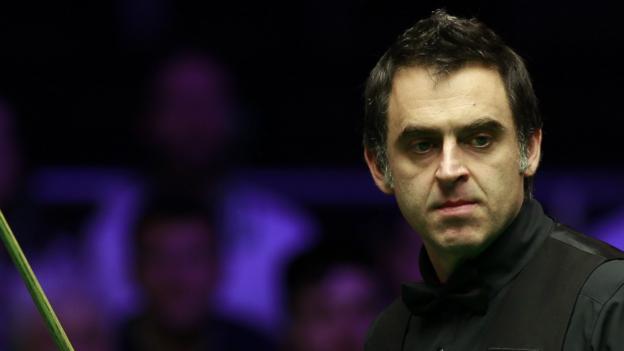
O’Sullivan dropped just four frames in five matches en route to the semi-finals

Ronnie O’Sullivan held his nerve to beat world number one Mark Selby on the final black and reach the Northern Ireland Open final.

O’Sullivan, ranked third in the world, led for most of the contest, only for Selby to fight back from 5-3 down and force a deciding frame.

O’Sullivan then trailed in the decider but edged it 70-68 to claim a thrilling 6-5 win at Belfast’s Waterfront Hall.

Judd Trump defeated Eden Sharav 6-3 in Saturday’s other semi-final.

The Englishman raced into a 3-0 lead thanks to breaks of 54, 107 and 68 before Scottish player Sharav pulled a frame back.

A 108 from Trump restored the three-frame advantage but Sharav hit back to make it 4-3.

World number five Trump knocked in a 97 break to go two clear before sealing his spot in Sunday’s final.

O’Sullivan, 42, had failed to get beyond the last 16 in the first two years of this tournament but arrived in good form having won the Champion of Champions event last week.

He dropped just four frames in five matches en route to this year’s semi-finals, where he enjoyed frame-winning breaks of 135 and 114 before taking a 3-2 lead.

The five-time world champion stretched that to 4-2 with a break of 112, before going 5-3 up, but Selby managed to draw level at 5-5.

The 35-year-old three-time world champion led during the final frame only to give the initiative back to O’Sullivan, and he made it count to reach his first Northern Ireland Open final.

Between them, O’Sullivan and Selby have won five of the last seven world championships

Read More

from Trendy News Day https://ift.tt/2DtXrS8
via IFTTT

Malaysia and Indonesia are bucking the global trend on democracy

news image

In October, Latin America’s most populous nation, Brazil, elected as president Jair Bolsonaro, a former military man and historically fringe, far-right senator known for his pro-gun, pro-torture views. In 1999, he told Brazilian television, “Elections won’t change anything in this country. It will only change on the day that we break out in civil war here and do the job that the military regime didn’t do: killing 30,000. If some innocent people die, that’s fine. In every war, innocent people die.”

Elsewhere in the world, Donald Trump, Xi Jinping, Vladimir Putin, Recep Erdogan, Viktor Orban and Rodrigo Duterte are some of the names that have dominated headlines as leaders who are spearheading the world’s reported march towards authoritarianism. In January, the Economist Intelligence Unit’s Democracy Index for 2018 reported that electoral democracy was continuing its “disturbing retreat” the world over. The TIME magazine recently declared that “a new archetype of leader has emerged. We’re now in the strongman era.”

If this is true of Brazil, the United States, China, Russia, Turkey and even the Philippines, it is not so in the Malay Archipelago.

In May, Malaysian politics was changed irrevocably with the election of its opposition for the first time in 60 years of independence. Accountability, openness and democratic progress appear to be finally within reach.

While many Western observers continue to argue that Islam is incompatible with democracy – Indonesia and Malaysia beg to differ. With the former already the strongest electoral democracy in Southeast Asia and the latter an unlikely late bloomer, the two countries are leading the charge for democratic politics in their immediate region, and perhaps the world.

‘Reformasi’

As Malaysia went to the polls in May, Indonesia was celebrating 20 years of Reformasi – a word in both Malay and Indonesian which means reform, specifically of the democratic kind. Protests from a broad civil society coalition of students, Muslim groups and women in 1998 saw Indonesia’s outrageously corrupt dictator of more than three decades, Soeharto, step down.

UP FRONT: Reality Check – Yes, Islam is compatible with democracy (2:38)

It has since seen the unshackling of its media; the emergence of non-traditional political actors including trade unionists, rights activists and feminists as well as a forceful re-emergence of Islamists; and the establishment of a range of anti-corruption and human rights protection institutions.

Indonesia’s wildly popular if somewhat goofy President Joko “Jokowi” Widodo has been accused of authoritarian tendencies, particularly after the outlawing of the Hizbut Tahrir group, which campaigns for Indonesia to adopt Islamic law and become a caliphate, under a controversial presidential decree in July 2017.

But unlike most heads of state in the region, he is less about smearing the media and threatening NGOs than he is about shoring up support through building rural infrastructure and giving land rights to indigenous groups. He likes groovy jackets and giving away push bikes to kids.

Indonesia’s smaller, richer cousin Malaysia had lagged behind in its own Reformasi. But come May 2018, Prime Minister Najib Razak was turfed out by the electorate despite incessant gerrymandering and a rigged voting system. His demise came largely due to accusations he stole hundreds of millions of dollars from the sovereign fund 1Malaysia Development Berhad or 1MDB and the return to politics of now-PM Mahathir Mohamad.

When in power between 1981 and 2003, Mahathir was known for his intolerance of critics and has since admitted to serving as a “dictator”. Shortly after being elected in May, however, the 93-year-old took to Twitter to chastise authorities for arresting a man who had allegedly slandered him and Islam on Facebook. “I don’t agree with the action taken against those who criticise me,” he said.

Rights concerns

Electoral democracy is not everything. Democracy is typically understood as requiring strong separation of powers and the protection of human rights. Like their Southeast Asian neighbours, both Indonesia and Malaysia have checkered human rights records. Law enforcement and the legal systems of both countries remain corrupt and inadequately independent.

The year 1965 saw the massacre of up to a million leftists in Indonesia – one of the worst mass killings of the 20th century for which the perpetrators are yet to face any consequences. Malaysia still organises its society along the lines of race and class, providing benefits to the Malay-Muslim majority in a system that elsewhere would be described as apartheid. In both countries, anti-LGBT sentiment has grown in recent years, sparked by growing Islamic conservatism and pushes for same-sex marriage and other LGBT equality struggles in the West.

Nevertheless, both states were the only in ASEAN to criticise Myanmar in a timely manner for the atrocities carried out against its Rohingya population, sending more than 700,000 people into neighbouring Bangladesh since August last year.

THE LISTENING POST: The new Mahathir and Malaysia’s media revamp (9:42)

Indonesian civil society organisations routinely criticise the government on a range of rights issues and stage public protests. Rapid domestic change is also afoot in Malaysia. Last month, the government announced it would bring in a moratorium on the death penalty with the view of abolishing it. The government has also said it will remove a “pink tax” on menstrual products.

Most importantly, the Malaysian Anti-Corruption Commission is finally able to do its work unobstructed. Authorities have raided former prime minister Najib Razak’s properties, seizing jewellery and luxury handbags worth millions of dollars. In September, he was arrested for alleged abuse of power, while his wife Rosmah Mansor was detained last month over money-laundering accusations.

While it faces ongoing political threats, Indonesia’s Corruption Eradication Commission (KPKremains one of the most important, independent institutions of the democratic era. Just this April, it took down the speaker of the house, Setya Novanto, jailed for 15 years for corruption, sending a strong message to the nation’s political class.

Despite Samuel Huntington famously proclaiming in 1993 that “Islam has bloody borders”, neither Malaysia nor Indonesia has fought a full-scale, international war since the Bornean Confrontation of the 1960s, in which Indonesia fought against colonial powers to oppose the formation of Malaysia. Neighbouring Australia, meanwhile, which then sent troops to repel the Indonesians, has fought in the Vietnam, Gulf, Afghanistan and Iraq wars, and has joined the coalition against the Islamic State in Iraq and the Levant (ISIL) in the Middle East.

Indonesia’s leadership within ASEAN has ensured decades of peace. None of the member states has fought each other since the 1980s. Former diplomat and dean of the Lee Kuan Yew School in Singapore, Kishore Mahbubani, has even argued that the bloc deserves a Nobel Peace Prize.

The democrats in ASEAN are Muslim

Conservative pundits in the West have long argued that Islam is incompatible with democracy. But since 2004, Indonesia has held competitive elections deemed free and fair by international observers.

“If the 1990s was a decade of reform and political transformation in Southeast Asia, then the first two decades of the twenty-first century have seen disappointing dividends,” concluded former editor of the Far Eastern Economic Review, Michael Vatikiotis, in his 2017 book Blood and Silk. Across the Mekong region, most ASEAN states have increasingly adopted the People’s Republic of China’s mode of autocratic capitalist development.

A different story, however, is playing out in the Malay part of archipelagic Southeast Asia. Having campaigned on the issue, Malaysia’s new government has cancelled several projects it deemed threatening to state sovereignty, while the Indonesian opposition has vowed to review China’s Belt and Road project if elected in the 2019 presidential elections. Both countries are careful to maintain good relations with the West and India, as well as their trading partners in the Middle East.

Much of the world may be having its doubts about democracy. Even in the Asia Pacific’s veteran democracy Australia, a recent poll showed that a third of the population favoured an authoritarian or “strongman” type leader. But in the Muslim Malay world, it looks like democracy is here to stay.

The views expressed in this article are the author’s own and do not necessarily reflect Al Jazeera’s editorial stance.

Read More

from Trendy News Day https://ift.tt/2Q7jwge
via IFTTT

ATP Finals: Novak Djokovic beats Kevin Anderson to reach final

news image

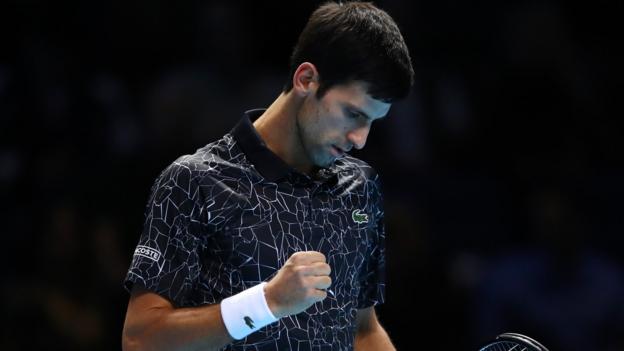
Novak Djokovic’s serving has been impeccable this week – he has not been broken at all in four matches

World number one Novak Djokovic put in a ruthless display to beat Kevin Anderson and reach the final of the ATP Finals in London.

The Serb will play Germany’s Alexander Zverev in Sunday’s season finale after a 6-2 6-2 victory.

In what was a re-run of July’s Wimbledon final, Djokovic dominated in the same way this time to reach his seventh final of the year.

The 14-time Grand Slam champion has not dropped a set all week.

“I think it was the best match I’ve played so far this week,” Djokovic said after sealing victory in one hour and 16 minutes with a forehand that bounced off the top of the net.

“It came at the right time. Kevin has been playing great tennis this week.

“He lost serve in the first game which was big because he relies so much on his serve. I tried to win as many points on his second serve as possible. It worked very well.”

Djokovic serves up a masterclass

Widely seen as the best returner in the game, Djokovic has in fact been notable for his impeccable serving this week.

He is yet to be broken in four matches – facing just two break points – and it took Anderson until the sixth game of the opening set to win his first point on the Serb’s serve.

The South African won only seven points on the Djokovic serve in the entire match.

Where Anderson delivered big serves that averaged more than 130mph, Djokovic’s were about the 114mph mark but were all about accuracy, placement and setting up the next shot.

He beat Anderson 6-4 on aces – no mean feat against a player so known for racking up the aces that he has been donating money to charity for each one this week.

And his total of first-serve points won was a huge 85%.

Asked in his on-court interview if it was some of the best serving he has produced, Djokovic replied: “Possibly. It is not very common to serve more aces than Kevin. That stat helps the confidence.”

Anderson was making his debut at the ATP Finals, having enjoyed a successful year where he won two titles and reached a career-high ranking of five.

But he was outclassed and under pressure from the off, with Djokovic breaking in the opening game and creating two further break points in Anderson’s next service game.

While the South African held off that challenge when Djokovic hit wide, he gifted him another break in the seventh game when he sent a forehand long.

The second set followed the same pattern with Djokovic capitalising on an Anderson double-fault to establish another early break.

A crosscourt forehand earned the top seed a break for 4-1 and while Anderson limited the damage in the next game with a hold, Djokovic served out the match with style.

Next up, Zverev… again

Zverev beats Federer in ATP semi-final

Standing between Djokovic and a record-equalling sixth title at the season-ending tournament is 21-year-old Zverev, who beat 20-time Grand Slam champion Roger Federer 7-5 7-6 (7-5) earlier on Saturday.

The pair have already met this week, with the German pushing the Serb hard in the opening set of their group match before seeming to run out of steam as Djokovic won 6-4 6-1.

“I played very well in the group stage against Sascha [Zverev] but I don’t think he was close to his best,” said Djokovic, who also beat Zverev in the Shanghai semi-finals in October.

“He had a great match today against Roger and he has been serving well, so it will be a similar approach as today, trying to get as many first serves back.

“It is the last match of the year for both of us, so let the better player win.”

Victory for Djokovic would cap a remarkable year in which he came back from elbow surgery to win Wimbledon and the US Open and returned to the top of the world rankings for the first time in two years.

Watch: Zverev booed after beating Federer

Read More

from Trendy News Day https://ift.tt/2Kbax8l
via IFTTT

Sri Lanka v England: Moeen Ali and Jack Leach wrap up series win for tourists

news image

Second Test, Pallekele (day five)
England 290 & 346: Root 124, Foakes 65*, Burns 59, Akila 6-115
Sri Lanka 336 & 243: Mathews 88, Karunaratne 57, Leach 5-83, Moeen 4-72
England win by 57 runs
Scorecard

Moeen Ali struck twice and Jack Leach claimed his maiden five-wicket haul to bowl England to their first series win in Sri Lanka since 2001 with a 57-run victory in the second Test.

The hosts resumed on 226-7, needing 75 more, and calmly added 14 in 28 balls.

But Moeen drew Niroshan Dickwella into edging to first slip for 35, before bowling Sri Lanka captain Suranga Lakmal two balls later for a duck.

Leach had Malinda Pushpakumara caught and bowled soon after to seal the win.

England lead the three-match series 2-0 with the final Test in Colombo starting on Friday.

It is England’s first away series win since beating South Africa in 2016 and first away series victory under captain Joe Root.

More to follow.

Read More

from Trendy News Day https://ift.tt/2DrEqzY
via IFTTT

England attempt to wrap up victory – listen to The Cricket Social

news image

Sri Lanka v England live – second Test, day five – Live – BBC Sport


<!–


<!–

<!–
<!–

<!–

<!–

<!–


Summary

  1. Sri Lanka begin fifth day needing 75 more runs for victory; England require three wickets
  2. England will win three-match series if they wrap up victory
  3. Play to start at 04:15 GMT
  4. Listen to The Cricket Social from 04:00 GMT


Read More

from Trendy News Day https://ift.tt/2qScC0b
via IFTTT

Design a site like this with WordPress.com
Get started