Battle for Hodeidah: 110 Houthis, 7 civilians killed in 24 hours

news image

At least 149 Yemenis, including seven civilians, have been killed in the past 24 hours as forces loyal to exiled President Abd-Rabbu Mansour Hadi close in on areas held by Houthi rebels in the strategic port city of Hodeidah.

Medics in hospitals across the city – which is the main gateway for imports and relief supplies into Yemen – said on Monday that 110 Houthi fighters and 32 pro-government soldiers had been killed in overnight fighting.

Sources at the Al-Alfi military hospital, seized by the Houthis during their 2014 takeover of the city, said charred body parts had been delivered there overnight.

Meanwhile, a military official in Hodeidah told the AFP news agency that seven civilians had died in clashes without giving further details.

Al Jazeera’s Mohammed Adow, reporting from neighbouring Djibouti, said fighting was raging in eastern and southern areas of Hodeidah city.

“Some of the fighting is on the streets of residential areas, something that is causing concern about the safety and welfare of the people still holed up in the city,” Adow said.

“There are people stuck there who could not find ways of leaving because of the blocked roads and many checkpoints set up by Houthi fighters,” he added.

The renewed fighting comes as a new round of peace talks to end the war, which has killed more than 56,000 people according to a recent estimate, was pushed back to late December after it was scheduled to take place in Sweden in November.

‘Catastrophic’ situation

Bessma Momani, a professor of political science at Canada’s University of Waterloo said the Saudi-UAE military alliance was trying to take control of Hodeidah ahead of the summit.

“I think that’s the strategy overall, but of course it comes at an enormous cost for civilians,” Momani told Al Jazeera.

“It’s important to point out, 80 percent of all food come through Hodeidah – it is food scarcity and famine that we should be worried about because this is the cost that will be paid by the average civilian for the retaking of Hodeidah.”

On Monday, UN Secretary-General Antonio Guterres warned that the destruction of the vital Yemeni port of Hodeidah could trigger a “catastrophic” situation.

“If the port at Hodeidah is destroyed, that could create an absolutely catastrophic situation,” Guterres told France Info radio during a trip to Paris.

Hodeidah, a large city on Yemen’s Red Sea coast, is the latest battleground between Houthi rebels and the Saudi-UAE alliance which has been fighting for control over the country for the past three and a half years.

Since November 1, there have been more than 200 air attacks reported in the city, with the AFP news agency reporting nearly 600 deaths.

Aid agencies have long warned that fighting in Hodeidah risks escalating the country’s dire humanitarian crisis.

‘Enormous cost for civilians’

Momani added that, following the killing of Jamal Khashoggi at the Saudi Consulate in Istanbul, elements within the US may press for sanctions on weapons sales to the kingdom.

“Now that we have seen the Democrats take over the House of Representatives, one part of the legislature, we are going to see a lot of ugly facts against this war – logistics, intelligence, training – you name it.”

“We have to find a way to solve this because really the Yemeni people have suffered far too much,” she said.

The conflict in Yemen, the Arab world’s poorest country, began when the government slashed fuel subsidies in the summer of 2014, prompting angry protests and forcing thousands onto the capital’s streets.

The Houthis seized the opportunity and marched south from their stronghold of Saada province to Sanaa, where they toppled President Hadi’s government.

Concerned by the rise of the Houthis, a US-backed Saudi-UAE military coalition intervened in 2015 with a massive air campaign aimed at reinstalling Hadi’s government.

Since then, data collected by Al Jazeera and the Yemen Data Project has found that more than 18,000 air attacks have been carried out in Yemen, with almost one-third of all bombing missions striking non-military sites.

Weddings, funerals, schools and hospitals, as well as water and electricity plants, have been targeted, killing and wounding thousands.


Read More

from Trendy News Day https://ift.tt/2qJdHqY
via IFTTT

Afghanistan: Suicide bomber targets protesters in Kabul

news image

At least 10 people have been killed or wounded after a suicide bomber hit a protest site in the Afghan capital, Kabul, according to local media reports.

Tolo News, a Kabul-based news website, said that the blast happened on Monday close to Pashtunistan Square where hundreds of people had been protesting over insecurity in the country.

The Ministry of Interior told Tolo that at least 10 people were killed or wounded.

Images posted on social media appeared to show dead bodies lying in the street.

The explosion came as Taliban fighters killed scores of security forces in the western province of Farah and the eastern province Ghazni overnight on Monday.

At least 37 local policemen were killed in Farah, and 20 members of the Afghan security force were killed in Ghazni’s Jaghuri district.

Taliban spokesman Zabihullah Mujahid claimed responsibility for the Ghazni attack and said in a text message that the armed group had captured Ghazni’s Malistan district.

Taliban fighters have ramped up attacks on Afghan security forces and government facilities in recent months, leaving troops thinly stretched throughout the country.

A US watchdog agency said last week that the Afghan government was struggling to recover control of districts lost to the Taliban while casualties among security forces had reached record levels.

The government had control or influence over 65 percent of the population but only 55.5 percent of Afghanistan’s 407 districts, the Special Inspector General for Afghanistan Reconstruction (SIGAR) said in a report.

Read More

from Trendy News Day https://ift.tt/2qPstwx
via IFTTT

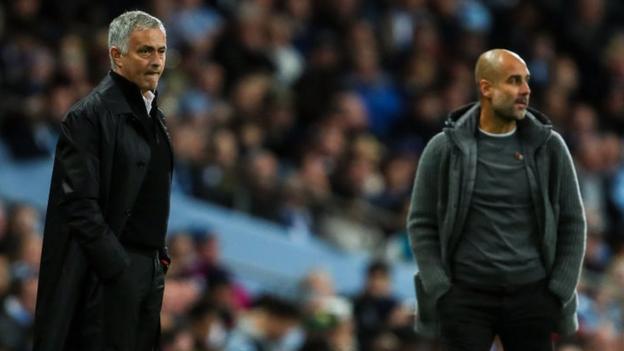
Man City 3-1 Man Utd: ‘Jose Mourinho deluded if he can’t see gulf in class’

news image

Zero words against United players – Mourinho

Manchester City’s cursory dismissal of Manchester United simply confirmed their status as the Premier League’s outstanding team – and reduced Jose Mourinho to the ranks of the deluded.

Pep Guardiola’s reigning champions also finished off Manchester United’s own title aspirations for this season as City’s 3-1 win opened up a 12-point gap between these neighbours that no realist can seriously see being bridged.

Mourinho’s excuses a poor disguise

It may have taken until Ilkay Gundogan’s goal four minutes from time to confirm City’s win and give the scoreline an appearance the hosts’ superiority deserved but the gulf in class and quality had been spread all over Etihad Stadium for the previous 86 minutes.

Manchester United defied logic by staying in the game until that closing phase, Anthony Martial’s penalty offering faint hope – very faint hope – of a repeat of last season’s derby here when they overturned a 2-0 lead to delay City’s title celebrations.

And while Mourinho, deprived of injured Paul Pogba, mounted a stout defence of his players, his words came accompanied by the sound of straws being clutched.

He spoke of fear around the stadium when United made it 2-1 – but if there was, and it was a very dubious claim, United did little to increase it as it was City who looked more likely to add to their lead.

If anything, United became even less effective after being given that unlikely lifeline.

Mourinho also pointed out that City had, in his words, “friendly” home games in the 6-1 win against Southampton in the Premier League last weekend and the 6-0 Champions League victory against Shakhtar Donetsk, while United had arduous away games at Bournemouth and Juventus before this derby.

The jibe might have carried more weight had United been inflicting similar damage on opponents this season.

Dig deeper and study Sunday’s evidence, however, and the brutal truth is Mourinho fools only himself if he does not accept there is a vast gap between these two clubs.

Mourinho points out the scale of City’s investment but he has hardly been living on the breadline himself and is currently behind Bournemouth and Watford in the Premier League table.

United are the only team in the Premier League’s top 10 with a negative goal difference, -1, which puts them effectively 32 goals behind City after 12 games. These are damning statistics.

Manchester United have a -1 goal difference after scoring 20 goals and conceding 21 in their first 12 games of the season

Here, they barely laid a glove on City either side of Martial’s penalty. By the time David Silva put City ahead in the 12th minute, United had made only 11 passes, five of which were completed.

Mourinho can forget the Premier League title. They are seven points off Tottenham in fourth, so another pre-season target is also becoming tougher to attain.

While City were swift and slick – Gundogan’s goal came after a 44-pass sequence – United were vulnerable in defence, static in midfield and toothless in attack. Outclassed.

Nemanja Matic, Marouane Fellaini and Ander Herrera were like statues as the likes of David and Bernardo Silva moved fluidly around them, the magnificent Fernandinho the glue holding it all together.

Mourinho’s selection was an open invitation to City domination and for United’s loss of Pogba, Guardiola and City could mention the injured Kevin de Bruyne.

United are 12 points ahead of Cardiff City – in others words as close to the relegation zone as they are to City at the top.

When it was pointed out, Mourinho response was an acerbic: “I think we are not going to be relegated.”

True enough – but there is also as much chance of Manchester United winning the Premier League after only 12 games and, after being outplayed in this comprehensive manner, that must hurt a club of such aspirations.

City setting the standard

Manchester City have had a tough week off the field with private club emails leaked by German news magazine Der Spiegel amid allegations that they attempted to circumvent Uefa’s financial fair play regulations.

Manager Guardiola reiterated his “trust” in the club’s hierarchy – and they can certainly trust him.

This latest peerless display simply underlines the standards Guardiola has set and how he has placed his imprint all over City’s football operation.

City wanted to win against Untied – Guardiola

At this stage last season, after a 2-0 win at Leicester City, Manchester City were eight points clear of Manchester United in second and had a superior goal difference of +33.

Liverpool were 12 points back on 18 November last year and even their 30-point haul in an unbeaten season so far, their joint best at this point in the Premier League era, still leaves them two points behind City.

Jurgen Klopp’s side have made an outstanding start to the season but such has been City’s own brilliance that we are already at the stage where every single point is precious.

And in their first dozen games City have come through away games at Arsenal and Spurs, where they won, as well as getting a draw at Liverpool. They can also now tick off another potentially hazardous fixture on their schedule against Manchester United while inflicting heavy defeats on those below top-six standard.

Yet still Guardiola demands more from his team, flagging up some first-half deficiencies when City took their foot off the gas after going ahead.

One thing is clear after Manchester City’s latest masterclass – if anyone is going to take the title off the team that claimed the crown with a historic 100 points last season, it is going to take a monumental and virtually flawless effort.

Read More

from Trendy News Day https://ift.tt/2RN98Y1
via IFTTT

Samsung’s foldable phone will be insanely expensive, report says

news image

If you’re excited about the prospect of buying a smartphone that folds, better start saving now. 

According to a report from Yonhap News Agency (via The Verge), Samsung’s foldable phone, recently teased at a company event, will cost around 2 million won or $1,770. 

That price is a fair bit higher even than the price of the most expensive iPhone XS Max variant you can buy, which costs $1,449. 

The report claims Samsung’s phone will be called Galaxy F and should arrive in March 2019, shortly after the February launch of the Galaxy S10. Samsung’s head of mobile DJ Koh previously said the phone should arrive in the first part of 2019. 

The Galaxy F will have a 7.4-inch screen when unfolded, and an additional 4.6-inch screen when folded, and — unlike the Galaxy S10 — will not support 5G connectivity, according to the report. 

The device Samsung had shown at its November event was partially hidden from view, and nearly no specs were revealed. We did, however, found out that Google is working to make Android play nice with foldable phones, which will apparently be a thing next year. A few weeks ago, Chinese company Royole unveiled its own version of the foldable phone, which should arrive in December, and Huawei is also expected to launch a similar device next year. 

Https%3a%2f%2fblueprint api production.s3.amazonaws.com%2fuploads%2fvideo uploaders%2fdistribution thumb%2fimage%2f86975%2fcd020117 1349 4f90 989c 81488d0de33f

Read More

from Trendy News Day https://ift.tt/2DAUYq5
via IFTTT

Why does the language of journalism fail indigenous people?

news image

I really want to do this story justice.

It is a mantra I adhered to long before I became a journalist; my parents travelled great distances to build a life together and I’ve always wanted to pull my weight in that happy ending.

It is also the mantra I carried with me this summer as I left my home in Qatar for the 10,000km journey to Alaska, as I boarded the nine-seater plane at the tiny air taxi office in Anchorage and as we flew over a snowy mountain range and rolling tundra.

I was returning to Iliamna, my mother’s remote Alaskan village, which lies on the waters of the largest sockeye salmon run in the world. My mother is an Alaska Native – a member of the Dena’ina ethnic-language group.

My father is a Qatari. Every summer, my parents, sister and I would return to Iliamna to visit family and help with the salmon run – assisting with catching, smoking, brining and canning the salmon that is so central to the community’s subsistence lifestyle.

I was working on a film about the pressures facing this community – a community I feel both a part of and removed from. Despite knowing many people there since childhood, I was worried that people wouldn’t want to talk on camera. I knew I would feel apologetic and hurt if they didn’t, despite trying to reason with myself. For me it wasn’t about securing or losing an interview; it was about confirming or rejecting that I had a place in the story.

Telling a personal story can be scary because you are admitting that you don’t know everything about your own language, culture and family. You have to ask hard questions. Were you ignorant about something because you didn’t care enough to learn it? Were you too embarrassed to ask? Sometimes it’s hard to tell the difference between apathy and shame; you are either motionless from lack of care or paralysed by too much of it.

Despite knowing many people there since childhood, I was worried that people wouldn’t want to talk on camera … For me it wasn’t about securing or losing an interview; it was about confirming or rejecting that I had a place in the story.

Amira Abujbara, journalist

Despite months of planning and phone calls back and forth, it was only as we sat down for our first interview – with an elder in his house on a small cliff overlooking Lake Iliamna – that I truly believed the film was going to happen and that people would actually talk to us.

The interview began as most would in the coming days: quietly. His wife fidgeted nervously outside the camera frame. I assumed a casual slouch on the sofa, more to calm my own nerves than his. He was a distant relative and our paths hadn’t crossed before because we both lived outside the village.

Like most people in the community, he was a good storyteller and his cadence gave the world rhythm. He offered me another thread that tied me to this place and I marvelled. Then the door burst open – a team of neighbours had come to mow his lawn – our interview would have to resume another day.

There were logistical challenges to filming in Iliamna; time works differently in a community where the sun sets at midnight and daily activities are dictated by the weather.

It is hard to track down interviews somewhere where there are few roads and people can be anywhere from “over the road” to “somewhere upriver”. We were also visiting during the busiest time of the year when residents are balancing jobs with the labour-intensive process of catching and storing salmon for the year.

During the summer, residents are balancing jobs with the labour-intensive process of catching and storing salmon for the year [Showkat Shafi/Al Jazeera]

On a personal level, I was worried that I would get it wrong; that I would ask the wrong questions, at the wrong time or in the wrong way. I feel this way about any story I work on – I think being self-critical is essential for any journalist – but when you are of mixed heritage you feel indebted to a community for giving all of itself to you when you feel like you only ever give half of yourself to it.

So when an opportunity like this one comes along, you want to do everything possible to get it right.

‘Media has rarely served Native communities well’

I assume most TV crews that pass through the Iliamna Lake area shoot nature documentaries or focus on the controversial Pebble mining deposit nearby – or are trying to track down the mythological Iliamna Lake Monster. So, I really wanted this story to be about the community and for the community.

With this came the added pressure of history. Media has rarely served Native communities well, and this has fostered a distrust towards journalists.

This distrust wasn’t overt in Iliamna – I think that was partly because of my family’s connection to the community but also because it serves as a regional hub and is in relatively close proximity – a 50-minute flight – to the city of Anchorage.

There were some exceptions; one family friend yelled me and the rest of the crew out of his workshop before we could open our mouths. He later told me that there were no hard feelings but that TV crews always twisted words. I couldn’t disagree.

I suspect distrust is even greater in those indigenous communities that subsist off of marine mammals. They were deeply impacted by animal welfare campaigns attacking whaling and seal hunting in the 1970s and the cultural and economic devastation of those campaigns – from food shortages to sky-high suicide rates – still run deep.

I had previously reached out to a Native organisation in the Bering Strait region, which is located in northwest Alaska and largely made up of whaling and seal-hunting communities, and was met with defensive anger.

The representative questioned my background, my company and my motives. After some discussion, she explained that they wanted to keep their way of life to themselves because people so often misunderstand it.

‘It is hard to track down interviews somewhere where there are few roads and people can be anywhere from ‘over the road’ to ‘somewhere upriver” [Showkat Shafi/Al Jazeera]

She was gracious, considering what she knew was at stake; Native people have long been misrepresented and penalised for a way of life that is portrayed as primaeval, cruel or embarrassing – rather than as something deeply felt and timeless in its adaptability.

She reminded me of an incident last year in which a 16-year-old boy from Gambell, a small Siberian Yup’ik community located on St Lawrence Island in the Bering Sea, faced online hate – including death threats – after striking a whale to help feed his community.

The hundreds of messages he received came after a prominent environmental activist shared an article about him in a disparaging social media post.

I think the issue is a fundamental one. Journalists have rarely done justice to indigenous communities because the language of journalism has rarely done justice to indigenous peoples.

Indigenous people know that their representation has failed before they’ve even begun speaking, because the medium through which they are represented – a hard, sharp language rooted in ideas rather than feeling – has rarely granted them territory.

Journalists have rarely done justice to indigenous communities because the language of journalism has rarely done justice to indigenous peoples.

Amira Abujbara, journalist

The language that media uses today does not heed silence and self-interpretation. It does not respect the power of conjured stories. It does not favour the collective over the individual. And this does not fit with indigenous perspectives.

But we have much to learn from those perspectives. In my experience, Native culture does not flinch. It does not try to separate itself from its surroundings because that makes no sense when you rely on your surroundings to support your family and feel like yourself.

It is rooted in an attitude that says “this is the way it is”, not “this is what I need it to be”. It has the ability to innovate out of necessity, not greed. It offers a different kind of normal and we as consumers, creators and polluters are in dire need of a new normal.

Straddling two worlds

This was my first film project, and collaborating with director Ciara Lacy and her team was exciting for me because suddenly we could speak with sound and images.

In writing, tone can be a blind spot; how a person says or feels something isn’t always self-evident in a direct quote, and you often have to work at making it feel right by drawing out the silent spaces of a conversation. But with film, you can say nothing and a scene will speak for itself. It is so powerful.

I found comfort and solidarity working with Ciara and composer Kayla Briet, who are also mixed-heritage indigenous women. Their work teaches me more about celebrating the roots I have, no matter how big or small, and owning them as part of my identity.

‘In my experience, Native culture does not flinch … It is rooted in an attitude that says ‘this is the way it is’, not ‘this is what I need it to be” [Showkat Shafi/Al Jazeera]


I wonder if it is being of mixed heritage that makes me feel more connected to my Alaskan community, because the perspectives of indigenous people today are inevitably those of mixed heritages; after colonisation we were all straddling two worlds, all putting effort into learning our own cultures and languages – and often feeling guilty about it.

But I think this is where we find a lot of strength – and where everyone can find strength. When we move between worlds, we are positioned to tell new stories. And when we tell new stories, we invent new ways of telling them.

Finding a new language can be a difficult and unsupported task, but it means we can then approach stories with the nuance of our lived experiences. And out of that, we find new truth.

Read More

from Trendy News Day https://ift.tt/2RPXX0O
via IFTTT

Khashoggi killing: Demand for justice at Istanbul memorial

news image

About 200 people gathered in Istanbul to honour the memory of murdered Saudi journalist Jamal Khashoggi, demanding justice over the killing.   

Supporters met on Sunday to talk and watch videos of eulogies for the Washington Post contributor, who was killed on October 2 inside Istanbul’s Saudi consulate, where he went to handle paperwork for his upcoming marriage. His fiancee was among the participants of the memorial.

Turan Kislakci, head of the Turkish-Arab Media Association (TAM), to which Khashoggi belonged, called for justice to be done “so that these barbaric tyrants can never do the same thing again”.

Yemeni human rights activist Tawakkol Karman, who won the 2011 Nobel Peace Prize for her participation in the Arab Spring uprisings, said the killing was reminiscent of crimes committed by the Islamic State of Iraq and the Levant (ISIL, also known as ISIS) group.

Saudi Arabia has changed its narrative about the murder several times amid international outcry and intensifying scepticism over its account.

After insisting for more than two weeks that Khashoggi had left the consulate, it then admitted the journalist had died in a fistfight inside the building. Later, Riyadh conceded Khashoggi was killed in a premeditated murder, but that the murder was an unplanned “rogue operation”.

Erdogan’s accusations

However, Turkish President Recep Tayyip Erdogan has accused the “highest levels” of the Saudi government of ordering the hit, while some officials have pointed the finger at the crown prince – a charge Riyadh denies.

Erdogan said on Saturday that Turkey shared recordings related to the killing of Jamal Khashoggi with Saudi Arabia, the United States, Germany, France and Britain.

Erdogan: Turkey shared Khashoggi tapes with Saudi, US and others (2:36)

The Turkish leader discussed the issue with US President Donald Trump during a dinner marking the end of the First World War in Paris, according to White House officials.

Sources told Al Jazeera on Saturday that Turkish police ended the search for Khashoggi’s body, but that the criminal investigation into the 59-year-old’s murder would continue.

Al Jazeera also learned through sources that traces of acid were found at the Saudi consul-general’s residence in Istanbul, where the body was believed to be disposed of with the use of chemicals. The residence is at walking distance from the Saudi consulate.

SOURCE:
Al Jazeera and news agencies

Read More

from Trendy News Day https://ift.tt/2FcYJDA
via IFTTT

Manchester derby & Premier League reaction

news image

Man City beat Man Utd in derby & Premier League reaction – Live – BBC Sport


<!–


<!–

<!–
<!–

<!–

<!–

<!–


Summary

  1. Man City top after 3-1 derby win
  2. Mkhitaryan scores late to snatch draw for Arsenal
  3. Liverpool beat Fulham 2-0 at Anfield
  4. Chelsea and Everton in stalemate
  5. Get involved: #bbcfootball, or text 81111 (charged at your standard message rate)


Read More

from Trendy News Day https://ift.tt/2PR13UY
via IFTTT

Supermarket ad banned for being too ‘political’ becomes an online hit

news image

In April, Iceland became the first major UK supermarket to ban palm oil from its own products, in light of the severe environmental damage caused by increased global demand for the substance.

The issue has been raised in a TV commercial for the supermarket, but the ad has been banned from television in the UK for being too “political” — and people are not happy about it.

Clearcast, a body responsible for clearing ads on behalf of the four major UK commercial broadcasters, said the ad was in breach of political advertising rules in the country’s broadcasting code.

The rules prohibit advertising that is “inserted by or on behalf” of a group that is of a “wholly or mainly of a political nature.” 

Greenpeace originally created the ad, which features a voiceover by Saving Mr. Banks’ Emma Thompson, and it had run on the environmental campaigning organisation’s website for months.

“This was a film that Greenpeace made with a voice over by Emma Thompson,” Iceland’s founder, Malcolm Walker, told The Guardian. “We got permission to use it and take off the Greenpeace logo and use it as the Iceland Christmas ad. It would have blown the John Lewis ad out of the window. It was so emotional.”

Since news broke of the ad’s ban, people have stepped up to try and get it aired. A petition on Change.org has more than 600,000 signatures at the time of writing, while the likes of James Corden and Bill Bailey have pledged their support on social media.

It’s certainly publicity you can’t buy.

Https%3a%2f%2fblueprint api production.s3.amazonaws.com%2fuploads%2fvideo uploaders%2fdistribution thumb%2fimage%2f86979%2f16ac0c38 0b64 40b5 9893 26116290566e

Read More

from Trendy News Day https://ift.tt/2Df9ov4
via IFTTT

Oculus co-founder reportedly claims he was ousted for his pro-Trump views

news image

A 'Wall Street Journal' report claims Palmer Luckey told people he was ousted due to his political views.
A ‘Wall Street Journal’ report claims Palmer Luckey told people he was ousted due to his political views.

Image: Horacio Villalobos – Corbis/Corbis via Getty Images

Oculus co-founder Palmer Luckey told CNBC in early October he couldn’t talk about his departure from Facebook, but said “that it wasn’t my choice to leave.”

When he left the company in March 2017, there was speculation it was due to Luckey’s donation to a pro-Trump organization called Nimble America, a trolling group which spread memes against Hillary Clinton, as reported by The Daily Beast.

Now a Wall Street Journal report claims that Luckey was put on leave, then fired, and that he had told people recently it was due to his support of Donald Trump.

Following the revelations of Luckey’s donation, employees were reportedly angry that his support extended to Nimble America, which was founded by two moderators of subreddit /r/The_Donald, infamous for its casual misogyny and hate speech. 

Citing internal Facebook emails, WSJ reports Luckey received a payout amounting to $100 million following his exit, and that he had been pressured by Facebook executives, including CEO Mark Zuckerberg, to publicly voice support for libertarian candidate Gary Johnson in the aftermath of the donation.

However, sources who spoke to the publisher said that Luckey being fired for his politics was “too simplistic” an assertion, and that his lack of honesty amid the donation debacle and a diminishing role at Oculus were bigger factors.

Facebook has long denied Luckey’s departure had anything to do with his politics, with Zuckerberg reiterating this during his testimony to Congress in April. A Facebook spokesperson told WSJ via email, “We can say unequivocally that Palmer’s departure was not due to his political views. We’re grateful for Palmer’s contributions to Oculus, and we’re glad he continues to actively support the VR industry.”

Facebook’s vice president of VR/AR Andrew “Boz” Bosworth echoed that statement, tweeting that Luckey’s departure had “nothing to do” with his politics.

Also critical of the WSJ report was NBC reporter Ben Collins, who, alongside reporter Gideon Resnick, originally covered Luckey’s donation to Nimble America for The Daily Beast. In a tweet, Collins said the notion of Luckey being fired due to his conservative politics “seems kind of nuts.”

Collins added that before he had admitted to the donation, Luckey had lied to Facebook about his support for the trolling group, which he did so under a secret pseudonym called “NimbleRichMan.” Luckey had confirmed this to Resnick via email.

Facebook has been contacted for comment.

Https%3a%2f%2fblueprint api production.s3.amazonaws.com%2fuploads%2fvideo uploaders%2fdistribution thumb%2fimage%2f86979%2f16ac0c38 0b64 40b5 9893 26116290566e

Read More

from Trendy News Day https://ift.tt/2JUs3xn
via IFTTT

Design a site like this with WordPress.com
Get started