A dreadful man-eating tiger is dead. And that’s good for conservation.

news image

After killing and eating more than a dozen villagers in India over the last two years, an elusive tigress was shot dead by government-hired hunters on November 2. 

Killing endangered wild tigers certainly isn’t ideal, as there are only some 2,150 to 3,150 adults left in the wild, globally. But, in the unusual case that a tiger begins hunting people, it’s necessary that the tiger be killed, or if possible, relocated.

The legendary cats’ greater existence, in a human-dominated world, depends on it.  

“When you have a tiger that’s killed 13 people, that really undermines the conservation effort,” John Goodrich, a tiger biologist and chief scientist at the wild cat conservation group Panthera, said in an interview.

A November 3, 2018, photo of the dead tigress, T-1

A November 3, 2018, photo of the dead tigress, T-1

This particular tigress, officially called “T-1,” eluded government rangers for two years. When community members live in perpetual fear of such a powerful carnivore, they can turn against the decimated species. 

“It’s very easy to poison [tigers],” Anish Andheria, a large carnivore specialist and president of India’s Wildlife Conservation Trust, said in call from India. “So when you have a tiger like this, you should act immediately — so the system remains intact.”

That means allowing the rare wild tigers to exist in healthy, growing numbers by feeding on wild prey, not being gradually picked off after ingesting poison-laden animal carcasses. Ideally, they live on protected, wild lands. But the furtive predators are not fenced in, so they commonly roam outside refuges and sometimes (less ideally) feed on domesticated cattle, goats, or pigs. 

The rare rise of a man-eater, however, isn’t fair to local people, many of whom have no choice but to enter tiger country.

“They are the poorest of the poor, making $150 a year maximum,” said Andheria. “They live in constant fear of attack,” he said, noting that they have no choice but to go outside and graze their animals. 

“It’s not a good feeling when staying at home isn’t an option,” he added.

“Animal welfare is different than conservation.”

So the state government, Maharashtra, called in renowned wildlife hunter Nawab Shafath Ali Khan to find and dispatch the tigress with his team, the New York Times reported.

Understandably, there has been an outcry, particularly on social media. The tigress was a mother with young cubs. 

“People are feeling sorry for her cubs,” said Andheria. “The cubs will suffer.”

It’s a tough situation, he agrees. But conservation trumps other concerns.

“Animal welfare is different than conservation,” Andheria emphasized. “What can you do if you have a murderer? You can’t let the murder go scot-free.” 

What drives a tiger to become a man-eater?

“The bottom line, there’s no one thing you can pin it on,” said Goodrich.

Goodrich, who spent 15 years working with tigers in Russia, captured those involved in various human-wildlife conflicts. Around 70 percent of tigers that interacted with people had some sort of injury that likely led them to act aggressively towards people, perhaps driven by hunger. The behavior of the tigress might also have been altered by an infectious disease, he noted.

Yet, with a tiger that’s been killing for two years, Goodrich said such health problems are unlikely.

<img class="" data-credit-name="Aditya Singh/Barcroft India / Getty Images
” data-credit-provider=”custom type” data-caption=”A poisoned Indian tiger found dead in 2010″ title=”A poisoned Indian tiger found dead in 2010″ src=”https://i.amz.mshcdn.com/5nVzQ_wzWkstteAUIabIPXhu9KQ=/fit-in/1200×9600/https%3A%2F%2Fblueprint-api-production.s3.amazonaws.com%2Fuploads%2Fcard%2Fimage%2F880083%2F71a1e693-3631-420e-a867-a4c14676c47f.jpg&#8221; alt=”A poisoned Indian tiger found dead in 2010″ data-fragment=”m!a0f5″ data-image=”https://ift.tt/2DxL9sK; data-micro=”1″>

A poisoned Indian tiger found dead in 2010

Image: Aditya Singh/Barcroft India / Getty Images

Still, like any animal — from wild bears to pet dogs — each tiger is different. And wildlife is inherently unpredictable.

“Occasionally some predators have individual quirks or behaviors that lead them to conflicts with humans,” Sugoto Roy, coordinator of the International Union for Conservation of Nature’s (IUCN) Integrated Tiger Habitat Conservation Program, said over email. “In some cases they are termed ‘rogues.’” 

This is especially the case when they become habituated to people, and are no longer weary of approaching humans. This may be the case with the farmer the tigress T-1 killed, even though he was surrounded by cattle

“It is a matter of time before a tiger loses fear,” said Andheria.

It’s important to note that humans, who are on the smaller spectrum of tiger prey, are not nearly a reliable, meaty-enough sustenance for tigers.

“Humans are not an adequate but an easy source of prey, as they are easy to kill,” said Roy.

Sometimes people get too close to tigers that are munching on livestock, which leads to a human death.

“This is how man-killing starts,” added Roy.

A bright, striped future?

Most wild tigers in the world, about 65 percent, live in India, said Andheria. 

“Despite having 1.3 billion people, India supports more tigers than all the other countries put together,” he noted. 

“To have them, in the 21st century, living alongside people is a miracle,” Andheria added. “Nowhere else on Earth are large carnivores like tigers surviving in human-dominated landscapes.” 

A track through forested tiger country in Tadoba National Park, Maharashtra, India

A track through forested tiger country in Tadoba National Park, Maharashtra, India

Image: FLPA/REX/Shutterstock

Some of these tigers live in protected national parks and sanctuaries. But about 30 percent live in non-protected areas interspersed with farmland, as did the once-deadly tigress T-1. And tiger populations in India have been rising, in part because they rarely seek out and distress people. 

“If they were predisposed to kill people, we would lose 60 or 70 people every two days,” Andheria said. 

The killer tigress, although taking as many as 13 lives, could have easily taken many more.

“She was probably coming into contact with people almost every day,” said Goodrich.

Though the last official count in 2014 arrived at an estimated population of 2,226 tiger adults in India, there’s likely room for many more striped predators. 

“There is enough forest to support 5,000 to 10,000 tigers,” said Andheria.

It’s less certain if Indian communities will accept the spread of more tigers. 

“Biologically it is possible to hold more tigers, but socially it’s a question,” he said.

Regardless of how or if the population grows, a healthy human-tiger relationship simply can’t tolerate man-eaters. Maintaining a harmonious coexistence has known, realizable solutions to avoid such rare circumstances, noted Roy. This includes connecting existing patches of forest together, fencing in farm animals, and developing rapid alert systems to notify communities when tigers are nearby. 

Tigers are wondrous, stalking creatures from another time — when land was untrammeled and bona fide wild predators ruled the land. Coexistence is now the only solution if both species are to endure. But coexistence doesn’t just mean killing man-eaters. It means giving tigers room to be tigers. 

“Tigers and people don’t get along very well,” said Goodrich. “Where they overlap, tigers lose.”

At least, eventually. 

Https%3a%2f%2fblueprint api production.s3.amazonaws.com%2fuploads%2fvideo uploaders%2fdistribution thumb%2fimage%2f85981%2f120f5e1f 7646 4214 ac05 8e5ec6b6f03d


Read More

from Trendy News Day https://ift.tt/2RHqKVc
via IFTTT

FA Cup first round – Maidenhead v Portsmouth first of 29 ties

news image

FA Cup first round live: Saturday’s action as it happens – Live – BBC Sport


<!–


<!–

<!–
<!–

<!–
<!–

<!–

<!–

<!–


Summary

  1. 29 FA Cup first-round ties on Saturday
  2. Maidenhead United v Portsmouth – 12:30 GMT
  3. In-play highlights from Maidenhead v Portsmouth
  4. Seventh-tier Met Police host Newport at 15:00
  5. Nine games on Sunday
  6. Hampton & Richmond v Oldham on Monday concludes first round
  7. Get involved #bbcfacup


Read More

from Trendy News Day https://ift.tt/2z3yytL
via IFTTT

Group texts can be a problematic social network all their own

news image

Welcome to , an ongoing series at Mashable that looks at how to take care of – and deal with – the kids in your life. Because Dr. Spock is nice and all, but it’s 2018 and we have the entire internet to contend with.


Your kids aren’t allowed to use Snapchat, you monitor their Insta DMs (and their finsta), and they’ve held off on a Facebook account for now. But there’s another option that has many of the same problematic dynamics as the services above and no barrier to entry. In fact, you probably make your kids use it all the time: the group text.

Group texts are the 21st century version of congregating in front of a middle school locker. Kids carry this communication in their pocket and into their homes. At their best, group texts offer a sense of community and acceptance, enhancing social connections and forging friendships. At their worst, they provide one more avenue for drama, exclusion and some downright nasty comments. 

While discussions about social media use and teens are common, it’s inclusion in group texts that carry weight with my 13-year-old, and exclusion that causes heartache. In our house, the text alerts start at 6:24 am, every school day. Outside of school hours, when the kids have to keep their phones in their lockers, it’s a near-constant string of texts, discussing everything from homework to soccer practice, the funny thing a teacher said to why a comment – or a person – was annoying.

Sometimes, it’s a genuine misunderstanding, but other times the intent is clear.

Both parents and kids need to develop skills to deal with this new version of social interaction. Group texts, like all written communication, function differently than an eye-to-eye conversation, and understanding those differences can help kids navigate tricky texting territory. The structure of a group chat, the pressure to comment (and therefore stay in the group) and the lack of nonverbal communication are things families need to consider as tweens transition to holding most conversations over text. 

Missing cues

Text conversations occur in a flat hierarchy, something that makes deeper conversations and understanding difficult,  says Dr. Devorah Heitner, author of and the blog . It’s like having a conversation where everyone shouts the answers and the responses are out of sync. 

“You don’t want to be left out, but at the same time, it’s kind of a disorganized way to talk,” she says. “You’re not going to have a really deep talk in terms of group texts.”

Help your child realize that some of the nuance, body language and expression are missing. Humor and sarcasm are often lost as well, and teens need to learn to either give a friend the benefit of the doubt, or ask how a text was intended.

“It’s not always clear if someone is being mean on purpose or not, particularly if it seems out of character based on what you know of the person,” O’Rourke says. 

Not quite bullying

While is well documented, and kids are learning in school and at home how to screenshot and , discussions about the kind of borderline-mean behavior parents are seeing over text are less common. Just like real life, behavior in a group text can veer between friendly and unkind, leaving a tween feeling hurt over a text. 

“First off, teens are often mean to one another even if they are friends. Some of this is banter, some of it is genuinely a person being mean. Social life can be a tumultuous place,” says Dr. Danny O’Rouke, a clinical psychologist at the Evidenced Based Treatment Centers of Seattle and author of the blog .

Tweens have to decide what a text might mean, and respond to an entire group of friends, while wondering where they fit in the social hierarchy. Sometimes, it’s a genuine misunderstanding, but other times the intent is clear. 

“People use the term relational aggression, or people trying to cement their status. Being in the group text is one way to show your status, but then being mean or talking about people that you’re potentially excluding from the group text would be another way that kids might try to reinforce their status,” says Heitner. “Another thing someone might do is being mean, but in a way that’s subtle enough…so if you’re being mean you might not want to be overly mean and call somebody names or something like that.” 

As a parent, seeing snarky comments in text form, I sometimes wonder if my daughter should drop out of a group text, but suggesting she leave the chat is just like asking her to ditch her friends IRL. 

“If it’s kind of back-and-forth, trying to show who’s boss in a sense, or who has the most friends, or who’s the most desired, or who’s the most pretty, but there’s a little bit of power going on for both kids or all of the kids,” Heitner says. “And boys and girls both do it. It plays out a little differently with boys, but it’s not something that just girls do.”

Prepare to be the excuse

What if, even given all this, a text does go too far? Or what if your kid just dislikes the dynamic, something I’ve seen play out in my own home several times now. Parents can act as a backstop, a means of halting conversations that make your tween uncomfortable. 

“If kids are talking smack about another kid or a teacher, you could just say you guys are not being nice and my parents look at my phone sometimes and I’ll get in trouble, I don’t want to be part of this,” Heitner says.

For now, I’m encouraging my daughter to practice kindness, in group texts and real life. I’m suggesting deeper conversations, and a social life face-to-face, especially in situations where feelings can get hurt. 

The challenge lies in bridging the gap between my hope for in-person interaction and her preference for conversations both by text, and in a form that includes all her friends.

“I would definitely encourage teens and parents to consider that their social network should be as much in-person as possible,” O’Rourke says.

Read more great stories from Small Humans:   

Read More

from Trendy News Day https://ift.tt/2OzsU7z
via IFTTT

Erdogan: Turkey shared Khashoggi tapes with Saudi, US and others

news image

Turkey has given recordings on the killing of Saudi journalist Jamal Khashoggi to Saudi Arabia, the United States, Germany, France and Britain, President Recep Tayyip Erdogan said on Saturday.

Turkish sources have said previously that authorities have an audio recording purportedly documenting the murder.

Speaking ahead of his departure for France to attend commemorations to mark the 100th anniversary of the end of World War One, Erdogan said Saudi Arabia knows the killer of Jamal Khashoggi is among a group of 15 people who arrived in Turkey one day ahead of the October 2 killing.

Erdogan said he might meet with US President Donald Trump in Paris during the commemorations. “When we go to Paris, we will try to secure an opportunity and we will realise a bilateral meeting,” Erdogan said ahead of his departure.

Sources told Al Jazeera on Saturday that Turkish police ended the search for Khashoggi’s body, but that the criminal investigation into the Saudi journalist’s murder will continue.

Al Jazeera has learned on Friday that traces of acid were found at the Saudi consul general’s residence in Istanbul, where the body was believed to be disposed of with the use of chemicals.

The residence is at walking distance from the Saudi consulate, where Khashoggi, a Washington Post columnist critical of the Saudi government and Crown Prince Mohammed bin Salman, was killed by a team of Saudi officers and officials.

Saudi Arabia initially attempted to cover up the killing by insisting that Khashoggi had left the consulate. It then changed its narrative, saying the journalist died in a fistfight. Later, Saudi Arabia admitted Khashoggi was killed in a premeditated murder, but that to killing was an unplanned “rogue operation”.

Turkish and Saudi officials have carried out joint inspections of the consulate and the consul’s residence, but Erdogan said some Saudi officials were still trying to cover up the crime.

SOURCE:
Al Jazeera and news agencies

Read More

from Trendy News Day https://ift.tt/2z4UYKX
via IFTTT

Saturday’s Premier League football

news image

Cardiff City v Brighton & Hove Albion live in the Premier League – Live – BBC Sport


<!–


<!–

<!–
<!–

<!–
<!–

<!–
<!–

<!–

<!–

<!–


Summary

  1. Six Premier League matches on Saturday
  2. Leicester’s first home game since helicopter crash
  3. Cardiff host Burnley (12:30 GMT) aiming for second league win
  4. Newcastle host Bournemouth and hoping for back-to-back wins
  5. Spurs travel to Crystal Palace at 17:30 GMT
  6. Is the Premier League competitive? #bbcfootball


Read More

from Trendy News Day https://ift.tt/2qD4MHB
via IFTTT

Remembering World War I in the Middle East

news image

Signs of World War I are everywhere and nowhere in the Middle East.

Overlain by subsequent conflicts and decades of bitter contestation, the legacies of the wartime experience continue to reverberate long after the conflict passed into history in Europe. With the Middle East in the throes of renewed political turmoil and having experienced decades of regional and international crises, many deriving from the decisions taken after the World War I, the complicated legacies of the war may not immediately be apparent but are nonetheless highly relevant.

A parallel may be drawn with the divided Europe up until 1989, where the ramifications of the World War II remained highly visible across multiple generations and made it difficult to establish historical distance from events whose legacy continued to resonate decades after.

The fighting in the Middle Eastern theatres of the war – Egypt, Palestine, Lebanon, Syria, modern-day Iraq, and Turkey – came to an end with the Armistice of Mudros signed by British and Ottoman officials on a warship in the Aegean Sea on October  30,1918.

In his post-war memoirs, Britain’s acting Civil Commissioner in Baghdad, Arnold Wilson, recalled how the looming end of hostilities led him to urge “every effort … to score as heavily as possible on the Tigris before the whistle blew”.

Thus, the city of Mosul, widely (and correctly) believed to be in the heartland of the richest oilfields in Mesopotamia, was occupied on November 10, 1918. This may have been one day before the end of the war in Europe, but it was 11 days after the Armistice of Mudros and it signalled a start of the clash of competing visions for translating wartime gains into peacetime.

Busy square in Mosul, Mesopotamia. The region, formerly part of the Turkish Ottoman Empire, came under British military control in October 1918 [Getty Images]

While the Treaty of Versailles signed with a vanquished Germany on June 28, 1919 (the fifth anniversary of the assassination in Sarajevo of Archduke Franz Ferdinand that triggered the slide to war in 1914) is by far the most well-known outcome of the post-war peace conferences, four other treaties also were formulated to address different regional aspects of the conflict.

These were the Treaty of Saint-Germain with Austria on September 10, 1919, the Treaty of Neuilly with Bulgaria on 27 November 1919, the Treaty of Trianon on June 4, 1920 with Hungary, and the Treaty of Sevres with the Ottoman Empire on August 10, 1920, which subsequently was superseded by the Treaty of Lausanne made on June 24, 1923 with the new Republic of Turkey.

The Treaty of Sevres covered the partitioning of the Ottoman Empire and determining the nature of the post-war political entities that took its place. In addition to raising Kurdish and Armenian hopes that some form of conditional independence might be granted to them, the treaty imposed swingeing political and financial terms on Istanbul.

France, Italy, and Greece were all given zones of influence in southern, western, and central Anatolia while Greece also made large territorial gains in Thrace. These effectively removed the Ottoman Empire from the European landmass, while Istanbul itself remained under the direct British, French, and Italian occupation that had started on November 12, 1918.

It took more than 16 months of tortuous negotiation for the Treaty of Sevres to come to fruition. Following the initial meetings in Paris in the spring and summer of 1919, the negotiations continued into 1920 with substantive meetings at the Conference of London (February 12-24) and the San Remo Conference (April 19-26). In addition to formulating a punitive treaty on the rump of the Ottoman Empire, the victorious powers also faced the task of reconciling their divergent wartime objectives and agreements.

These included the vague wartime promises made between 1915 and 1917 – the Hussein-McMahon correspondence of 1915-16, the Sykes-Picot Agreement in 1916, and the Balfour Declaration of 1917 – which planted the seeds of resentment and conflict once their full extent, and their imperialist and contradictory nature, was revealed in 1918. 

Against the backdrop of rising nationalist movements across the Middle East and an assertive Turkish military and nationalist alliance sweeping away the final vestiges of Ottoman rule, the wartime allies attempted to maintain political control by devising and distributing a system of mandates for administering the region.

Turkish general and statesman Mustafa Kemal Ataturk reviewing his troops during the war of independence against Greece [Getty Images]

The result was the formation of the boundaries of the modern Middle East, albeit in the face of concerted public and political opposition from local populaces. Yet, the ink on the Treaty of Sevres was hardly dry before it was rendered obsolete by radical shifts in the situation on the ground.

Already in 1919, Britain’s position in the Middle East was shaken by an uprising in Egypt against the continuation of British wartime powers and a nationwide anti-British rebellion in Iraq in 1920. Syria and Lebanon, meanwhile, saw fierce confrontation between local and international plans for the post-war settlement, which led to a falling-out between erstwhile allies Britain and France, sharp clashes with French troops sent to occupy Syria, and, ultimately, the embedding of Arabism at the core of Syrian national identity and the establishment of Hashemite Kingdoms in Iraq and Jordan rather than in Syria itself.

In what remained of the Ottoman Empire, a Turkish National Movement orchestrated by the victor of Gallipoli, Mustapha Kemal Ataturk, grew from strength to strength as it capitalised on feelings of anger and humiliation and organised the political and military resistance to the occupation. What began as a loose umbrella of nationalist groups across the country quickly swelled into a unifying national movement against the occupying powers.

A series of congresses were convened in the second half of 1919 at which delegates from all over Turkey drew up a political manifesto. In March 1920, in the run-up to the final deliberations of the Treaty of Sevres, the Turkish National Movement formally split with the Ottoman state and established its own parliament, the Grand National Assembly, in Ankara. It met for the first time on April 23, just as the allied powers were meeting in San Remo to draw up the system of mandates for the Middle East.

Relations between the Turkish National Movement and the Ottoman Government broke down irretrievably in October 1920. By that stage, French, Greek, and Armenian forces were all engaged with units directed by the Grand National Assembly in separate parts of Turkey.

Kemalist forces overwhelmed Armenian units in November 1920 and, in March 1921, Turkey signed the Treaty of Moscow with the Soviet Union that incorporated the rump of Armenia as a Soviet republic and returned two “lost” Ottoman provinces of Kars and Ardahan to Turkey. Allied support for Kurdish independence slipped away in the face of Turkish gains.

French forces withdrew from the southern Turkish region of Cilicia in 1921 following a gruelling conflict with Turkish nationalists that cost France heavily in lives and money. Greek troops fighting to realise Eleftherios Venizelos’s “Megali Idea” (Big Idea) initially pushed inland through Anatolia towards Ankara in 1921. However, Kemal’s counterattack in August 1922 shattered the Greek army and pushed them back into the coastal city of Smyrna (today’s Izmir).

Smyrna was taken in September and its Greek and Armenian communities forced to flee as representatives of the great powers looked on powerless to intervene.

Thousands of local Greeks fleeing by sea from Smyrna, Turkey, driven out by the armies of Mustafa Kemal Ataturk [Getty Images]

Aside from settling the modern boundaries of Turkey and Greece (and in the process unleashing a humanitarian catastrophe as hundreds of thousands of Greeks and Turks were forcibly exchanged), the resolution of the Greco-Turkish war had another consequence. It led to the political downfall of Britain’s wartime leader, David Lloyd George, whose Liberal party remained in its post-1915 alliance with the Conservatives.

This occurred after the “Chanak Crisis” in October 1922. The resounding defeat of Greek forces in Anatolia opened the way for Kemal to march north towards Istanbul. To prevent this, Lloyd George’s government in London called on the British Empire and its allies to hold the line at Chanak, on the Asiatic shore of the Dardanelles.

However, in a humiliating development for Britain, only New Zealand supported the call for bellicosity, while France and Italy both refused to support Lloyd George. As criticism of Lloyd George mounted, his Conservative coalition partners voted to withdraw from the government, removing Lloyd George as prime minister and deposing his Liberal Party permanently from office.

Lloyd George’s sudden departure from office was the last decisive break with the wartime era. Recognising that the Treaty of Sevres was unenforceable, it was replaced by the Treaty of Lausanne in July 1923.

The treaty extended international recognition of Turkish sovereignty in response to the abandonment of territorial claims for all non-Turkish regions of the Ottoman Empire. Allied forces also ended their military occupation of Istanbul (in September 1923) and Ankara was declared the new capital of the Republic of Turkey on October 29, still celebrated today as Turkey’s national day.

In March 1924, the new Turkish government headed by Ataturk formally abolished the caliphate, the last remaining Ottoman symbol, and embarked upon a process of reshaping Turkey into a modern, secular, European nation-state.

World War I thus was pivotal to the creation of the modern Middle East. It hastened the demise of the Ottoman Empire and paved the way for the emergence of a state-system (albeit initially under mandatory rule) that remains largely in place today.

The entire political landscape of the region was reshaped as the legacy of the war sapped the ability of imperial “outsiders” to dominate and influence events as nationalist groups succeeded in mobilising mass movements around distinctly national identities. Issues such as the Sykes-Picot Agreement and the Balfour Declaration remain spoken about as if they refer to contemporary controversies, and it was no accident that when militants of the Islamic State of Iraq and the Levant (ISIL, or ISIS) bulldozed the border post between Syria and Iraq in 2014, they claimed they were dismantling the Western boundaries imposed by and after the war.

Turkish troops of the Iron Division march across the Galata Bridge into Constantinople, Turkey, in October 1923 to mark the end of its occupation by foreign allies [AP Photo]

A century on, Armistice of Mudros, and the end of the war, more generally, will be marked for different reasons in Turkey than in Europe. The way Gallipoli catapulted Ataturk to national status cemented his subsequent role as the builder of the modern Turkish nation.

However, over the past 15 years, the nature of the Turkish state he put in place has been superseded by the domination of President Recep Tayyip Erdogan, who this year surpasses Ataturk’s longevity in power. After the war and the turbulence of the immediate post-war years, the ties between the erstwhile foes repaired rapidly, epitomised by the moving words attributed to Ataturk on a war memorial at Gallipoli.

As Ataturk oversaw a programme of social modernisation, he moved Turkey decisively towards Europe and away from the Middle East in a shift that, again, has only started to reverse in recent years under Erdogan.

For Europeans, World War I will remain dominated by the battles on the Western Front – Verdun for the French, the Somme and Passchendaele for the British, the Kaiser’s Great Offensive for the Germans – that have been seared into historical memory and national mythmaking.

And yet, the role of the war in shaping and creating the state-system of the modern Middle East merits much more than an afterthought when the ceremonies to mark the end of the war are commemorated on Sunday.

While the modern bedrock of European relations with Turkey was cemented after World War II, when hundreds of thousands of Turks migrated to post-war Germany and Turkey’s strategic orientation was enshrined in NATO, it was the settlement of the earlier war that set Turkey on its trajectory and gave it the hybrid identity it retains today.

The views expressed in this article are the author’s own and do not necessarily reflect Al Jazeera’s editorial stance. 

Read More

from Trendy News Day https://ift.tt/2FejT4d
via IFTTT

The ultimate ‘pushy parent’ goes viral

news image

Media playback is unsupported on your device

Media captionThe video has been seen by millions of people

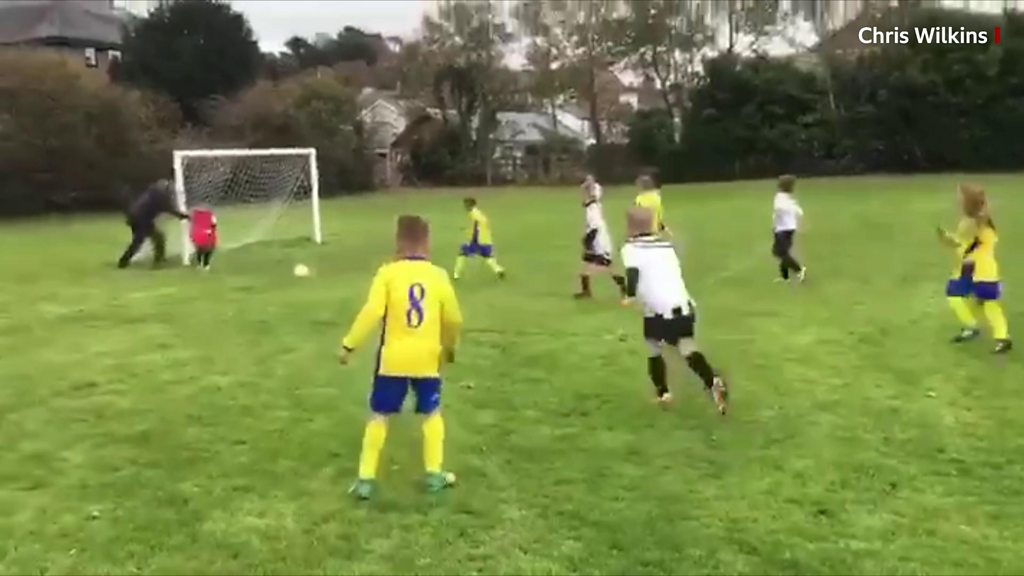
When Phil Hatfield was watching his six-year-old son play football, he could not resist giving him a “helping” hand.

Little did he know the moment would be seen by more than 18 million people.

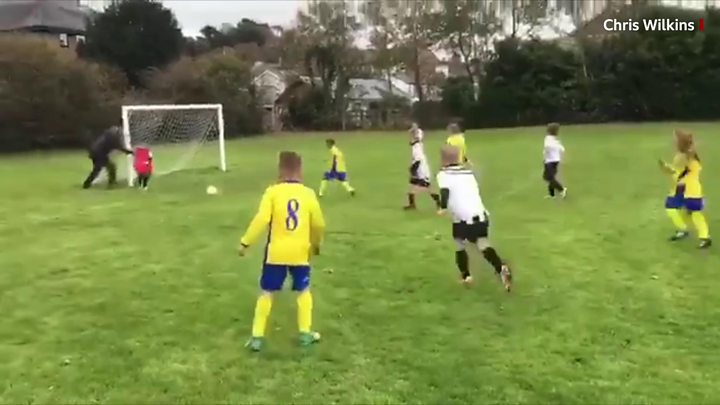
The video of the children’s game in Bow Street, near Aberystwyth, shows under-8s goalkeeper Osian saving a shot – but only after being pushed on to the ball.

Mr Hatfield told BBC Wales he would be staying on the touchline and keeping quiet during future games.

“All the action had been on the other half of the field… he hadn’t had much to do,” he said.

“So I went over to try and keep him focused, keep him going and shouting instructions… he came towards me because he hadn’t heard what I said and [I was] just trying to guide him back to position, and he fell over.”

Former Wales and Everton goalkeeper Neville Southall offered some advice for budding goalie Osian, tweeting: “Keep hold of first ball”.

News channels as far away as Australia have been showing the video.

Bow Street Magpies, in their first season of existence, had scored their first ever goals to lead 2-0.

Unfortunately for Osian, a Llanilar player knocked in the rebound from his save to halve the lead before a second goal saw the game finish 2-2.

Image caption

Coach Amlyn Ifans admitted he missed the goal because he was “bent over” laughing

However, Magpies coach Amlyn Ifans said they were still happy to pick up their first league point.

“We were bent over laughing so much that we didn’t see the lad put the ball in the net,” he said.

“It wasn’t out of the coaching manual… but it was perfect timing.

“After speaking to the parents they saw the funny side of it and knowing that Osian was quite happy, we’ve all had a good laugh.”

But the push could get the club into trouble with football authorities.

A Football Association of Wales spokesperson said: “While we appreciate that this video has gone viral and that many find it humorous, the FAW has a code of conduct for parents, guardians and spectators.

“We’re duty bound to request observations from the club in relation to this matter.”

Read More

from Trendy News Day https://ift.tt/2PlyLT5
via IFTTT

Unique gifts for men: Fun, funny, and interesting gift ideas for the men in your life

news image

CURIOSITYSTREAM

BEST FOR DOCUMENTARY-LOVING GUYS

If you’re buying a gift for a guy who has already binged How to Make A Murderer and every iteration of Planet Earth — twice — CuriosityStream would be a perfect gift. With more than 2,000 shows and documentaries to choose from, featuring flicks by the world’s best filmmakers and experts across science, nature, history, technology, society, lifestyle, travel, and more, he’ll never run out of content to fascinate his curiosity. Try it free for a month using the code winter2018, then it’s just $2.99 after that.

Read More

from Trendy News Day https://ift.tt/2QvzXje
via IFTTT

Eugenic sterilisation in Japan: ‘We all have the right to live’

news image

When Kikuo Kojima returns to Japan’s Nakae Hospital, the memories come flooding back – of isolation, electric shocks, beatings, starvation and finally, surgery.

“They pinned me down, took my pants off, and when I tried to resist, they gave me an injection in my arm … the anaesthetic didn’t work. It was excruciating,” he recalls.

Kojima was one of 25,000 people who were sterilised in Japan under the government’s Eugenic Protection Law.

The law was introduced after World War II to prevent the birth of children who the government deemed “inferior”. This included people with physical disabilities and mental illness, who for decades have faced discrimination and isolation in Japanese society.

After 57 years of silence, Kikuo Kojima told his wife Reiko that he was one of 25,000 people sterilised by the Japanese government [Al Jazeera]

The Hokkaido region, where Nakae Hospital is located, has the highest number of forced sterilisations in the country.

“I remember what the nurse said clearly: ‘Mr Kojima, you have schizophrenia. You have a disability. People like you should not have children’,” Kojima recalls.

He was left physically disabled after suffering from polio as a child, but Kojima says he was never formally diagnosed with a mental illness.

He was admitted to the hospital by police when he was 18, after arguing with his foster parents over money.

“The nurse said I was at a psychiatric hospital. Why a psychiatric hospital? I had never hurt anyone … I didn’t think I had a mental illness … And when I tried to resist, they tasered me,” Kojima says.

While there, he says he witnessed other patients being taken for sterilisation surgery, some as young as 14 years old.

Not long after his own sterilisation procedure, Kojima escaped the hospital. But he says he couldn’t escape the shame he felt over what happened and kept his it a secret for 57 years.

“People with disabilities … we all have the right to live … They stripped us of this right,” he says.

Kojima finally revealed to his wife what happened to him after another sterilisation victim launched a case against the Japanese government.

Now Kojima is also taking legal action, demanding an apology and compensation.

“I hope more people will get to know there are people like us. And I hope the same thing will not happen in other countries … We have to make some noise,” he says.

I wonder whether Japan will truly become as accepting of diversity as we are told? Will this event [the 2020 Paralympics] just come and go without creating lasting change?

Kikuo Kojima, sterilised under Japan’s Eugenic Protection Law

Scars of discrimination

When Japan hosted the Paralympic Games in 1964, the Eugenic Protection Law was still in force. It was only repealed in 1996.

In 2020, the games will be held again in Tokyo, but Paralympic athlete Hajimu Ashida questions whether the country has moved on from its history of discrimination.

“I wonder whether Japan will truly become as accepting of diversity as we are told? Will this event just come and go without creating lasting change?” he says.

Ashida bears the physical scars of a desmoid tumour, a rare disease that engulfed the muscles and bones in his right arm. It left his arm stunted with a permanently dislocated elbow.

Today, he says he fights to be recognised as an athlete, rather than someone with a disability.

“Japan is good at putting people in boxes. I’m trying to remove the disability label. As long as people look at you through coloured lenses, it will affect the way people look at you and evaluate you,” Ashida says.

“I want to compete in able-bodied athletes’ events. For me, it will mean breaking through all kinds of obstacles,” he adds.

Hajimu Ashida says that as a Paralympic athlete (with a desmoid tumour in his right arm) he wants to fight the label of disability in Japan [Al Jazeera]

Barriers for people with disabilities

Japan has more than seven million disabled people. This year, the government increased employment quotas for disabled people. Employees with a disability must now make up 2.5 percent of the public sector workforce and 2.2 percent in the private sector.

But Japan’s own government has not always adhered to these quotas.
In August 2018, authorities were forced to admit they had given false information and inflated the number of disabled people employed in 27 government ministries and agencies.

Only half the number of disabled people had actually been given a job.

For those who work in employment services for people with disabilities, this hypocrisy was a blow.

“The government itself is not following the regulations, even though they made the regulations. There are some people who get extremely angry about this …  Disabled people will think that they can’t work if they see this,” says Yumiko Kobayashi, director of the Tama Shurottei organisation.

In a country which classifies mental illness as a disability, Kobayashi’s organisation runs centres that help people with a mental illness learn more about their disability and train for the workforce.

“The starting point for people with mental illness is one episode, but that can be controlled with medication … But when that mental illness gets worse and you don’t get help from society, disability occurs,” says Kobayashi.

She believes it’s harder for people with mental illness to express their needs to employers because their disability is invisible, making it more difficult for them to find work.

As hiring quotas for disabled people rise, so too do the numbers of disabled workers leaving employment, Kobayashi says.

Kazuhiro Horii, a disabled job seeker at one of Shurottei’s centres, left his previous part-time job because he wanted to work full-time. He says the revelations that the government was publishing inflated employment figures for disabled workers should prompt a major rethink.

“I feel angry and sad … Because we’re disabled people, maybe they think that this is alright that this happened. I can’t forgive that at any cost,” Horii says.

In Hokkaido, Kojima says the Paralympics present the perfect opportunity for Japan to face up to its past and present discrimination, in order to move forward.

“When the games are held, it would be better if everyone, including those who are disabled, come out and fight against the way that Japan looks at people with disabilities,” he says.

“I will do my best and win this case. And then for future cases after mine … it’s clear the government did something wrong … The future generations, I have to fight for them in order for the government to apologise for what they did.”

Read More

from Trendy News Day https://ift.tt/2PiNONk
via IFTTT

Fans in ‘5,000-1’ helicopter tribute walk

news image

Tributes left near the stadiumImage copyright
Charlie Slater

Image caption

About 20,000 people are expected to march from Jubilee Square to the King Power Stadium

Thousands of Leicester City fans are set to join a memorial walk in honour of those killed in the helicopter crash outside the club’s stadium.

Club owner Vichai Srivaddhanaprabha was among five people who died when the aircraft came down on 27 October.

The 5,000-1 walk is named after the odds the club overcame to net its “fairytale” 2016 Premier League win.

Fans will march from Jubilee Square to the King Power Stadium before the Foxes play Burnley.

On Friday, the club announced plans to erect a statue of Mr Vichai at the King Power Stadium.

Image copyright
Craig Elliott

Image caption

Leicester fans Megan Elliott, 14, and her sister Casey, 11, once met Mr Vichai

The idea for the memorial walk came from young supporters Megan Elliott, 14, and her sister Casey, 11, who initially appealed for 5,000 fans to march to the stadium in honour of the Thai billionaire and chairman.

However, about 20,000 people are expected to join the parade, which Megan said “means a lot”.

Casey said Mr Vichai had “done lots for Leicester” and was “the best chairman ever”.

Leicester City Council said the walk will leave Jubilee Square at 12:45 GMT and follow a route towards De Montfort University campus and along the riverside to the King Power Stadium.

The authority said it was expecting a “large number of people” and road closures would be in place along the route.

Image copyright
Getty Images

Image caption

A huge number of tributes have been left outside the club’s stadium

Tributes left outside the stadium following the crash were moved to a designated memorial area close to the accident site on Friday.

Leicester’s players will wear special shirts with their former owner’s name embroidered on them for the game, and a tribute video will be shown before kick-off.

Fans will be given commemorative scarves, pin badges, clappers and programmes in honour of Mr Vichai.

Image copyright
AFP

Image caption

Vichai Srivaddhanaprabha bought the club in 2010

The club said a two-minute silence would be observed prior to the game in memory of servicemen and women, as well as the five who died in the crash.

An inquest, opened on Tuesday, heard there was “minimal chance” for anyone on board the helicopter to survive the crash.

Players and staff attended the start of Mr Vichai’s seven-day funeral in Thailand earlier in the week.

Image copyright
Getty Images/Facebook/Instagram

Image caption

(L-R): Vichai Srivaddhanaprabha, Kaveporn Punpare, Nusara Suknamai, Izabela Roza Lechowicz and Eric Swaffer were killed in the crash on 27 October

Two members of Mr Vichai’s staff – Kaveporn Punpare and Nusara Suknamai – as well as pilots and partners Eric Swaffer and Izabela Roza Lechowicz were also killed in the crash.

Police have said Ms Lechowicz was a passenger at the time of the crash.

The Air Accidents Investigation Branch is investigating the cause.

Follow BBC East Midlands on Facebook, on Twitter, or on Instagram. Send your story ideas to eastmidsnews@bbc.co.uk.

Read More

from Trendy News Day https://ift.tt/2Fe3e0L
via IFTTT

Design a site like this with WordPress.com
Get started