How an app developer helped Alexandria Ocasio-Cortez make history

news image

In the wake of the 2016 presidential election, app developer Leo Sussan was unhappy and looking for a way to become more politically active. So he volunteered for a long-shot congressional candidate, 29-year-old Alexandria Ocasio-Cortez, in New York City. 

Since he was a full-time employee at a real estate startup, Sussan offered his programming skills to the campaign during his off-hours. The app he and his small team created, Reach, reimagined the way volunteers found other sympathetic voters — and ultimately helped get Ocasio-Cortez elected. 

Historically, political campaigns have reached voters through a process called “canvassing,” or making direct contact with people door-to-door. Apps typically facilitated this process by giving volunteers in the field an easy way to access a list of voters compiled by the Democratic Party.

The list of potential voters was usually built from historical voting data and party registration. Volunteers would use it to find sympathetic voters, knock on their doors, and ask them a predetermined set of questions, typically about whether they were likely to vote for a specific candidate.

But Sussan’s app — Reach — was different. It made it easier for volunteers to find brand-new voters, regardless of whether they’d voted in a previous election or registered as a Democrat in the past. It was a technological solution to one of the campaign’s key principles: Ocasio-Cortez wanted to expand the electorate, and help more people take part in the political process. Sussan did too, so he built the app with this as a core principle.

Now, using Reach, volunteers were able to easily target new voters on the street, at the mall, or basically anywhere they could think of, and log their interactions. Canvassers were no longer confined to a list of people who’d voted for a Democrat in the past or registered with the Democratic Party. Instead, they could add new names and contact information to the list on the spot. Plus, it helped that Reach worked on all the major platforms including iOS, Android, and web browsers, making it easier to get into the hands of the right people.

When Ocasio-Cortez faced off against 10-year incumbent Joe Crowley in the Democratic primaries in June, the app played a pivotal role in her upset victory, according to Sussan. Shortly after the win, Sussan left his day job to join Ocasio-Cortez’s campaign full-time as the technology director.

Ocasio-Cortez’s midterm victory over Republican Anthony Pappas (she won a whopping 78 percent of the vote) made her the youngest woman ever elected to Congress, but that doesn’t mean Sussan can rest. We spoke to him just a few days before Election Day to get a better sense of how he’s continuing to build technology that will help find potential voters and what the future holds for progressives in the technology industry.

Leo Sussan (standing in white) celebrates with the rest of the Ocasio-Cortez team upon learning of her primary win in June.

Leo Sussan (standing in white) celebrates with the rest of the Ocasio-Cortez team upon learning of her primary win in June.

Image: Andrew Bard Epstein

Can you tell me more about the app you created, Reach?

We built Reach as a tool for ourselves. We wanted something that let us go where people are and have electorally relevant interactions. Reach let us canvas and record responses at community events, on the streets, on subways, in taxis, and even online. Volunteers set up tables on the street and would talk to folks on their way to work, in Ubers and on the subway. All of these interactions that are usually untracked by a campaign were now being fed into our get-out-the-vote system and our outreach efforts.

How did this differ from the old way of getting out the vote?

Traditional door-to-door canvassing methods limit who you talk to and where you’re able to effectively collect data. One of the main ways that canvassing is broken is that it’s list-driven. Those lists are generated based on what a campaign has guessed would predetermine support for their candidate. A major variable is whether or not they voted in the last election. What ends up happening is a lot of voters who are already supporters get knocks on their door. You end up selling to the [people who’ve already been] sold [to].

Screenshots of the Reach app for iOS.

Screenshots of the Reach app for iOS.

How important was Reach to the success of the Ocasio-Cortez’s upset primary win against Joe Crowley?

After we won, we looked back, and Reach accounted for about 10 percent of our total positive IDs, or in other words, pledged voters. Reach was only deployed in the last three weeks before the primary. And the difference in the number of votes between Crowley and Ocasio was about 15 percent. So, I’d like to think that there was an impact, but you can’t see who votes for who. I think it played a big role, especially in bringing out folks that had not voted before.

Reach is now being deployed in campaigns other than Ocasio-Cortez’s. How did the app branch out to other candidates?

A lot of Ocasio’s volunteers went over to work on other campaigns and were like, ‘Why are we using this old piece of software? And why can’t we use Reach?’ The problem at the time was the solution wasn’t built to scale. It was built just to solve our own [campaign’s] problems. We had to rebuild it.

About 20 campaigns ended up using it. We had a waiting list of something like 35 campaigns.

We ran a beta in the final days of a campaign in early August. The results were insane. We ended up accounting for 10 percent of IDs in just the three days that we deployed it in the field with volunteers. That was unexpected. 

About 20 campaigns ended up using it. We had a waiting list of something like 35 campaigns. The next step for us is to bring it to as many folks as humanly possible while maintaining control of the technology, making sure that only the right candidates get access to it. We’re only working with progressives and hard-left campaigns right now.

Screenshots showing Reach in action for the iOS.

Screenshots showing Reach in action for the iOS.

How do you determine which campaigns to work with?

Everyone who built Reach, and there’s about seven of us total plus a few others who contributed some code to it, votes on any campaign that comes to us asking to use it. If 60 percent or more of us say yes, then we’ll deploy it for them. We’ve turned down a couple campaigns. Because each voter file in each state is different, we have to essentially build new data loaders for each state. 

Our calculus that goes into it is A) do all of our members like the politics of a candidate who is requesting it? and B) given that they do, can we build the loader in time to have an impact, and if not, should we re-prioritize and focus on campaigns in states we’re already working in?

All the candidates we worked with were long shots. And all but one were running against incumbents. We’re only interested in the most progressive races and making a difference in them regardless of their chance of victory.

What if a canvasser using Reach comes across someone who isn’t registered to vote? 

Because it’s based on the voter file, if you were to search a person who isn’t registered to vote yet, they would not show up. But I’ve been recently experimenting with builds that allow you to register a voter on the spot and that is one thing that we’re heavily considering as a kind of a major release to all campaigns that end up using us moving forward.

Alexandria Ocasio-Cortez talks with reporters after casting her ballot in the 2018 midterm general election.

Alexandria Ocasio-Cortez talks with reporters after casting her ballot in the 2018 midterm general election.

Image: JUSTIN LANE/EPA-EFE/REX/Shutterstock

Can you tell me more about Reach and its use as an online get-out-the-vote tool?

We’re working on using social media as a way of generating IDs. We’re taking some of the folks that consistently interact with us on social media platforms like Twitter and finding them in the voter file and marking them. By doing that we’re able to follow up with them outside of the sphere of social media to get them out to vote.

What do you think of Google, Facebook, and other major tech companies’ roles in the political arena, particularly in the wake of the Cambridge Analytica scandal?

As global monolithic entities, these companies have a huge impact on what our politics look like. They need to do better. Companies as distinct entities have one job and one job only, and that’s to look after their shareholders and to extract the maximum amount of value. But companies are made up of parts, the people that are working at these companies. Those individual parts are getting experience and access to valuable resources that they wouldn’t have before. As a result of that and this kind of globalized awakening of people to the political process, the net result is going to be a lot of politically involved techies trying to use their skills to create new and better solutions for progressive campaigns. As an example, almost all the folks who work on Reach with me had not worked in politics prior to this campaign.

Any final thoughts on the future?

What I can say with certainty is that my future has been written for me. I want to be involved in creating the solutions that elevate us from where we are to where we need to be. So whatever I end up doing, it’s going to be for the greater good in the political world.

This interview has been lightly edited and condensed for clarity.

Https%3a%2f%2fblueprint api production.s3.amazonaws.com%2fuploads%2fvideo uploaders%2fdistribution thumb%2fimage%2f86967%2fbdebb75c df40 4152 b10a 1a97b6973843

Read More

from Trendy News Day https://ift.tt/2qBdm9w
via IFTTT
Sri Lanka president ‘dissolves parliament’ amid deepening crisis

news image

Colombo, Sri Lanka – Sri Lanka’s President Maithripala Sirisena has signed an order dissolving the country’s parliament, according to two sources, amid a worsening constitutional crisis triggered by the sacking of Prime Minister Ranil Wickremesinghe last month.

The move on Friday will pave the way for snap elections in January, a source close to Sirisena told Al Jazeera.

“The president has signed the gazette notification and it will be published very soon,” the source said. 

“The elections commission can call for nominations within 14 days, and elections are likely to be held in the first week of January.”

A senior government official confirmed Sirisena’s move, and told Al Jazeera the president had no choice but to dissolve parliament because of Wickremesinghe’s refusal to step down.

The deposed leader has remained holed up at the prime minister’s residence since his abrupt dismissal on October 26, while demanding a parliamentary vote to prove his majority.

His United National Party (UNP) has denounced Wickremesinghe’s removal as unconstitutional, arguing the president does not have the authority to sack a sitting prime minister – a claim Sirisena denies. 

The UNP, responding to the president’s latest move on Friday, said it “vehemently rejects” the dissolution of parliament.

“He has robbed the people of their rights and the democracy that we have enjoyed,” the party said in a Twitter post. 

But the government official who spoke to Al Jazeera insisted Sirisena was acting well within his constitutional rights in dissolving parliament.

“The best thing is do now is go for an election. This is what the people also want,” he said.


Read More

from Trendy News Day https://ift.tt/2FeGRIA
via IFTTT

Oleksandr Usyk v Tony Bellew: A southpaw headache, Olympic pedigree and predictions

news image

The world will see a new cruiserweight king – Bellew
Usyk v Bellew
Venue: Manchester Arena Date: Saturday, 10 November Ring walk: From 22:30 GMT
Coverage: Radio commentary on BBC Radio 5 live and live text commentary on BBC Sport website from 20:30 GMT.

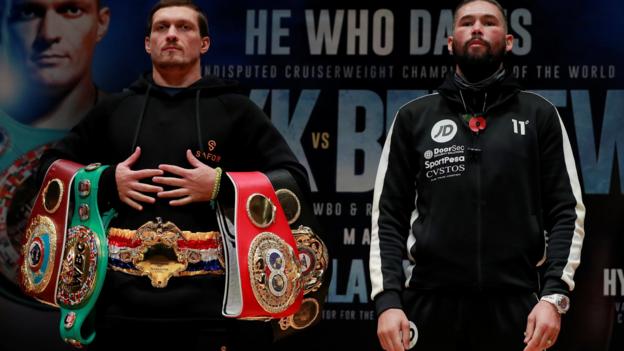
Tony Bellew must deliver one of the biggest wins ever by a British fighter if he is to humble Oleksandr Usyk, says BBC Radio 5 live’s Mike Costello.

Saturday’s Manchester Arena bout will present Bellew with the chance to become the first Briton to hold four world titles in a weight division.

Ukraine’s Usyk – IBF, WBO, WBA and WBC cruiserweight champion – is unbeaten.

“I think it will be one of the all-time best displays by a Briton home or abroad if Bellew wins,” said Costello.

“In Usyk, we are talking here about one of the best. If he is allowed to get into a rhythm, he does so very quickly within two or three rounds and becomes just about untouchable.”

The bout – which will be broadcast on BBC Radio 5 live – is described by Eddie Hearn as “the best fight I have ever promoted”. Four world titles will be on the line for just the sixth time in men’s boxing history.

Room for one final flourish?

Dereck Chisora expects Bellew to be losing on the judges’ cards but land a knockout on Saturday

In his own words Bellew, 35, is ready to “shock the world and then do the greatest disappearing act.”

Retirement beckons for a fighter who won three British amateur titles before earning professional belts at British, European, commonwealth and – famously at Goodison Park in 2016 – world level.

Early days spent earning supplementary income stuffing pillows in a factory or working nightclub doors created a gateway to an 11-year pro career which even took in a Hollywood film appearance as ‘Pretty’ Ricky Conlan in ‘Creed’.

After two wins at heavyweight over David Haye, his rollercoaster career faces one final challenge against an opponent he describes as “a monster”, despite insisting he will “break” Usyk’s “heart”.

“I just hope he comes back from it well as he will get a shock he does not see coming,” Bellew told BBC Radio 5 live.

Why is ‘regal’ Usyk so good?

Usyk became undisputed world cruiserweight champion and won the Muhammad Ali Trophy in July

Social media footage of 31-year-old Usyk dancing demonstrates a sleight of foot not typically associated with men in the cruiserweight division.

His obscure movement and high-pace assaults helped him claim gold at the London 2012 Olympics, catapulting him into a professional career which saw him win the inaugural World Boxing Super Series – and all four titles – in his 15th and most recent bout.

His display in the Super Series final – beating Russia’s Murat Gassiev in Moscow – was described as “regal” by 5 live’s Steve Bunce. It also ensured the father of three became the first Ukraine fighter to become an undisputed champion in a division.

Bellew’s trainer Dave Coldwell said: “If you just looked at the Gassiev win you’d think ‘how on earth do you beat this guy?’ But there are fights and moments where he doesn’t have it all his own way. Do I think my fighter can take advantage? Yes I do.”

In addition to movement, speed, Olympic pedigree and general work rate, Usyk brings another notable challenge…

‘Havoc’ from the ‘maverick’ southpaw

Bellew admits he has in the past faced a “massive problem” in dealing with fighters – like Usyk – who sport a southpaw stance.

He says he has overcome the issue since working with trainer Coldwell but the clash of orthodox versus southpaw can historically present problems.

“I often used to refuse to go near southpaws,” Bellew said. “I’ve sparred them for 12 weeks now so I can hit them and know what they do. This guy is unlike any other fighter in the world.

“He’s a one-off, a maverick, he’s formidable at what he does. I just know I am going to find a way. I even know how I am going to do it, I just can’t say.”

BBC 5 live commentator Mike Costello:

Why is there that issue? It is very difficult to get a jab going and get into a good rhythm against a southpaw. The reason the southpaws don’t have the same problem is the numbers mean they are so used to meeting plenty of orthodox fighters compared to the other way around. It took 100 years until we saw a southpaw heavyweight world champion – Michael Moorer.

We know the old adage of a kid turning up at a gym and being asked what hand he writes with. Whatever the strong hand is tends to be a fighter’s back hand as it’s then more powerful, so a right handed kid would typically be orthodox in his stance.

I’ve read about the great Soviet coach Andrei Chervonenko who went to Cuba and revolutionised their boxing in the 60s. He was committed to turning fighters to southpaw regardless of their strongest hand as he felt southpaws would wreak havoc on the international scene.

BBC 5 live analyst Steve Bunce:

From when I first started covering international events in the late 1990s, you’re stunned by just how many Eastern Block fighters and the entire Cuban team are southpaws. They 100% switch guys around and make southpaws out of guys that should have been orthodox.

‘Tony wins, it’s in the stars’ – what they said…

Usyk (left) is a strong favourite to beat Bellew with bookmakers

Former world heavyweight champion David Haye: I consider Bellew a friend. Someone who fairly beat me. It’ll be better for my ego to say I got beat by a guy who beat Usyk. He can do it. If he doesn’t it’s a points loss. Usyk on points, or Bellew by stoppage.

British heavyweight Dereck Chisora: It is just written in the stars. Tony wants this badly. He will be losing this fight but when he hits this guy he will stay hit. He will knock him out, 100%. Then Tony becomes the number one fighter in the United Kingdom.

Former British middleweight champion Matt Macklin: If Bellew wins this it is without doubt the best win of his career.

Former two-weight world champion Paulie Malignaggi: People have counted Tony out before, made him the underdog. Appreciate Usyk but appreciate the desire and determination Bellew has shown us over the years. He always gives people their money’s worth and comes to fight.

Send us your predictions to #bbcboxing.

Final thoughts – ‘What if?’

Usyk (left) has aspirations of moving up to heavyweight to face Anthony Joshua after facing Bellew

BBC 5 live commentator Costello:

Bellew is a bookmakers’ underdog just as he was against David Haye twice, Nathan Cleverly twice and Adonis Stevenson.

In Usyk, we are talking here about one of the best. He claimed the World Boxing Super Series but in the semi-final, he did see a few problems against Mairis Briedis, who varied the line of attack, going to the body and head in the same attack.

It did get through. And one judge gave it a draw while the others two went 7-5 Usyk, so there is a way to get to him.

BBC 5 live analyst Bunce:

In the Super Series, Usyk was owning every second of every single fight. I doubt he lost 20 seconds of any of the fights he had.

This is a Bellew fight. If we are still working in 25 years time, when crazy fights come up we will be saying ‘that’s like a Bellew fight that is’.

Usyk is the man who will fight Anthony Joshua, maybe dominate for five years. And then you start to think about it, the two words that come up in boxing come into your head, ‘what if?’

Read More

from Trendy News Day https://ift.tt/2Qwtd4K
via IFTTT

LinkedIn adds events to make it easier to network IRL

news image

LinkedIn wants to make it easier to meet up IRL.

The company is launching a new events feature, which lets users arrange offline meet-ups to compete with platforms like Meetup. 

The feature is pretty similar to Facebook events. You create an event, fill in the relevant details such as the time, location, and a brief description. From there, you can invite people you’re connected with on LinkedIn and share it in your feed. 

When you’re invited to an event, the invitation will appear in the same tab where you see new connection requests. And everyone who marks themselves as attending can chat with one another on the event’s main page.

LinkedIn's new Events feature.

LinkedIn's new Events feature.

Overall, the feature is pretty limited. For starters, it’s only available in New York and San Francisco as part of an initial pilot program. There’s also no way to create private events or much of a discovery process to connect you with events you might be interested in. LinkedIn says it plans to add these features and expand to all users “in the next few months.”

Basic though it is, the feature makes a lot sense. It’s actually kind of surprising the self-described largest professional network didn’t have any kind of native events feature before now. Instead, people would either have to use workarounds like group messaging, or link to outside platforms like Meetup.

“We have seen behavior where people are using the platform to organize meet-ups and they will add a bunch of folks to the comments and tag them and hose folks will in turn invite more,” says LinkedIn product manager Ashu Dubey.

It’s also another sign the company is increasingly focused on enabling connections offline. Last year, LinkedIn began experimenting with Snapchat-like video filters for live events. That feature still hasn’t had a significant expansion, but it was one of the first signs the company was dipping its toe into features pegged to real-life events. 

Https%3a%2f%2fblueprint api production.s3.amazonaws.com%2fuploads%2fvideo uploaders%2fdistribution thumb%2fimage%2f86968%2f57478993 1c1c 424f 9f02 e59fde783a81

Read More

from Trendy News Day https://ift.tt/2PhaYUl
via IFTTT

Danny Welbeck: Arsenal say forward has ‘significant’ ankle injury

news image

Arsenal’s Henrikh Mkhitaryan checks on Danny Welbeck following the striker’s awkward landing

Danny Welbeck sustained a “significant” right ankle injury during Thursday’s Europa League game against Sporting Lisbon, his club Arsenal have said.

The 27-year-old England international was carried off on a stretcher during the goalless draw at Emirates Stadium.

Welbeck, who was injured when he jumped for a header and landed badly on his right ankle, remains in hospital and will continue to be assessed.

“A further update will be issued over the next 72 hours,” said the club.

Several of Welbeck’s team-mates appeared distressed as he received lengthy treatment and needed an oxygen mask.

Arsenal manager Unai Emery said: “He was working well and he was having a good match. He had some chances too. His injury was with the mentality of the players.”

Welbeck, who has scored 16 times in 42 international appearances, was named in the latest England squad for the upcoming games against the United States and Croatia.

He has five goals from 14 matches for the Gunners this season.

Read More

from Trendy News Day https://ift.tt/2RJCmak
via IFTTT

Watch this stop-motion music video made using 2,250 photos

news image

Normally, stop motion kinda creeps me out (claymation, especially), but in this case I’m just shocked by how impressive this video is.     

This video from Canadian band Said The Whale takes stop motion to a new level, featuring a grand total of 2,250 photos and zero (they claim) special effects.

Beyond the impressive video, the song “UnAmerican” is pretty catchy, too. Give it a watch.

Read More

from Trendy News Day https://ift.tt/2Dw7pU8
via IFTTT

Trump restricts asylum at the US-Mexico border

news image

US President Donald Trump signed a proclamation on Friday suspending the entry of migrants through the US southern border between ports of entry for 90 days.

The proclamation, taken together with a regulation issued by the Trump administration on Thursday, will bar migrants who cross the US border with Mexico between official ports from receiving asylum in the United States.

Trump’s proclamation does not apply to unaccompanied children, officials said.

“What we are attempting to do is trying to funnel … asylum claims through the ports of entry where we are better resourced, have better capabilities and better manpower and staffing to actually handle those claims in an expeditious and efficient manner,” a senior administration official told reporters in a news briefing on Thursday, on condition of anonymity.

The new rules is Trump’s administration’s latest move to limit the eligibility of individuals for asylum in the United States as part of its “zero tolerance” policy.

Earlier this year, former Attorney General Jeff Sessions implemented rules that made it harder for individuals fleeing gang violence or domestic abuse to apply for asylum.

‘Immoral and inhumane’

The new restrictions are expected to be challenged in court. Rights groups call rules unconstitutional and a violation of international law.

“These restrictions are illegal – asylum is a legal right regardless of how someone enters the country,” RAICES, an immigrant legal services organisation in Texas, said in a statement. “They hurt thousands of women and children … who have been denied a future already by US foreign policy” the organisation added. “It is immoral and inhumane.”

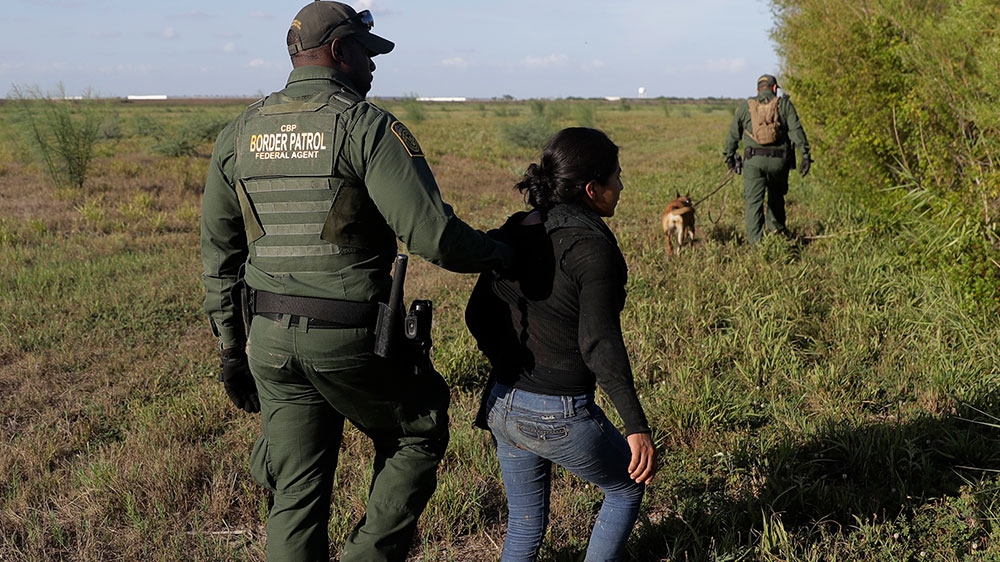
A man suspected of crossing into the United States between official ports of entry along the Rio Grande near Granjeno, Texas, is held by US Customs and Border Patrol agents [File: Eric Gay/AP Photo]

The National Immigration Law Center tweeted that “once again, Trump seeks to divide us by preying upon people in most need of help.”

Trump first announced his intention to limit asylum last week. More than 5,000 US troops have already been deployed to the border, and Trump said the number could rise to 15,000. The president has also said massive tent cities are being built to house asylum seekers indefinitely until their claims are processed.

Friday’s proclamation comes less than three days after the midterm elections in which Republicans maintained their hold on the Senate, but lost control of the House to the Democrats.

Caravan plans to apply for asylum at official port

During the election, Trump sought to sow fear over a caravan of Central American migrants and asylum seekers currently trekking north through Mexico. 

The initial wave of the caravan left Honduras a month ago, and thousands more have followed. The caravan’s participants have told Al Jazeera they are fleeing violence, including political persecution, and harsh economic situations.

The US president railed against the caravan in the lead up to the election, telling the refugees and migrants they would not be welcomed in the United States.

The caravan has remained undeterred, and participants said they plan on applying for asylum at an official port of entry.

Honduras migrants walk to the U.S as they approach Zacapa, about 70 miles northeast of Guatemala City, Wednesday [File: Oliver de Ros/Reuters] 

More than 100 people set out Friday morning from Mexico City for Tijuana. Others with the initial wave are deciding which route to take north, according to journalists travelling with the caravan. 

Last week, a group of parents travelling with their children in the caravan, filed a lawsuit against the Trump administration, saying the president “continues to abuse the law, including constitutional rights to deter Central Americans from exercising their lawful right to seek asylum in the United States”.

SOURCE:
Al Jazeera and news agencies

Read More

from Trendy News Day https://ift.tt/2RFVwxI
via IFTTT

Women’s World T20: India bat first v New Zealand – in-play clips & radio

news image

New Zealand v India in the ICC Women’s World Twenty20 – in-play clips & radio – Live – BBC Sport


<!–


<!–

<!–
<!–

<!–

<!–

<!–


Summary

  1. Opening game of the tournament
  2. India won the toss and elected to bat first
  3. In-play clips available to UK users only


Read More

from Trendy News Day https://ift.tt/2PRqvcU
via IFTTT

Actors voice ‘The Office’ scene as ‘SpongeBob SquarePants’ characters

news image

The actors behind some of SpongeBob SquarePants‘ most iconic characters read lines from The Office, creating the mashup you didn’t know you needed.

On the latest episode of the Nerdist YouTube series Talkin’ Toons, voice actors Rob Paulsen and Clancy Brown read lines from a scene in The Office using the voices of SpongeBob SquarePants characters. Paulsen read Dwight K. Shrute’s lines with Carl Wheezer’s voice, while Clancy read Michael Scott’s lines with the voice of Mr. Crabs. 

The result: an extremely ridiculous and enjoyable combination of two of television’s most beloved series. 

Read More

from Trendy News Day https://ift.tt/2DbsYYV
via IFTTT

Why the repeal of a racist 19th-century Florida law is important

news image

Amid the highlights of the US midterm election results was the triumph for voting rights in the state of Florida. The nation’s third largest state, which often plays an important role in presidential elections, voted overwhelmingly to approve a constitutional amendment restoring the right to vote for those with a felony conviction.

This is a major step forward in a nation where millions of people are denied a basic right of citizenship, based on laws rooted in a legacy of racism.

Passing with 64 percent of the vote, in excess of the 60 percent supermajority threshold required for passage, Amendment 4 restores voting rights to Floridians who were convicted of felonies, provided they have completed their sentences. The measure excludes people who were convicted of murder or felony sex offences.

The impact of the new law is sweeping, affecting more than one million people in Florida who have been stripped of their voting rights due to a criminal record. For people of colour, the implications of Amendment 4 are even more pronounced, as the measure grants the vote to 20 percent of African American adults in Florida who have been barred from the franchise due to a felony record – and a staggering 40 percent of African American men.

In a state in which eight million voters participated in the 2018 election, the addition of over one million voters has the potential to transform its politics and policies. Florida is the most important US swing state and its vote is crucial in presidential and congressional elections. It has selected the winner of every presidential contest this century and provided the margin of victory to George W Bush in 2000.

In recent years, the state has been under control of the Republicans who have been pushing for regressive pro-gun and anti-environment policies. The more than one million eligible voters who just got added to Florida’s electorate could change all that. Given that Amendment 4 affected predominantly African American men, who tend to vote for the Democratic Party, it is quite possible that in 2020 Florida would see a different outcome at the polls. Analysts have projected Democrats gaining as many as 102,000 more votes as a result of this enfranchisement effort.

But beyond its possible impact on future polls in Florida, the repeal of Amendment 4 carries a broader and more historic significance for the US as a whole; it is a major victory against voter suppression.

Many would be surprised to know that in the so-called “land of the free”, the right to vote is not automatic for many. In a nation that originally limited voting to white male landowners and regarded enslaved people as three-fifths of a person with no citizenship rights, the right to vote has been granted to marginalised groups only through protest and, in some cases such as the US civil rights movement, bloodshed and martyrdom.

During the Reconstruction era following the American civil war, liberated black people had the right the vote and took advantage of it, electing 2,000 black officials, a governor of a US state, senators and members of Congress – many of them former slaves.

The pathway to political empowerment for black people ended when white men retook control of the Southern states, presided over a rollback of civil rights and denied voting rights to African-Americans by law and through intimidation, and the threat of physical violence and death.

Felony disenfranchisement laws have their origins in the era of American apartheid, the days of racial segregation, as a means of suppressing black aspirations and rendering them invisible.

Florida’s felon disenfranchisement law dates back to 150 years ago when white elites were faced with the prospect of thousands of new black voters rendering white men a minority of the state’s voting electorate.

A lifetime voting ban on people with a felony record muted black political power, with a racialised regime targeting black men and singling them out for punishment with trumped-up charges and crimes designed solely for them. The laws eliminated thousands of black people from civic participation for life and made them unavailable as political competitors.

Across the country, as of 2016, 6.1 million people were unable to vote because of a felony conviction, with Florida accounting for roughly one quarter, according to the Sentencing Project. This includes 1 in every 40 adults, 1 in every 13 African-Americans and 1 in every 56 non-black voters. With the recent changes in Florida, of the 34 states that impose voting restrictions on past criminal convictions, Kentucky and Iowa are the only remaining states imposing lifetime disenfranchisement.  

Although the changes to the Florida law are a positive and decisive step in furthering democracy, the US is still experiencing a voting rights crisis. For all of the ample evidence of foreign intervention in US elections, American officials are effectively denying the rights of their fellow citizens, working in earnest to rig elections and block people of colour, students, the elderly and others at the ballot box through restrictive voter ID laws.

The right-wing US Supreme Court has gutted the enforcement mechanism of the Voting Rights Act, allowing states and localities to deny racial minority groups’ access to democracy with reckless abandon. Between 2014 and 2016 alone, states purged nearly 16 million voters from their voter rolls. The nation’s high court also allowed the unlimited role of money in politics – legalised corruption – with its decision in Citizens United v Federal Election Commission.

Gerrymandering of electoral districts has amplified the voice of the majority, entrenched the powerful and sidelined the interests of marginalised groups.    

Despite these many challenges, the restoration of voting rights to the formerly incarcerated in the Sunshine State is cause for celebration, as those who have served their time and paid their debt to society should have the opportunity to participate as productive members of society.

The views expressed in this article are the author’s own and do not necessarily reflect Al Jazeera’s editorial stance.

Read More

from Trendy News Day https://ift.tt/2PN4Z97
via IFTTT

Design a site like this with WordPress.com
Get started