Lawn Tennis Association facing £7.5m loss for 2018

news image

The Lawn Tennis Association is based at the National Tennis Centre in Roehampton, London

The Lawn Tennis Association is facing a loss of about £7.5m for 2018, leaving a “financial black hole” for next year, BBC Sport has learned.

It follows a £4.7m loss in 2017, amid falling revenues and participation.

It is understood regional offices may close to reduce costs, but regional operations will continue.

The LTA says it “has a new vision to open tennis up and grow the sport through making it relevant, accessible, welcoming and enjoyable to anyone”.

A spokesperson for the national governing body continued: “The LTA is now looking at how best to deliver the new vision and where it can have the greatest impact, to meet the needs of fans, players, coaches and venues to play tennis across Britain.”

Regional briefing documents seen by BBC Sport warned the LTA is facing a “financial black hole” because of this year’s anticipated losses, combined with last year’s confirmed £4.7m deficit.

A temporary reduction in revenues from the Wimbledon Championships because of the construction of a roof on Court One, which is due for completion in 2019, has contributed to the financial shortfall.

The documents also state that participation in tennis in Britain has fallen by nearly 10% compared to last year, despite relative successes on the court by leading players, including Kyle Edmund’s run to the Australian Open semi-finals.

The LTA currently has nine regional offices in England, all of which are understood to be set to close to reduce costs, although their activities will continue to operate from a central base and it is thought that the work of county associations will be unaffected.

Those regional offices are in Loughborough, Cambridge, Roehampton, Southampton, Leeds, Edgbaston, High Wycombe, Bromley and Bristol.

In June, the LTA announced it was setting up national academies in Stirling and Loughborough in 2019 in a bid to boost the number of British players in the top 100.

LTA ‘to build on charity’s tremendous legacy’

On 8 October it was announced that much of the work done by the Tennis Foundation charity will be brought back under the LTA’s control, but that integration is being welcomed and provision for disability tennis is set to be enhanced.

The LTA continued: “The work of the Tennis Foundation with disabled people, young people in education and young people in urban and disadvantaged communities is being integrated into the LTA to give it greater scale and reach.”

The Tennis Foundation added: “We are taking advantage of the opportunity to integrate these activities into the LTA in order to achieve real inclusion across our sport.

“The move received the unanimous support of our board and will see our work not only play a key role in supporting the LTA’s new vision to open up tennis and grow the sport in Britain but, crucially, enable it to be delivered with greater scale and greater impact than ever before.

“We are tremendously proud of the achievements of the Tennis Foundation over the last 31 years and the legacy we have created, which the LTA can now take forward and build on as part of a bright future for our sport.”

Analysis

Russell Fuller, BBC tennis correspondent

The LTA may have reserves of nearly £140m, but will be concerned by a potential loss of about £12m over two years.

This year’s accounts will be compromised by the end of a lucrative nine-year partnership with Aegon. The financial services company acted as both lead partner of British Tennis, and title sponsor of June’s grass court events, until the end of 2017. The sponsorship provided by Fever Tree and Nature Valley in the summer of 2018 was not as extensive.

The LTA is at least assured a healthy long-term income as, under an agreement with The All England Club, it will receive 90% of the profits generated by Wimbledon until 2053.

A fall in revenue from Wimbledon was the principal reason for last year’s financial loss, although safeguarding and IT costs were also a factor.

The outgoing chairman David Gregson said at October’s meeting of the LTA Council that “work had to be done to align certain areas so that reserves were not used in the future”.

Read More

from Trendy News Day https://ift.tt/2OvJTrk
via IFTTT

Cameroon child hostages released by kidnappers

news image

All 78 children and a driver kidnapped in west Cameroon were released on Wednesday, but the school principal and one teacher are still being held by the armed men, a priest conducting negotiations said.

The group was abducted in Bamenda, a commercial hub of Cameroon’s restive English-speaking region, on Monday.

“Praise God 78 children and the driver have been released. The principal and one teacher are still with the kidnappers. Let us keep praying,” Samuel Fonki, a minister of the Presbyterian Church in Cameroon, said. 

He had earlier put the number of children taken at 79 but later said one of their numbers was, in fact, a teacher, who remained with the kidnappers.

A video purportedly of the kidnapped children was released on social media by “Amba boys”, a reference to the state of Ambazonia that armed separatists are trying to establish in Cameroon’s northwest and southwest regions, The Associated Press news agency reported.

In the video, the kidnappers force several students to give their names and the names of their parents. The children say they were kidnapped by the Amba boys, and they do not know where they are being held.

Fonki and the Cameroonian military have accused anglophone separatists of carrying out the kidnappings, but a separatist spokesman denied involvement.

In an inauguration speech following last month’s election to extend his 36-year rule, President Paul Biya told the separatists to lay down their arms or face the full force of the law, offering no concessions to them.

Anglophone secessionists have imposed curfews and closed schools as part of their protest against Biya’s French-speaking government and its perceived marginalisation of the English-speaking minority, although they had never kidnapped children before.

Read More

from Trendy News Day https://ift.tt/2qvWb9v
via IFTTT

Allying with Bolsonaro will harm Venezuela’s opposition

news image

Venezuela, without a doubt, has experienced the most dramatic democratic erosion in Latin America (PDF) since the region’s third wave of democratization began. Free and fair elections are off the table, all state institutions are controlled by the government, civil and political liberties are no longer respected, and the opposition is being jailed, exiled or threatened.

Nevertheless, some opposition leaders and parties have persisted in their efforts to motivate and mobilise the Venezuelan people to pursue a peaceful transition. Many of them have spent their days in the streets demonstrating for state and policy reforms or doing the rounds in neighbourhoods to bring a message of hope to the most marginalised voters of the country. Many continue to insist on building an electoral majority to dislodge President Nicholas Maduro at the polls.

But while this insistence on observing the electoral process to achieve a change of power is commendable, there have also been some worrying trends within the opposition. One of them is its growing public support for Brazil’s president-elect Jair Bolsonaro voiced by some opposition leaders, which casts doubt over their commitment to democracy.

Bolsonaro is a retired army officer and back-bench congressman, who in his 26 years as a legislator, only managed to pass two of bills he proposed. While he has not impressed the public with his work, he has done so with his non-democratic views and contempt for human rights.

Bolsonaro has praised torture as an effective political strategy and endorsed the crimes of the former military dictatorship in Brazil. He has promised to give the police forces in Brazil expanded authority to kill suspects, saying that a “good criminal is a dead criminal” and has openly humiliated and threatened women, LGTBQ, native and black communities. Based on this rhetoric many fear Brazil’s young democracy is now at risk, and rightly so. 

Given Bolsonaro undemocratic tendencies, why did several Venezuelan opposition leaders not only congratulate him on his victory, but also explicitly invite him to help Venezuela transition to democracy? Why would Venezuela want his support in recovering democracy, while he is a clear threat to Brazil’s own democratic order?

The opposition cannot campaign against Maduro’s authoritarian government, while allying with leaders who seem to be or are authoritarian themselves. Opposition leaders need to understand that they cannot have it both ways. They cannot expect Venezuelans to be patient during the country’s most severe socioeconomic crisis or ask the international community for support, when demonstrating this self-contradictory and opportunistic behaviour.

Cooperating with Bolsonaro, or with factions of the Trump administration who have already contributed to democratic backsliding in the United States, or discourses inviting an open invasion of Venezuela, only harms the country and kills any hopes for a transition. In fact, these actions are only a gift to Maduro who can now, with “proper” evidence, say that the opposition conspires with the “global right” against him.

If the opposition is committed to a democratic transition and consolidation, it needs to be consistent in upholding its democratic commitment. This means rejecting any cooperation with leaders or parties, governments or organisations, who spread an authoritarian rhetoric full of hatred and polarisation.

Venezuela has suffered vastly from this same damaging discourse, which is precisely the reason why opponents to Maduro’s dictatorship should forcefully refuse any association with this kind of rhetoric.

Surely, leading a transition is not an easy task, let alone a linear path and certainly, politicians are allowed to make mistakes. However, it is their duty to recognise these mistakes and change their strategies when necessary.

The time has come for the Venezuelan opposition to do so. If leaders from the opposition want to govern the country one day, they need to earn the respect and trust of their voters first. If they want to replace an authoritarian regime that has polarised and politicised all aspects of life; if they believe that Venezuelans deserve to trust state institutions again; or if they want migrants to eventually return to their country and families previously divided along political issues to reunite, they need to start being consistent and demonstrate that democracy is worth fighting for – even if this implies turning down attractive but damaging short-term alliances.

An alliance with Bolsonaro is not the way to go. Building global networks with leaders committed to democracy, learning from their past mistakes, overcoming internal divisions and reconstructing a unified discourse, proposing concrete state and policy reforms, or supporting forcefully displaced citizens at the Venezuelan-Colombian or Venezuelan-Brazilian border, is.

As German sociologist Max Weber has argued, politics should be a vocation and should be “made with the head, not with the other parts of the body, nor the soul”.

In this sense, Venezuelan opposition leaders should think carefully before acting impulsively. They should recover and uphold their moral convictions.

One thing is for sure, being anti-Chavez, anti-Maduro or anti-PSUV does not make any opposition politician democratic per se. Standing up against bullies, misogynists, racists or fascists, does.

The views expressed in this article are the author’s own and do not necessarily reflect Al Jazeera’s editorial stance.

Read More

from Trendy News Day https://ift.tt/2yTDVeQ
via IFTTT

Vietnam to host F1 race in 2020

news image

The official F1 website provided a computer-generated image of the proposed 5.565km track layout in Hanoi

Vietnam will host a Formula 1 grand prix for the first time in 2020.

A “multi-year” deal has been agreed to stage the race, which will take place on the streets of the capital Hanoi.

It is the first new addition to the calendar under Liberty Media’s ownership of the sport.

“Since we became involved in this sport in 2017, we have talked about developing new destination cities to broaden the appeal of Formula 1,” said F1’s chief executive Chase Carey.

“The Vietnamese Grand Prix is a realisation of that ambition.”

The Hanoi track, which features 22 turns over its 5.565km length, will become F1’s fourth street race, along with Monaco, Singapore and Azerbaijan.

The circuit, designed in collaboration with ubiquitous F1 designer Hermann Tilke, also features long straights, one of which is 1.5km in length and should see cars reach speeds of around 335km/h (208mph).

The design also liberally borrows features from other world famous tracks.

The first two corners mirror those of Germany’s Nurburgring, while the section from Turns 12 to 15 have been nspired by a section of Monaco street circuit, running from Sainte-Devote up the hill to Massenet.

Turns 16-19 echo the sweeping Esses at Suzuka and the final three corners take inspiration from Malaysia’s Sepang.

Carey added that work had been done to “enable a circuit that will not only test the drivers but also ensure that our fans enjoy the racing spectacle”.

“It’s a further demonstration of Vietnam’s ability, as one of the fastest growing economies in the world to host events on a global scale and attract tourism to the country,” said city of Hanoi chairman Nguyen Duc Chung.

The Vietnam Grand Prix is the third race to be established in south-east Asia following Singapore and Malaysia – the latter being scrapped following the 2017 race due to poor ticket sales.

Read More

from Trendy News Day https://ift.tt/2QoVA4J
via IFTTT

Why Iranian women are among the most vulnerable to US sanctions

news image

On November 5, further US sanctions on Iran went into effect and are expected to bring devastating consequences on the Islamic Republic and its people. 

It is feared that women along with children and impoverished Iranians are most at risk.

Fatemeh, 27, works at a public health policy start-up and teaches biology at a high school in the Iranian capital, Tehran. 

Born in Iran in the aftermath of the Iran-Iraq war, she and her family moved to Canada and relocated to California at age 13.

After graduating, she decided that she wanted to return. Like many others, she has already started to feel the effect of sanctions.

“It definitely hasn’t been easy,” she told Al Jazeera. “Six, seven months ago, when the dollar and [rial] went crazy, prices went up. It makes me doubt if [returning] was really a good decision, and whether I can sustain this for much longer.

“No matter how much money I make, it is worth nothing in dollars.”

With the devaluation of Iran’s currency, Fatemeh’s monthly salary is equivalent to about $160, a steep decrease from what it used to be, around $800.

To add to income woes, women’s products such as menstrual hygiene items and certain medication have become steadily more difficult to find and much more expensive.

Over time, sanctions eventually impoverish the middle class and they are designed to do that.

Azadeh Moaveni, gender consultant at International Crisis Group

Fatemeh said searching for Western brands like Always or Kotex can be frustrating. 

“I went to six or seven pharmacies in a day and I just couldn’t find them anywhere,” she said.

She ventured to Jordan, a more affluent part of town, but the shelves were empty there, too.

Even Iranian brands have become more expensive; what was once 100,000 rial is now being sold for 160,000 rial, which is now worth around $3.80.

Azadeh Moaveni, gender consultant at the International Crisis Group, told Al Jazeera: “There are micro-shortages of every day things which erode the quality of life of different classes in different ways. Over time, sanctions eventually impoverish the middle class and they are designed to do that.”

The scarcity has also led to panic buying and hoarding.

“From the seller’s perspective,” Fatemeh said, “they might hold on to them and wait until the next week to try to sell their products for a higher value.”

Yasaman, a 22-year-old university graduate, works in her family’s fast restaurant in Shiraz. 

“People just aren’t buying anything right now if they can avoid it. I haven’t gone shopping recently, all the items have become more expensive,” she told Al Jazeera. “We had to increase the prices on our menu but customers understood that we didn’t have a choice.”

Khamenei’s call

After Norouz (New Year) celebrations last March, Ayatollah Ali Khamenei called on Iranians to support domestic production.

“A lot of people have taken it to heart,” Fatemeh said, “even those who don’t necessarily politically agree with Khamenei.”

But even locally made products are more expensive. Nappies, for example, are made with imported raw materials.

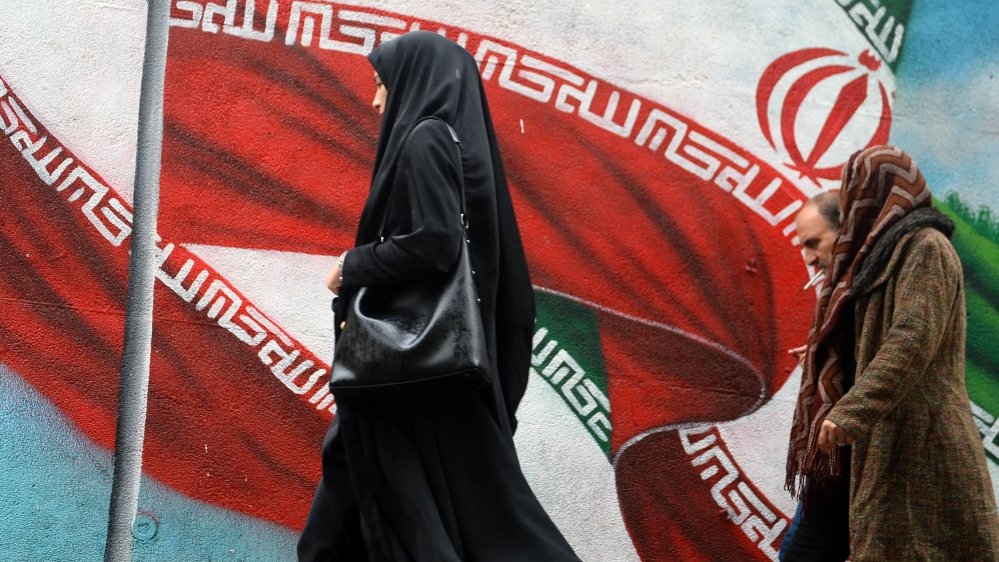
Analysts warned that economic sanctions could ultimately affect the traditional family dynamic and leave women vulnerable [Fatemeh Bahrami/Anadolu Agency/Getty Images]

One woman told Al Jazeera, speaking on the condition of anonymity, that the sanctions could lead to a lower birth rate.

She explained that people have been reconsidering having children because essential items such as nappies and formula are now unaffordable, even for an average dual-income household.

“When the Central Bank is sanctioned, it makes purchasing goods near impossible,” said Washington, DC-based Sussan Tahmasebi, the director of Femena, an organisation supporting women’s rights. 

She explained that the inability to transfer funds through SWIFT – meaning from one country to another – is the main problem.

Long-term effect

Beyond the immediate and visible effect – shortages and high prices – analysts warned that sanctions could disrupt the family dynamic.

Moaveni, the International Crisis Group consultant, said: “Women, as organisers of family life, healthcare, education, will often carry the burden of trying to come up with alternatives for their families in all instances.

“If men can’t provide for their families in a society that is still largely traditional and patriarchal, if they can’t fulfil the [perceived] duties of their gender role, it does tend to create tension and encourage forms of more assertive masculinity that are not as constructive to women having a say in the family unit.

“Not being able to earn or support the family has an impact on men’s conception of themselves.”

Further US sanctions on Iran went into effect on November 5, 2018 [Abedin Taherkenareh/EPA-EFE]

On Monday, US Secretary of State, Michael Pompeo tweeted in Farsi: “[US] sanctions do not apply to the sale of food, agriculture, medicine, and medical devices.

“[The US] stands in solidarity with the Iranian people.” 

But according to more than 50 academic studies, economic sanctions in the past on Iran have had a humanitarian effect.

They have adversely affected the standard of living for ordinary Iranians, made certain medications inaccessible, and triggered public health concerns. 

“People say medicine isn’t sanctioned and that humanitarian aid isn’t sanctioned,” said Tahmasebi, “but it is.”

Read More

from Trendy News Day https://ift.tt/2qwqsVN
via IFTTT

Champions League reaction

news image

Champions League reaction: Liverpool lose at Red Star & Tottenham defeat PSV – Live – BBC Sport


<!–


<!–

<!–
<!–

<!–

<!–

<!–


Summary

  1. Liverpool lose at Red Star
  2. Tottenham come from behind to defeat PSV
  3. Man City face Shakhtar with Man Utd at Juventus on Wednesday (20:00 GMT)
  4. Arsenal news conference (10:30 GMT)
  5. Get Involved: #bbcfootball or text 81111 (UK only)


Read More

from Trendy News Day https://ift.tt/2yZ9LH3
via IFTTT

Israeli minister in Oman to attend transport conference

news image

An Israeli minister is in Oman to attend an international transport conference and to pitch a railway project that would link the Gulf to the Mediterranean via Israel.

Transport and Intelligence Minister Yisrael Katz, who arrived in Muscat on Sunday, is expected to make his pitch at the International Road Transport Union, AFP news agency reported.

The Tracks for Regional Peace initiative calls for a rail link connecting Saudi Arabia with the Mediterranean Sea, according to local media.

The line would extend from Haifa, Israel’s largest port, passing through Jordan before connecting with existing railways in the Gulf.

The trip comes on the heels of a surprise visit by Israeli Prime Minister Benjamin Netanyahu to Muscat late last month where he met Oman’s Sultan Qaboos bin Said – the first such visit in more than 20 years by an Israeli prime minister.

The trip was a coup for Netanyahu, who wants to bolster ties with the Arab world in the face of the perceived expansion of Iranian influence across the region.

Last month, Katz said he had presented the plan to German Chancellor Angela Merkel, whose government had expressed interest in participating in the project.

Strategic move 

Separately, Israeli Sports and Culture Minister Miri Regev attended a Judo tournament in the United Arab Emirates, where one of the country’s athletes won gold.

Regev’s emotional appearance at the Judo Grand Competition’s award ceremony in Abu Dhabi was unprecedented and sparked a backlash on Arab social media, given her political leanings. She is an outspoken nationalist popular with Israeli hardliners.

In Abu Dhabi, Regev also toured the grand Sheikh Zayed Mosque. Wearing a loosely wrapped headscarf and the traditional floor-length gown known as an abaya, she was warmly welcomed by local officials.

While Israel has full diplomatic relations with only two Arab states, namely Egypt and Jordan, analysts say the country is trying to ride on a wave of anti-Iran sentiment in the region to boost its popularity and normalise ties with its historic enemies.

Netanyahu and members of US President Donald Trump‘s administration argue that a normalisation of Arab-Israeli ties is conducive to peace with the Palestinians.

The Trump administration is pushing to bridge relations between Israel and Saudi Arabia as it seeks an Israeli-Palestinian peace settlement.

Trump’s Middle East envoy Jason Greenblatt welcomed Katz’s visit to Oman, tweeting: “These efforts support our efforts.”

Israel’s occupation of Palestinian territory, however, remains a major obstacle to official recognition by other Arab countries.

SOURCE:
Al Jazeera and news agencies

Read More

from Trendy News Day https://ift.tt/2JLS2XZ
via IFTTT

Molly Bartrip: Reading defender on overcoming teenage anorexia

news image

Reading defender Molly Bartrip’s battle with ‘evil Ana’ anorexia

Ana wasn’t a relative of Molly Bartrip’s. She wasn’t a team-mate and she most definitely wasn’t a friend.

Bartrip hates what Ana did to her. She had control of her life and “played her like a puppet” – yet Ana wasn’t a real person.

‘Ana’ was the name Reading defender Bartrip gave to the voice inside her head during her teenage battle with anorexia.

“It was like this evil person on my shoulder who wanted me to fail,” she tells BBC Sport.

Now 22, Bartrip is a fit, strong and healthy athlete. But at the age of 14, she “self-destructed” after a torn hamstring and subsequent non-selection for the England Under-15s left her thinking the opportunity of ever representing her country was gone.

For six months, Bartrip did all she could to avoid eating. She would hide her food when her parents weren’t looking or throw it out of the window.

But while football was the trigger for Bartrip’s demise, “it was also my cure”, she says.

This is her story.

Aged 14 – ‘Ana’ takes control

“Ana told me everything I needed to do. ‘You need to go for an extra run today’, ‘look at the calories in this’. She had control of my life and played me like a puppet,” Bartrip says.

“I couldn’t fight her back, and I really thought I was going to give up at one point.”

Ana was a plague on Bartrip’s life, but whatever she said went. It was an incredibly tough time for Bartrip’s family but she felt no guilt towards them.

At her lowest, Bartrip was self-harming – she would lock herself in her room, climb under her bed and hurt herself.

“I don’t know why I did it – it was Ana,” she says.

As anorexia and Ana took hold, Bartrip’s decline was rapid.

International hopes slip

Bartrip – pictured with her younger brother Joseph – on holiday in the USA aged 14

Bartrip has loved football from day dot. After being scouted while playing for a local boys’ team, she enjoyed spells at Tottenham, Charlton and Arsenal.

It was during her time at the Gunners that England came calling. But the day before their first game in the Netherlands, Bartrip was injured and was forced to watch the match from the stands, away from her team-mates.

“I remember seeing my mum, dad, brother and grandparents in the stand. I was sat a bit higher up, and my mum turned around to me and was crying, because she wanted me on the pitch,” Bartrip says.

She wasn’t selected for the next England camp and that’s when, Bartrip says, she “lost her head”.

“I don’t know how to explain what happened at that moment, I just knew I wasn’t OK and then gradually started to eat less and less,” she says.

“When I didn’t get selected, I thought that was the end of the world for me – that was my chance of ever playing for England gone.”

Losing a stone in three weeks – the diagnosis

Growing up, Bartrip loved food. Bacon and a packet of crisps – though perhaps not together – were her favourites, and her schoolmates would be jealous of her packed lunches.

But after missing out on international selection, she “lost control”, eating less and less every day and throwing her lunches away. It was only when her best friend caught her doing so that her mum found out.

“My mum took me straight to the doctors. I’d lost around a stone in about three weeks, and the doctor said it was obvious I had anorexia nervosa,” Bartrip says.

Bartrip was “sneaky” in how she avoided eating but her parents had a few tricks of their own, including putting full-fat butter in the tubs of low-fat spread in a bid to help their daughter put on weight.

“Sometimes when I got weighed, I would put extra clothes on so it looked as though I was heavier than I was, or I would put something in my pocket like my phone,” she says.

“That was Ana playing me, that was Ana telling me it was fine to do.”

At her lowest, Bartrip weighed just 43 kilograms – less than seven stone.

Liver failure – and light at the end of the tunnel

Bartrip eventually became so ill that her parents took her to hospital. Her BMI was dangerously low, her liver had started to fail and soft, downy hair had started to grow on her body. Had her BMI been just 1% lower, doctors would have been forced to tube-feed her.

“That was really scary,” she says. “I was basically killing myself at the time, which was quite drastic.

“From that moment, I knew I needed to change.”

Remarkably, it wasn’t that moment that provided the “kick up the bum” Bartrip knew she needed. In fact, it was looking at an Arsenal squad photo that had been posted on Facebook.

“Everyone on it looked huge. I looked at myself at that point and thought ‘maybe I’m never going to play football again because I can’t play football with those girls’,” she says.

“That was the moment I realised I did actually want to be playing, I wanted to reach my dream. It was definitely not a light switch moment, but each day I got better; each day I began to try and eat more.”

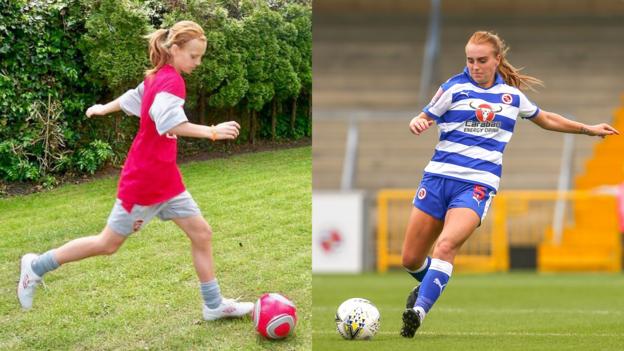
Bartrip joined Reading from Arsenal in 2014

‘Dad, I want a curry’ – on the road to recovery

“The one question I always feared was ‘what is for dinner?’ My dad would ask it but I would never answer,” Bartrip says.

“But this one day, I suddenly turned around and said ‘Dad, I really fancy a curry’. I don’t think I’ve ever seen him run so quickly in his entire life – he was straight down to the nearest curry shop.”

Bartrip knew at that point that she was going to get better, that she had the mental strength to beat the illness that for so long controlled her life.

“That was me basically punching this person on my shoulder,” she adds.

“I was definitely eating more and Ana got quieter and quieter. That was when I knew I was beating her. I didn’t hear her as much and it was the best feeling in the world knowing I could knock that person out.”

Such was the damage she had done to her body, Bartrip didn’t gain weight for years, despite returning to eating normally.

Not until five years later could Bartrip face eating bacon again, and it was at that moment, aged 19, she knew her recovery was complete.

Since her recovery, she has joined Reading and played for England’s youth teams on countless occasions. She screamed when she received her first call-up post-illness.

“I had to be with my family at that point,” she says. “I was starting at right-back, I sang the national anthem and I was thinking ‘I’ve done it, I’ve actually done it’.”

Her life since has not been without its ups and downs, however, having faced both anxiety and depression. But for now, Bartip says she feels “on top of the world”.

“Right now I feel that I can do whatever I want,” she says.

For details of organisations which offer advice and support with eating disorders, visit bbc.co.uk/actionline

Read More

from Trendy News Day https://ift.tt/2PfmKyE
via IFTTT

Sri Lanka v England: Can Foakes get debut century?

news image

Sri Lanka v England: First Test, day two – Live – BBC Sport


<!–


<!–

<!–
<!–

<!–

<!–

<!–


Summary

  1. England resume on 321-8 at 04:30 GMT
  2. Debutant Foakes on 87, Leach unbeaten on 14; Perera 4-70
  3. Day two of first Test in Galle – three-match series
  4. Listen and watch The Cricket Social from 07:00 GMT


Read More

from Trendy News Day https://ift.tt/2PfdmLh
via IFTTT

Design a site like this with WordPress.com
Get started