A court in Indiahas sentenced to death a man convicted of murder during the 1984 anti-Sikh riots that left nearly 3,000 people dead, following the assassination of Prime Minister Indira Gandhi.
The 1984 carnage erupted just hours after Prime Minister Gandhi was killed by her Sikh bodyguards.
The violence, which occurred mostly in the capital New Delhi, lasted three days when Sikhs were raped, murdered and burned alive, while their homes and businesses were torched.
Additional Sessions Judge Ajay Pandey on Tuesday handed the death sentence to Yashpal Singh and a life sentence to Naresh Sherawat, both for murder, rioting and other charges.
The pair were convicted last week of killing Hardev Singh and Avtar Singh, two men in their 20s, during the riots.
The verdict was pronounced in the high-security Tihar Jail due to security concerns after the convicts were attacked on a New Delhi court’s premises last week.
Singh and Sherawat “took out the victims, who were hiding inside a room, injured them with dangerous weapons with the intention to kill and threw them down from the first floor”, causing their deaths, the judge said while delivering the punishment, according to The Hindu newspaper.
Relatives of victims rejoiced after the judge announced the ruling, the first since 1996, which follows the setting up of a special probe in 2015.
They said they were relieved that “justice has been finally served” and hoped that next up would be two former Congress ministers, Jagdish Tytler and Sajjan Kumar.
‘Ray of hope’
Government-appointed commissions in the past failed to prosecute more than a handful in minor cases.
India’s top investigating agency blamed Kumar for inciting the mobs, but he was acquitted by a court in 2013.
Amarinder Singh, Punjab’s chief minister, welcomed the ruling in a Twitter post, saying that he hoped “others involved in the attacks are also soon brought to book for their horrendous and inhuman acts”.
Welcome the first conviction by a Delhi court in the 1984 riots case. Justice has finally been meted out to the perpetrators of the heinous crimes. Hope the others involved in the attacks are also soon brought to book for their horrendous and inhuman acts.
Florsch, who races for Van Amersfoort Racing, hit the back of Jehan Daruvala’s car on lap four of the F3 Macau Grand Prix, then launched over the inside kerb into the car of Sho Tsuboi. That impact catapulted her car over the barrier and into an area occupied by marshals and photographers.
Team owner Frits van Amersfoort estimated she was travelling at 276kmh (171.6mph).
“I want to thank all of my fans for every single get-well wishes, which I now start reading,” Florsch added on Facebook.
“This really motivates me and gives me courage. My thoughts are also with everyone who was involved in the accident. I hope everybody is healthy.
“At the accident were really nice people, which I still have in my mind. Thank you for all the encouraging, calming words in these tough minutes in my car.
“A real big thanks to the medical staff here in Macau for the friendly and professional treatment.”
Users in the U.S. and Europe began reporting that Facebook has been inaccessible since at least 8:15 a.m. ET.
Facebook has confirmed the outage over on its developer site. “We are investigating the issue and working on a resolution,” said a Facebook spokesperson over on Facebook for developers.
#FacebookDown is currently the top trending topic on Twitter as users flock to the site to report on the Facebook outage.
Users are also reporting that Instagram is also down. #InstagramDown is also trending on Twitter.
Dozens of people have been killed in a powerful suicide bomb blast that targeted a large gathering of top religious figures in Afghanistan’s capital, Kabul, according to officials.
Wahid Majroh, health ministry spokesperson, said Tuesday’s blast killed at least 40 people and wounded 60.
The death toll was expected to rise.
Najib Danish, interior ministry spokesperson, said “a suicide bomber detonated his explosives” inside a large wedding hall where hundreds of scholars and clerics had gathered to mark the birthday of Islam’s Prophet Muhammad.
A manager of Uranus Wedding Palace, which also hosts political and religious functions, told AFP news agency a suicide bomber blew himself up in the middle of the gathering of religious scholars.
“There are a lot of casualties – I myself have counted 30 casualties,” he told AFP, on the condition of anonymity.
#KabulExplosion – Dozens of ambulances rushed to the scene of tonight’s deadly bombing at a major wedding hall in the city center. Health officials said early indications are that over 40 people have been killed and dozens more wounded #Afghanistanpic.twitter.com/YrTagLtPo6
Fernando Alonso: the F1 great who couldn’t catch a break – part two of five
The second part of our series on the key moments of Fernando Alonso’s career reveals new secrets about the tempestuous events that ended his first spell at McLaren.
The 2007 Hungarian Grand Prix has gone down in Formula 1 folklore.
Fernando Alonso took pole after holding up McLaren team-mate Lewis Hamilton in the pits so he could not get out for a final qualifying lap.
That led to a second ‘spy-gate’ hearing, which re-analysed the claim that McLaren had benefited from secret Ferrari technical information. There, unlike at the first hearing, McLaren were found guilty, fined $100m and thrown out of the constructors’ championship.
But people forget what triggered all that. And, until now, exactly what Alonso said to Dennis in that fateful meeting has never become public. This is the full story.
A trick – and then payback
Hungary was the 11th round of the championship. Tensions at McLaren were higher than ever. Dennis and Alonso were no longer really talking. And, six races on from Monaco, the drivers were in exactly the same position in the championship – Hamilton leading Alonso by two points.
Lewis Hamilton and Fernando Alonso both finished the 2007 season with 109 points, a point behind title winner Kini Raikkonen
Final qualifying that year ran to a bizarre and complicated procedure whereby drivers began the session with the fuel load with which they would start the race. They then drove around doing what were called ‘fuel-burn laps’ before setting the lap times that defined the grid. Before the race, drivers were allowed to refill their tanks with the amount of fuel used on the ‘fuel-burn laps’.
This system could only cause tension in a team, especially one with two drivers going for the championship.
Firstly, there was the question of how much fuel was in the car when the driver did his final qualifying laps – more fuel means a slower lap time.
Secondly, there was always an optimum time for a first pit stop in the race – and therefore an optimum number of fuel-burn laps. But two drivers in the same team could not stop on the same lap in the race. So how to decide who got to choose the optimum strategy?
McLaren’s solution to this after the controversy of Monaco was to ensure both drivers had equal fuel loads for their qualifying runs – and to alternate who had the favourable race fuel strategy. In Hungary, it was Alonso’s turn to have priority.
That should have meant that he left the pits first and did the most fuel-burn laps. This conferred a double advantage – it would not only give him a lighter car when he did his final qualifying run, but also more fuel for the first stint of the race.
But that is not what happened.
Hamilton left the garage first and was at the head of the queue waiting to go out at the start of the session, with Alonso behind. As soon as the cars had left the pits, the team radioed Hamilton to let Alonso past so they could run to the plan. But he ignored repeated requests. Dennis even came on the radio to him, but still Hamilton did not comply.
Alonso was now at a disadvantage – he would not only have more fuel in his car when he did his qualifying runs, but he would get less back for the start of the race. He was shouting on the radio, asking why Hamilton was not letting him by. Then, he took matters into his own hands.
Realising he had been tricked, Alonso worked out a way to pay Hamilton back. He slowed down, gauging it so that he was almost a lap behind Hamilton at the end of the fuel-burn phase, and pitted before him.
They went out to do their first qualifying laps, with Hamilton setting a faster time, before returning to the pits, Alonso a few seconds ahead on the road.
The team prepared to ‘stack’ the cars – service Alonso with fresh tyres before waving him out and then do the same for Hamilton, who was waiting behind him.
McLaren did not collect any constructors’ championship points during 2007 after the ‘spy-gate’ scandal
But after his tyres were fitted, Alonso stayed where he was. Ten seconds went by before he accelerated away – just long enough to ensure there was not enough time for Hamilton to get back on track in time to complete a second lap. On his own second lap, Alonso took pole.
“The problems had started before,” a source says. “This was just the final volcanic eruption. But Lewis started it. Let’s not forget that. If he had let Fernando past, there would not have been an explosion.”
Hamilton’s father Anthony went to see the stewards and lobbied hard for Alonso to be punished. The stewards called up the two drivers and asked them what had happened. They took everything into account, and gave Alonso a five-place grid penalty.
Alonso’s demand to Dennis revealed
The next morning, Alonso was still furious.
For some time he had been telling Dennis that he and Hamilton should not be racing each other. The pattern was obvious. They were taking points off each other, and the Ferrari drivers were still too close for comfort. If they were not careful, Alonso believed, they would end up losing a title they should win.
Alonso decided to play his hand. With his manager Luis Garcia Abad also in attendance, he had a meeting with Dennis a few hours before the race.
Alonso told Dennis he needed to right the wrong Hamilton had caused him the day before. Hamilton had double-crossed him on the fuel-burn laps, Alonso said, and now he had a penalty and was sixth on the grid. It was not right.
The relationship was already broken after Monaco. But what Alonso said next ensured on the spot that he would have to leave the team at the end of the year.
It is well known that Alonso threatened Dennis that if the team did not do what he wanted, he would reveal to the FIA emails he had that were relevant to the ‘spy-gate’ case, in which McLaren had recently escaped censure for one of their engineers possessing a document of confidential Ferrari technical information that ran to nearly 800 pages.
“Hi Lewis, Fernando wants to say something.” Ron Dennis puts on a happy face
But what exactly he asked them to do has previously been known only by a handful of privileged insiders.
Alonso insisted that McLaren make Hamilton run out of fuel in the race.
Dennis asked Alonso to stop talking. He called in Martin Whitmarsh, his second in command, and asked Alonso to repeat what he had just said. He did. Dennis sent Alonso and Abad away, turned to Whitmarsh and asked what he thought they should do.
Dennis said he thought they should phone FIA president Max Mosley. Whitmarsh agreed. They also both agreed that they could not allow Alonso to race. They could not have a driver blackmailing the team.
Dennis phoned Mosley and told him what had happened. Mosley asked him what he was going to do, then advised Dennis not to take Alonso out of the car.
Then FIA president Max Moseley with Ron Dennis at the 2007 Belgian Grand Prix
It is widely believed that phone call led to the second spy-gate hearing, at which McLaren were heavily punished. But Mosley says that is not true.
“I already knew about the emails,” Mosley says. Alonso had told Flavio Briatore, his former Renault team boss and his manager. Briatore, Mosley says, had told F1 boss Bernie Ecclestone about them, and Ecclestone had told Mosley, who had seen them before Hungary.
About half an hour after the meeting, Abad went back to Dennis and said that Alonso wanted to apologise – he had lost his temper and completely retracted everything he said.
Hamilton won the race from pole. Alonso finished fourth from sixth on the grid. After the race, Alonso shook Dennis’ hand and apologised in person for what he had said at the meeting that morning. Dennis said at the subsequent FIA hearing: “I put it down to the heat of the moment, in which he was angry.”
Mosley decided to launch a second spy-gate investigation. He demanded access to all McLaren’s emails and, a month after Hungary, the team were summoned to attend a second hearing. They were thrown out of the constructors’ championship, and fined $100m, less the money they would have earned from whatever position they finished in the championship.
Not long afterwards, Dennis met Alonso on neutral ground with their lawyers and negotiated an early release from his contract.
Both Alonso and Hamilton won one more race each that year, and ended up losing the title to Ferrari’s Kimi Raikkonen by a single point.
As the championship reached its climax, the arguments Alonso had been making to Dennis about his fight with Hamilton came true.
Although his relationship with the team was now totally broken, Alonso beat Hamilton in both Belgium and Italy. That left Hamilton leading Alonso by two points with three races to go.
In Japan, Alonso, his car damaged and lacking downforce after a collision with another driver, crashed in the wet trying to keep up with Hamilton, who won.
In China, Hamilton crashed in the pit lane coming in to change badly worn tyres on which the team had left him out too long trying to ensure he beat Alonso. Had they brought him in earlier, he would have been champion that day at the end of probably the greatest season by a rookie in history.
Hamilton won one world title during his six-year spell with McLaren – he should have had two
Then, in the final race in Brazil, Hamilton ran wide on the first lap trying to pass Alonso around the outside, dropped to the back of the field with a brief electronics glitch and recovered to finish seventh. Alonso’s race was trouble-free but he could not keep up with the Ferraris.
Felipe Massa dominated, but Ferrari delayed him at his final pit stop, allowing Raikkonen to win the race and the championship. Alonso and Hamilton were tied, one point behind, Hamilton classified ahead by virtue of having more second places.
A month after that, Alonso officially left McLaren, and for a long time no-one thought he could ever go back.
When your personal brand is a blunt and explicit comedian, that can be hard to turn off, even when you’re doing press for a PG rated children’s movie.
Comedian Sarah Silverman, who voices the character Vanellope in the Wreck it Ralph sequel, Ralph Breaks the Internet, had a little trouble adapting a kid-friendly tone for the promotion of the movie.
Silverman told Seth Meyersabout an episode where she joked a little too candidly about the beloved video game character.
“[They] said ‘Just to remind you again, this is a children’s movie,’” Silverman said. “‘In that interview you just said that Q*Bert does coke.’”
Pakistan has summoned a high-ranking diplomat from the United States to lodge a strong protest against President Donald Trump’s “unwarranted and unsubstantiated” criticism of Islamabad’s role in the Washington-led “war on terror”.
Pakistan’s Foreign Secretary Tehmina Janjua called in the US Chargé d’Affaires (US CdA) Paul Jones to the foreign office in the capital, Islamabad, on Tuesday, after Trump alleged that Pakistan “don’t do a damn thing” for the US while defending his decision to cut hundreds of millions of dollars in military aid to the country.
“Conveying her government’s disappointment on the recent tweets and comments by the US president, the US CdA was told that such baseless rhetoric about Pakistan was totally unacceptable,” Pakistan’s foreign office said in a statement.
“The foreign secretary told the US CdA that no other country had paid a heavier price than Pakistan in the fight against terrorism,” the statement added.
This came a day after Prime Minister Imran Khan hit back at Trump’s “tirade”, accusing Pakistan of taking money while allowing former al-Qaeda leader Osama bin Laden to hide in the South Asian country.
In a series of Tweets on Monday, Khan reacted sharply and called on the US president to name an ally that has sacrificed more to fight armed groups after the 9/11 attacks.
“Trump’s false assertions add insult to the injury Pakistan has suffered in US war on terror in terms of lives lost and destabilised and economic costs,” he posted on Twitter.
“He needs to be informed about historical facts. Pakistan has suffered enough fighting US’ war. Now we will do what is best for our people and our interests.”
Record needs to be put straight on Mr Trump’s tirade against Pakistan: 1. No Pakistani was involved in 9/11 but Pak decided to participate in US War on Terror. 2. Pakistan suffered 75,000 casualties in this war & over $123 bn was lost to economy. US “aid” was a miniscule $20 bn.
The cricketer-turned-politician added that the US has made Pakistan a “scapegoat” for its failures in Afghanistan, where the Taliban are stronger than at any point since the 2001 US-led invasion.
War of words
In an interview with Fox News that aired on Sunday, Trump once again blamed Pakistan for allegedly sheltering Laden.
“He was living in Pakistan, we’re supporting Pakistan, we’re giving them $1.3bn a year, which we don’t give them any more. By the way, I ended it because they don’t do anything for us, they don’t do a damn thing for us,” he said.
Shortly after Khan’s comments on Monday, Trump doubled down on those claims on Twitter.
“We paid Pakistan billions of dollars and they never told us he was living there. Fools! We no longer pay Pakistan the billions because they would take our money and do nothing for us, Bin Laden being a prime example, Afghanistan being another,” Trump posted.
….We no longer pay Pakistan the $Billions because they would take our money and do nothing for us, Bin Laden being a prime example, Afghanistan being another. They were just one of many countries that take from the United States without giving anything in return. That’s ENDING!
Responding to Trump’s claims about Laden, the foreign secretary asserted that it was Pakistan’s intelligence cooperation that provided the initial evidence to trace the whereabouts of the former al-Qaeda leader, the ministry said in its statement.
Laden was found to be hiding in the Pakistani city of Abbottabad, where he was killed in a raid by US Navy Seals in 2011.
Meanwhile, the Pentagon has defended Pakistan’s role in maintaining peace in South Asia and said Islamabad remains a “critical partner” in the region.
“The US and Pakistan have a strong mutual interests in the region. As you know, they are critical [and] vital to the South Asia strategy and including the facilitation of a peace process that would lead to a stable and peaceful Afghanistan,” Colonel Rob Manning, director of Defense Department’s press operations, told reporters during an off-camera news conference on Tuesday.
Taliban talks
US-Pakistan relations have nosedived since Trump took office last year, mainly because of a clash of interests in war-torn Afghanistan.
Washington accuses Islamabad of providing safe havens to the powerful Haqqani network, which is blamed for numerous attacks on foreign forces in Afghanistan in recent years. Pakistan denies the allegations.
Analysts believe the recent friction could hamper Washington’s renewed efforts of peace negotiations with the Afghan Taliban.
“This won’t make it any easier for the US government to get Pakistan’s help in trying to launch talks with the Taliban. That is, if the US government thinks it needs Pakistan’s help. Which it ultimately will,” wrote Michael Kugelman, a US-based analyst and Asia Program deputy director at the Woodrow Wilson Centre in Washington, on Twitter.
POTUS is essentially repeating his same tweet from 11 1/2 months ago. This won’t make it any easier for the USG to get #Pakistan‘s help in trying to launch talks with the Taliban. That is, if the USG thinks it needs Pakistan’s help. Which it ultimately will. https://t.co/ZYLD7xWwrV
Al Jazeera’s Kamal Hyder, reporting from Islamabad, said: “The recent spat between the two heads of states is likely to worsen relations and that at a time when the US is looking for an exit strategy out of Afghanistan.”
“Pakistan is said to be playing a crucial role in trying to bring the Afghan Taliban to the negotiating table, so any fracturing of relations with the United States is likely to have consequences not just in Pakistan but beyond its borders.”
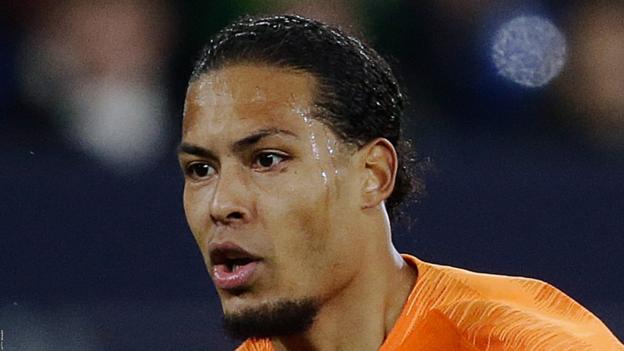
Van Dijk’s 91st-minute equaliser ensured the Dutch reached the semi-finals of the Nations League.
And the Liverpool defender showed his human side embracing the official at the final whistle.
“That man broke down, stood with tears in his eyes because he had just lost his mother,” Van Dijk said.
“I wished him strength and said he had refereed well. It’s a small thing, but I hope it helped him.”
Goals from Timo Werner and Leroy Sane had put Germany ahead.
But the Dutch implemented a tactical switch – that manager Ronald Koeman was originally unaware of – with Quincy Promes’ 85th-minute goal initiating their revival.
The Dutch boss passed on hand-written directions, penned by his back-up team, to full-back Kenny Tete which prompted Van Dijk to press forward.
“I got a note from Dwight Lodeweges and Kees van Wonderen,” Koeman said.
“When we were 2-0 down they [my assistants] asked me if we should change things around and I said ‘yes’.”
“Next thing I knew I had the note. So I gave it to Kenny. And in the end it’s fantastic that the equaliser came from the guy who was told on the note to push up front.”
This post is part of ourHigh-tech High series, which explores weed innovations, and our cultural relationship with cannabis, as legalization in several U.S. states, Canada, and Uruguay moves the market further out of the shadows.
These days, there’s a lot of potent weed to choose from. Take, for example, “Grandaddy Purple,” “Matanuska Thunder Fuck,” and “Gorilla Glue # 4,” to name a few.
After the recent midterm elections, there are now 32 U.S. states where marijuana is legal for adults, recreationally, medically, or both. Increased legalization naturally opens up a larger market and incentives for businesses to grow finer, more competitive cannabis products. For better or worse, that often means marijuana strains with higher contents of THC — the natural psychoactive chemical that binds to your brain and produces a high.
But how much THC, short for Tetrahydrocannabinol, can the human mind really handle? Is there a limit? Although there’s still relatively scant scientific research about how marijuana affects the mind and body, scientists largely agree that how high you can get — even from the most potent marijuana strains — depends almost completely on an individual’s weed habits.
“It’s really dependent on the history of use in that individual,” Richard Miller, a professor of pharmacology at Northwestern University’s Feinberg School of Medicine, said in an interview.
Our brain cells are covered in receptors, which can be thought of as docks or landing sites that chemicals like THC can bind to. Like turning a key to open a door, the binding of THC onto a receptor sets in motion a series of biological events that alters how you think and feel, creating a high.
But like anything used too much, these receptors can become overtaxed.
“They tend to work a little better or worse depending on how much they’re used,” said Miller.
For someone inhaling or consuming lots of cannabis, they’re likely to desensitize their brain receptors and grow a tolerance to even today’ s most potent cannabis.
“If you flood them [receptors] with lots and lots of cannabis there might be a tendency for them to work less well,” said Miller.
“That’s something we see with all drugs,” he added. “It’s true with Aspirin, nicotine, LSD, cannabis and so on.”
Still, Miller notes that scientists have much to learn about how high-potency marijuana, or concentrated THC devices like vape pens, affect us differently than other lower potency strains.
Cinnamon Bidwell, a neurobiologist at the University of Colorado Boulder’s Institute of Cognitive Science, emphasizes that these products are simply too new.
“Most of our data are based on very low-potency, government-grown cannabis,” Bidwell said, noting that cannabis is still federally illegal, and challenging to study. But even so, her lab has been able to begin studying how people are physiologically affected by extremely potent, concentrated cannabis products.
THC binds to the same receptors as the brain chemical anandamide.
“Our data suggests that there’s a tolerance,” she said.
In that case, “Matanuska Thunder Fuck” — however potent — will likely have a dramatic affect on the causal user, but a weaker affect on the everyday marijuana consumer with overtaxed receptors.
“It’s more a question of the pattern of use,” emphasized Miller.
Just how potent is today’s weed, anyway?
There’s little question that potent marijuana can be easily purchased today, in states where it’s legal. (Though, there’s evidence that popular or marketed strains have similar THC concentrations — regardless of what producers advertise.) But today’s potent weed is perhaps not quite as novel as some think.
Powerful pot has been around for a while.
“This narrative that there are much more potent strains of cannabis flower today is just not true,” Peter Hendricks, an associate professor of health behavior at University of Alabama at Birmingham’s School of Public Health, said in an interview. “There have always been very potent strains of cannabis on the market.”
What’s more, for centuries people globally have distilled hashish — a high-concentrated THC resin — from cannabis strains, Hendricks said.
What’s changed, he said, is that there’s not as much bad, or weak, weed around. “You’re less likely to find stains with low-THC content, whereas you may have in the past.”
Weed might generally be better, but the more significant advent — and potential problem — is the popularization of modern vaping devices that use highly-concentrated THC — with levels approaching 100 percent THC content (for reference, 20 percent THC in a cannabis plant is considered quite potent).
Cannabis oil inside a vape pen.
Image: Shutterstock / KG Design
“Now that could be somewhat problematic,” noted Hendricks. “It could lead to use that is less mindful.”
“One can simply insert a cartridge into a device and inhale,” he added.
And this could lead to a robust marijuana tolerance, even to the most potent cannabis products.
“They [users] have to use a highly-concentrated product to just experience a subtle effect,” said Hendricks.
For someone that has a low tolerance to THC, however, consuming too much cannabis or even low quantities of a highly-potent persuasion may experience a “green-out,” Hendricks said, resulting in nausea, dizziness, some disorientation. But overall, “it’s nowhere near as dangerous as alcohol or tobacco,” he said.
It’s also important to note that many new cannabis products are also often infused with other natural THC-related compounds, commonly called terpenes, that might influence the type of experience or high — known as the “entourage effect.” Cannabis producers often cite a 2011 study when they promote the medicinal, flavor, and psychoactive effects of terpenes, but there’s a need for many more peer-reviewed studies — which is research that is viewed critically and vetted by other scientists.
In its unaltered plant form, however, cannabis has likely been used by peoples of disparate cultures for thousands of years. Today’s strains might generally be more potent, and this means being mindful of how you use it — like any drug.
“Like any medicine, it has to be used properly,” said Hendricks. “If we want to call this a medicine, it requires you being respectful of it.”



/https%3A%2F%2Fblueprint-api-production.s3.amazonaws.com%2Fuploads%2Fcard%2Fimage%2F886086%2F2c5ecc2d-34fe-4e01-9b71-0a283dbee6bc.jpg)








 trendynewsday